

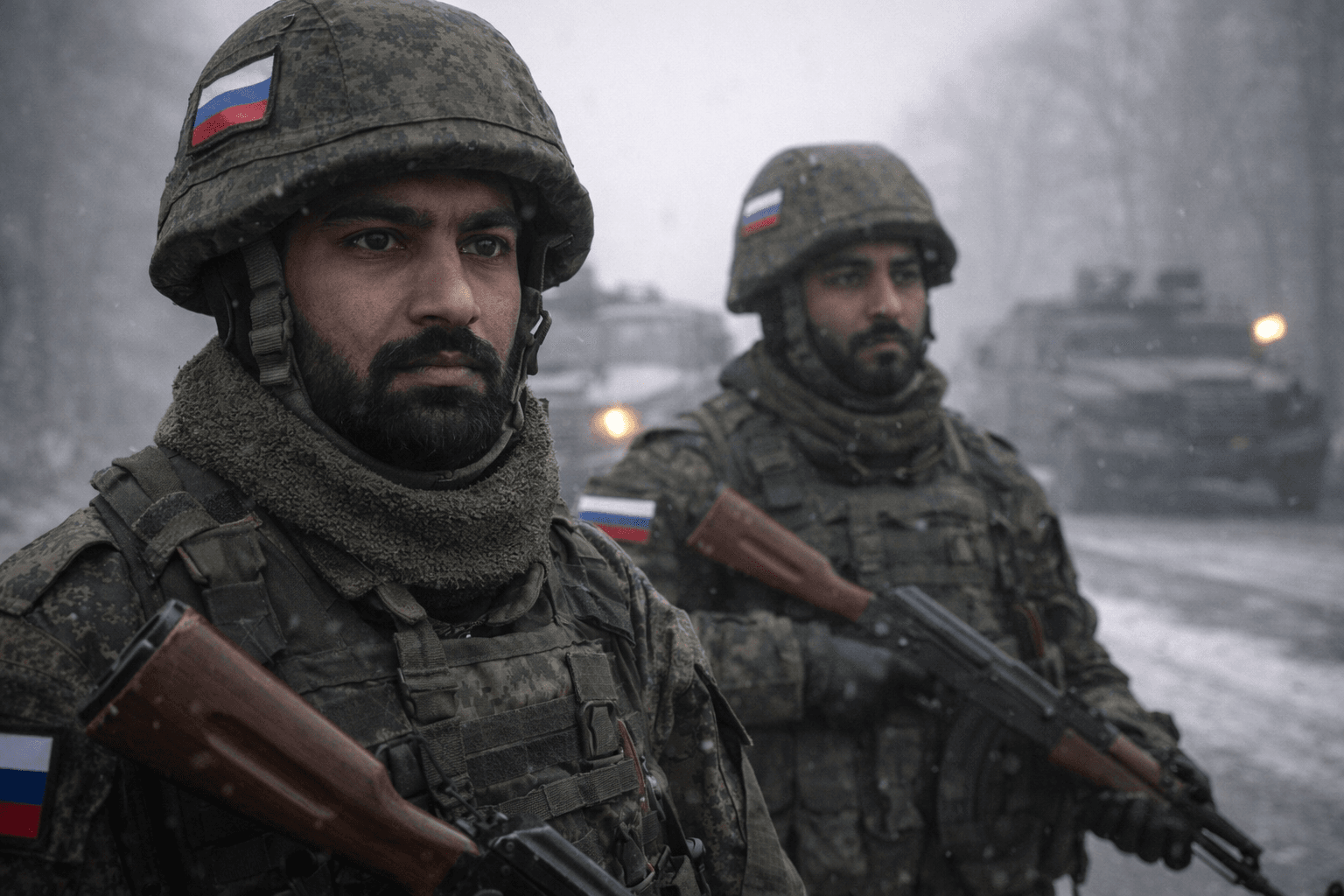
In a written reply in the Rajya Sabha, the Ministry of External Affairs (MEA) stated that 202 Indians are believed to have been recruited into the Russian armed forces since 2022, with 26 reported deaths and seven reported missing. The government said its diplomatic efforts have helped secure the early discharge of 119, while 50 individuals remain under process for discharge. Beyond the numbers, the disclosure spotlights three intertwined realities: deceptive recruitment networks, the limits of consular protection in a war zone, and the heavy administrative burden of bringing people, or their remains, back home.
What’s in the news
-
MEA told Parliament that 202 Indians are believed to have been recruited into the Russian armed forces since 2022.
-
Of these, 119 have been discharged following government efforts; 26 deaths and seven missing have been reported by the Russian side; efforts continue for 50 more discharges.
-
MEA said it assisted in repatriation of 10 mortal remains, and local cremation of two in Russia.
-
DNA samples of family members of 18 Indians reported dead or missing were shared with Russian authorities to help establish identity.
-
The issue is being raised at multiple diplomatic levels, including interactions between leaders, ministers, and officials.
Background and context
How such recruitment typically happens
This phenomenon does not usually begin with a battlefield decision. It often begins with a promise of ordinary work. Reports indicate that some Indians travelled on visas such as student or employment-linked routes, and later alleged they were misled by agents who offered roles like helpers, cleaners, or support staff. In a conflict environment, the lines between “support work” and “direct military involvement” can blur quickly, especially when contracts are opaque, language barriers exist, and individuals have limited local legal support.
Why the problem persists despite diplomatic assurances
Even if a host country’s policy position changes, illegal recruitment pipelines can continue through:
-
third-party intermediaries and informal brokers,
-
document manipulation and misrepresentation of job roles,
-
dependence on local networks for housing and paperwork,
-
fear and coercion once people are inside a controlled ecosystem.
When such networks become profit-driven and transnational, shutting them down requires coordinated enforcement at home and strong cooperation abroad, both of which are slow-moving compared to the speed at which people can be moved.
Why identification and repatriation are complicated in war zones
Unlike ordinary overseas deaths, war-zone fatalities involve:
-
unsafe access to bodies and records,
-
delays in recovery to “safe zones,”
-
incomplete documentation,
-
and a higher reliance on scientific identification like DNA matching.
Families experience prolonged uncertainty. Governments face a dual task: humanitarian support and evidence-grade identification that stands up legally and administratively.
Key provisions and operational actions described by MEA
This is not a “policy document” story; it is a consular operations story. The MEA reply effectively outlines the toolkit India is using:
-
Diplomatic engagement for discharge
India says it remains engaged with the Russian government to ensure safety, well-being, and early discharge, and that the matter is being taken up across levels of official interaction. -
Return logistics for discharged nationals
Support has included facilitating travel documents and, where required, air tickets to help discharged individuals return to India. -
Repatriation and local cremation process
MEA stated it assisted the repatriation of mortal remains of 10 Indian nationals and local cremation of two in Russia. -
DNA matching for identity confirmation
DNA samples of families of 18 Indians reported dead or missing were shared with Russian authorities to support identification of deceased individuals. -
Safe-zone transfer as a prerequisite
The reply notes that identification typically proceeds after remains are moved to a safe zone, followed by DNA matching and documentation.
These steps matter because they show the difference between public outrage and administrative capability. In such cases, the state is judged by whether it can deliver outcomes under extreme constraints.
Why it matters
1) Citizen protection is being tested in a hard theatre
Consular protection works best in normal times: arrests, medical emergencies, documentation, evacuation during political unrest. A live war theatre compresses timelines and expands uncertainty. Even a capable foreign ministry can only act within what the host state and ground situation allow. This is a stress test of India’s overseas citizen protection ecosystem.
2) Recruitment networks exploit aspiration and vulnerability
Many victims of deceptive recruitment are not “adventurers.” They are people seeking affordable overseas pathways, stable incomes, or educational opportunities. Agents exploit:
-
limited verification capacity among first-time travellers,
-
trust in “local references,”
-
desperation for quick placement,
-
and lack of awareness about overseas labour law and contract risks.
This is not merely a foreign-policy issue; it is also a domestic governance issue about controlling fraud ecosystems.
3) The social cost lands on families, not on the recruiters
Families bear:
-
emotional trauma and prolonged uncertainty,
-
financial distress from loans used to fund travel,
-
and social vulnerability when someone is missing or declared dead without closure.
Meanwhile, recruitment intermediaries often operate with low perceived risk unless domestic enforcement becomes consistent and visible.
4) Strategic diplomacy meets humanitarian urgency
India’s relationship with Russia spans defence legacy ties, energy and commodities, and geopolitical balancing. Humanitarian consular crises create pressure points: India must push for discharge and cooperation without turning the matter into a public escalation that hardens positions. This is a delicate diplomatic design problem.
5) It shapes public trust in overseas work pathways
India has a large overseas workforce and an expanding cohort of students travelling abroad. High-profile cases of deceptive recruitment can reduce trust, increase fear, and drive people into even riskier informal routes unless safe pathways are strengthened and clearly communicated.
Arguments for and against the current approach
Arguments supporting the government’s line of action
-
Outcome evidence exists: 119 discharges indicate sustained engagement produced results.
-
Consular process is being used systematically: travel documents, ticket support, identification procedures, and repatriation show an operational response, not only statements.
-
Diplomatic escalation is avoided: keeping channels open can be more effective for releases than public confrontation.
Arguments questioning adequacy and speed
-
Scale of vulnerability remains: if recruitment continued despite earlier assurances, networks are still active and adaptive.
-
Families face long uncertainty: missing persons and DNA-based identification can take months, amplifying distress.
-
Deterrence is unclear: unless agents and intermediaries face consistent prosecution and asset disruption, recruitment attempts may continue.
A balanced reading is that diplomacy can retrieve individuals, but only domestic enforcement can stop the pipeline.
Constitutional and legal angle
This issue sits at the junction of foreign affairs and domestic criminal law.
Consular obligations and state responsibility
India’s ability to help abroad flows from established consular practice and diplomatic engagement. However, India cannot unilaterally enforce law inside another sovereign country. In war-related circumstances, the host country’s military and security procedures dominate. That is why identity confirmation, release, and repatriation become process-heavy and slow.
Domestic legal triggers
The recruitment angle potentially engages multiple legal concerns in India, including:
-
human trafficking or forced labour elements where deception, coercion, or confinement is alleged,
-
fraud and cheating where jobs are misrepresented,
-
forgery and document manipulation where visa purpose and contracts do not match reality,
-
and illegal recruitment / emigration-related violations where agents operate without compliance.
The legal point is simple: if “agents” misled people into a war-linked role, the core offence is not only moral, it is prosecutable. The credibility of the state response improves sharply when cases convert into convictions and asset seizures, not only advisories.
Implications
1) Stronger scrutiny of overseas “placement” ecosystems
This episode will likely intensify pressure on enforcement agencies to investigate recruiters, travel facilitators, and money trails. It may also trigger greater scrutiny of small “consultancy” outfits and informal brokers operating through social media.
2) Diplomatic protocols for discharge may become more structured
As the number of cases becomes clearer, India may push for repeatable procedures with Russian authorities: lists, verification channels, timelines, and standardised documentation. Even modest procedural predictability can reduce family distress.
3) War-zone identification will remain a continuing burden
DNA matching and safe-zone transfers are inherently slow. This means the state apparatus must plan for long case cycles, sustained communication with families, and mental-health and financial support linkages at home.
4) Chilling effect on student and worker mobility to risky destinations
Even legitimate travellers can become more cautious. That is good for safety, but it can also push some into unverified routes if they feel formal channels are “too hard.” The policy challenge is to build safe mobility, not just fear-driven immobility.
5) Information warfare and rumours can spike
Such stories attract misinformation. Fake helplines, impersonation scams, and “paid rescue” frauds can emerge, targeting families. This becomes a second layer of exploitation unless communication is tightly controlled and verified.
Way ahead
A serious “way ahead” here is not a slogan; it is a practical containment plan that protects citizens and dismantles pipelines.
1) Make overseas recruitment verification easy, not elite
People fall for agents when verification feels impossible. The state can reduce vulnerability by ensuring:
-
a simple checklist for verifying recruiters and job offers,
-
clear red flags for war-linked or “too good to be true” placements,
-
and rapid, local-language verification channels accessible from Tier-2 and rural districts.
2) Treat recruiter networks as organised crime, not scattered fraud
To stop recurrence, enforcement must focus on:
-
money trails and commission structures,
-
repeat intermediaries across districts,
-
and coordinated action across States, because such networks rarely operate within one jurisdiction.
3) Institutional support for families as a standard protocol
Families need:
-
a single case officer model for updates,
-
predictable communication cadence,
-
legal help for documentation,
-
and support for travel, DNA collection, and formalities.
Where uncertainty persists, dignity in process becomes a form of justice.
4) Strengthen bilateral operational coordination on identification and repatriation
Even when politics is complex, operational coordination can be improved through:
-
standardised DNA and identity documentation pathways,
-
faster safe-zone transfer protocols where feasible,
-
and clearer timelines for release and repatriation steps.
5) Public messaging that deters without shaming victims
Many families hesitate to approach authorities due to fear of stigma. Messaging must:
-
clearly warn against agent traps,
-
encourage early reporting,
-
and avoid language that implies the victim “chose” a war role.
Deterrence works better when victims feel safe reporting, not judged.
Conclusion
The MEA’s disclosure does more than provide a count. It exposes a modern vulnerability: transnational recruitment fraud that can trap ordinary Indians inside extraordinary danger. India has shown it can secure discharges and coordinate repatriation, but preventing new cases will depend on whether domestic enforcement breaks the agent pipeline and whether safer, verifiable overseas pathways become the default for citizens seeking opportunity.
Source credits : The Hindu; Ministry of External Affairs reply in Rajya Sabha; parliamentary proceedings as reported.