

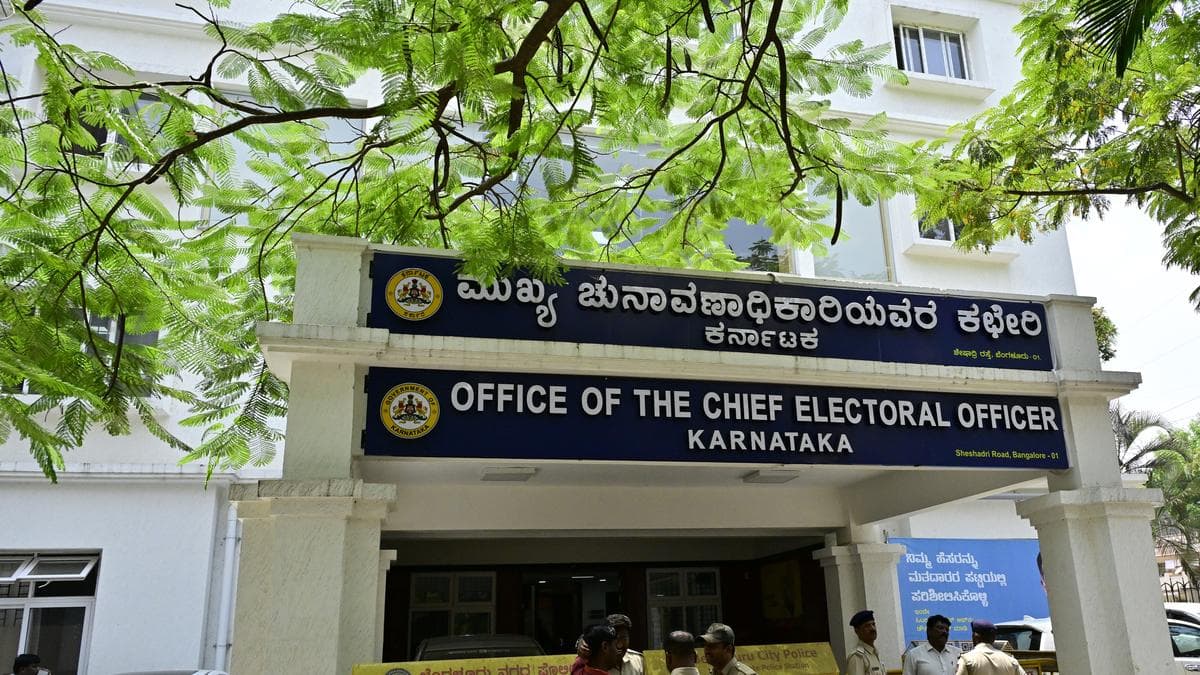
A Special Investigation Team probing alleged voter deletions in Aland has identified six suspects and a money trail tied to a Kalaburagi firm that allegedly mass-generated forged Form 7s. With raids yielding digital devices and searches at premises linked to former MLA Subhash Guttedar, the case has widened beyond local irregularities to a test of India’s safeguards against digital manipulation of electoral rolls.
What the SIT has found so far
-
The ₹80 trail: Investigators say operators were allegedly paid about ₹80 for each forged Form 7 (application to delete a voter) used to submit thousands of requests ahead of the 2023 polls.
-
Scale of forgery: Of 6,018 Form 7s flagged in Aland, 5,994 were found to be forged and rejected during verification, according to public statements around the FIR and subsequent probe.
-
Raids & evidence: SIT raids have recovered key digital devices and probed a “call-centre-like” outfit in Kalaburagi allegedly used to process the forgeries; separate raids were conducted at locations linked to former BJP MLA Subhash Guttedar.
-
Status of suspects: Six suspects have been identified; multiple individuals have been questioned, with statements recorded. (Names are yet to be formally released.)
The political backdrop
-
Electoral margins: Guttedar won Aland by 697 votes in 2018; Congress’s B.R. Patil won by 10,347 in 2023—hence why any organised deletion attempt would be consequential in a marginal seat.
-
From “probe gone cold” to SIT: After media reports flagged stalled inquiries and data gaps, Karnataka constituted an SIT in September 2025; the team has since reported “vital leads,” including the per-application payment finding.
-
ECI’s stance: The Election Commission has said large-scale wrongful deletions did not occur, while noting attempted deletions and pointing to an FIR filed from within the system to investigate the matter.
How the alleged scheme worked (as probed)
-
Bulk digital filings: A small team allegedly used voter-data inputs to generate mass Form 7 submissions online.
-
Distributed IPs & intermediaries: Applications reportedly originated from multiple locations, complicating traceability—one reason investigators sought technical data trails.
-
Low per-unit cost, high impact: At ₹80 per filing, the economics favoured volume; even if most were rejected on verification, the administrative load and risk of slippage increased.
Why this matters beyond Aland
-
Integrity of voter rolls: Mass tampering attempts—successful or not—undermine confidence in roll management and strain BLO-level verification.
-
Digital election security: The case spotlights the need for stronger identity/authentication checks in online roll operations and audit trails for bulk submissions.
-
Precedent for enforcement: SIT findings, once tested in court, could shape future SOPs on cyber-forensics, IP logging, and vendor oversight in electoral processes.
Legal & procedural angles to watch
-
Criminal charges: Potential sections include forgery, cheating, criminal conspiracy, and IT-Act violations (to be specified in charge-sheets).
-
Chain of payment & authorisation: The pivotal unanswered question remains who financed the bulk operation and whether any campaign entities or intermediaries directed activity.
-
Data access for probes: Expect renewed focus on how swiftly investigators can obtain logs from portals, ISPs, and devices to preserve evidentiary value.
What’s next
-
Forensics of seized devices and custodial interrogation of identified suspects.
-
Tracing the financial pipeline behind the ₹80-per-application payouts.
-
Institutional fixes—rate-limiters, KYC for bulk filings, and automated anomaly detection within electoral roll systems—are likely to be debated.
Credits: Reporting base and chronology cross-checked against coverage by The Hindu and other reputable outlets. (Primary tip-offs on probe status and attempted deletions were originally highlighted in The Hindu’s reportage timeline.)