

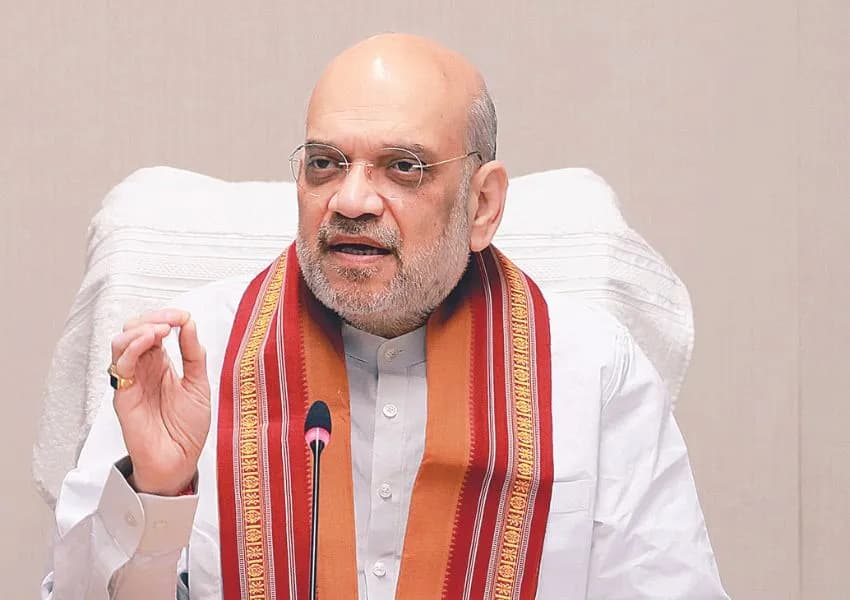
Union Home Minister Amit Shah on 5 October declared that the government will not engage in talks with Maoists until they surrender and join the mainstream. Speaking at Jagdalpur in Chhattisgarh’s Bastar district, he reiterated the Centre’s March 2026 target to end Left Wing Extremism (LWE) across India.
The Story
Addressing a public gathering at the Bastar Dussehra Lokotsav and the Swadeshi Jagran Manch’s Swadeshi Mela, Shah asserted that both the Central and State governments are committed to the development of Bastar and other Naxal-affected areas.
“What is there to talk about? A beneficial surrender and rehabilitation policy is already in place. Come forward and lay down your weapons,” Shah said, stressing that Maoism has deprived Bastar of development for decades.
The Home Minister credited government schemes such as Ayushman Bharat, Pradhan Mantri Awas Yojana, and free rice distribution for improving livelihoods nationwide, and said Bastar would witness similar progress once Maoism ends.
He cautioned that those who continued violence would face strong security action from the CRPF and State police. “March 31, 2026, is the date set to bid farewell to Naxalism from this country,” he declared.
Why It Matters
Shah’s statement reinforces the government’s zero-tolerance policy toward armed insurgencies. With Chhattisgarh and adjoining regions historically serving as Maoist strongholds, the success of this policy will determine whether India can permanently dismantle one of its longest-running internal security threats.
The address also comes at a politically significant time—months ahead of key State elections and amid reports of Maoist factions expressing conditional willingness to negotiate.
Background / Context
1. Historical Roots
The Maoist, or Naxalite, movement traces back to 1967, when peasants in Naxalbari, West Bengal, rose against feudal landlords under the influence of Maoist ideology from China. It evolved into the Communist Party of India (Maoist) after multiple splinter groups merged in 2004.
The movement claimed to represent marginalized tribal and rural communities, demanding land redistribution and socio-economic justice. Over time, it shifted toward violent insurgency targeting police, infrastructure, and local governance structures.
2. Geographical Spread
The Maoist insurgency spans the “Red Corridor”, stretching across Chhattisgarh, Jharkhand, Odisha, Maharashtra, Andhra Pradesh, Telangana, and Bihar. At its peak in the early 2010s, more than 200 districts were affected; today, active presence is limited to about 45 districts, according to MHA data (2024).
3. Political Dimensions
Constitutionally, law and order is a State subject, but the Union government coordinates through the Ministry of Home Affairs (MHA). The conflict raises questions of federal coordination, civil liberties, and the balance between security operations and rights-based development.
4. Causes and Persistence
-
Socio-economic inequality: Persistent land alienation and exploitation of tribal communities.
-
Governance vacuum: Weak administrative presence in forested interiors.
-
Resource conflicts: Mining, displacement, and environmental degradation.
-
Ideological appeal: Maoist rhetoric on justice and equality resonated in underdeveloped tribal belts.
Government Policies and Approaches
Security Measures
-
Operation SAMADHAN-Prahar: Integrated security strategy (Smart leadership, Aggressive operations, Motivation, etc.) launched by MHA.
-
Deployment: CRPF, CoBRA, BSF, and State forces operate jointly under the Unified Command structure.
-
Intelligence upgrades: Use of drones, satellite mapping, and road connectivity to penetrate forest interiors.
Developmental Initiatives
-
Aspirational Districts Programme: Targets multi-sectoral development in LWE-affected districts.
-
Civic infrastructure: Roads, telecom, and education expansion through Viksit Bharat Sankalp Yatra.
-
Surrender & Rehabilitation Policy: Offers financial incentives, housing, and livelihood training for former cadres.
Administrative & Legal Steps
-
National Policy and Action Plan (2015): Combines security, development, and rights-based governance.
-
Left Wing Extremism Division (MHA): Coordinates with States and tracks district-level progress.
Progress So Far
According to MHA data (2024):
-
Incidents of Maoist violence have dropped by over 77% since 2010.
-
Security personnel deaths fell by over 85% in the same period.
-
18 districts have been removed from the “most affected” list since 2022.
States like Andhra Pradesh and Odisha report almost complete elimination, while Bastar and Gadchiroli remain last pockets of resistance.
Implications
The reduction in violence underscores the success of India’s combined security-development approach, though challenges remain. Analysts caution that without sustained livelihood creation and institutional inclusion of tribal communities, insurgent ideologies may re-emerge in new forms.
Politically, Shah’s 2026 deadline sets a measurable target—but the test will lie in replacing coercive control with participatory governance in the tribal heartlands.
Conclusion
Amit Shah’s Bastar declaration marks both resolve and reminder: India’s battle against Maoism is not only a security mission but a moral and developmental challenge. The success of the 2026 target will hinge on whether the State can transform former conflict zones into engines of inclusive growth.