

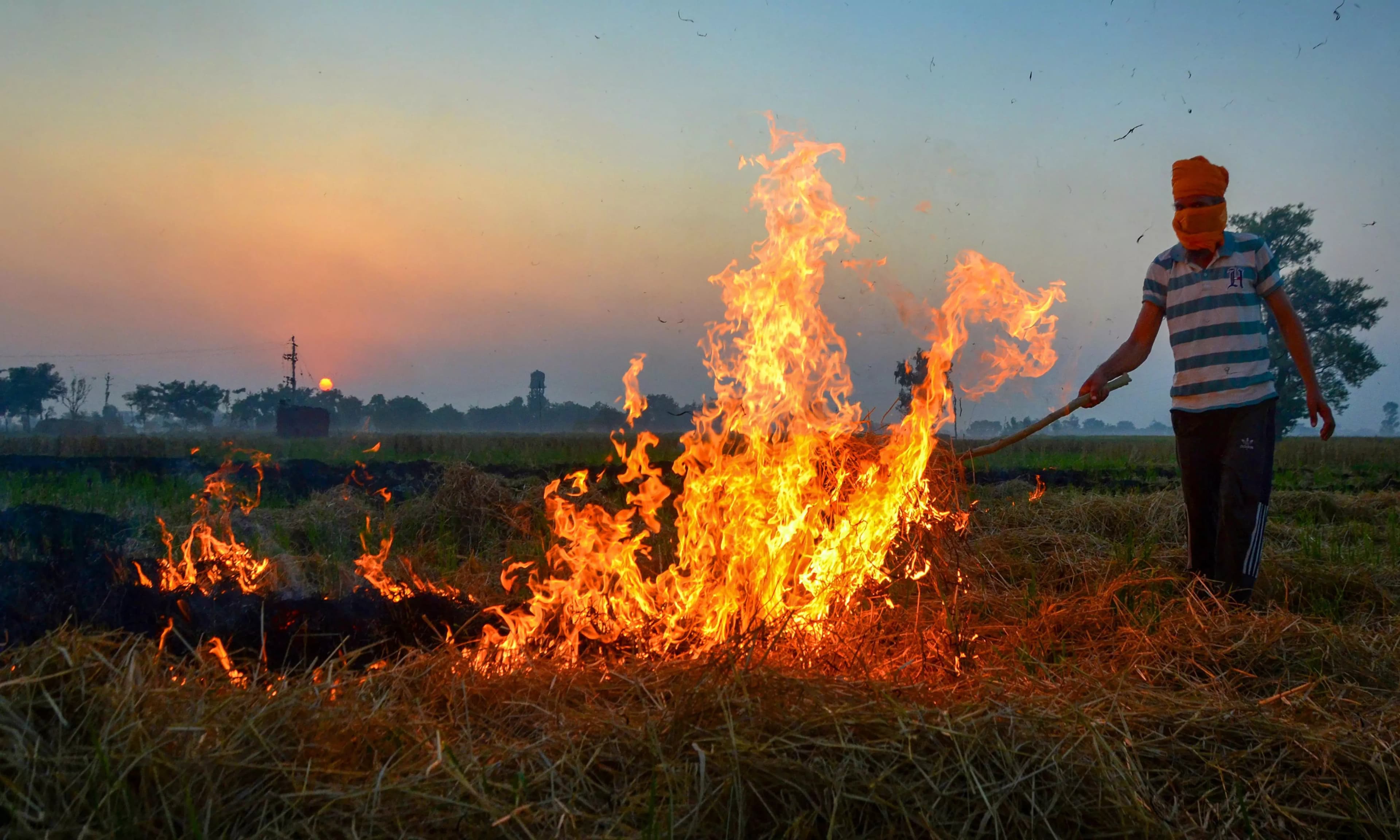
A parliamentary statement claiming a 90% reduction in stubble-fire incidents in Punjab and Haryana since 2022 sits uneasily alongside alternative evidence based on “burnt area”, which suggests the decline is far more modest. The heart of the concern is not merely technical; it is institutional. When air-quality policy is judged on proxies, the choice of proxy becomes political, and public trust becomes the first casualty.
What’s in the news
The Centre’s claim based on fire incidence counts
The Environment Ministry has highlighted a steep fall in recorded “fire incidences” in Punjab and Haryana in 2025 compared to 2022, implying a major success in tackling stubble burning.
Burnt-area estimates indicate a different trendline
Independent computation using different satellite imagery suggests the reduction in burnt area is closer to a gradual decline, rather than a dramatic collapse in burning.
Evidence of timing shifts in burning
Geostationary satellite observations are cited as indicating that burning may have shifted towards evening hours, potentially evading detection windows of polar-orbiting satellites.
A judicial nudge towards better measurement
The Supreme Court had earlier advised that “burnt area” should be ascertained to gauge stubble-burning trends, strengthening the argument for transparent reporting.
Background and context
Why stubble burning matters in North India
Farm stubble burning, especially after paddy harvest, is used to quickly clear fields for wheat. Over the past decade and a half, it has been linked to seasonal spikes in air pollution in October–November in Delhi and surrounding regions.
The policy mix in play
Governments have followed a carrot-and-stick approach: penalties for burning, subsidies for machinery, and incentives for collection and utilisation of residue, including co-firing in thermal plants. The editorial’s point is that measuring outcomes remains weak, making it hard to prove how much these interventions have changed Delhi’s post-monsoon air.
The measurement problem
Fire counts are a proxy, not the phenomenon
Counting “active fires” visible to satellites is a useful indicator, but it is not the same as measuring how much land actually burned. Fire counts can fall even if burning continues in larger patches, different locations, or at times that escape observation.
Burnt area better captures the real footprint
Burnt area reflects the physical extent of land burned. As a governance metric, it is closer to the actual environmental harm because it measures the scale of burning rather than the number of detected ignition events.
Satellite design influences what gets seen
Polar-orbiting satellites pass over at specific times. If burning shifts outside those windows, the count can drop without a commensurate reduction in burning. Geostationary satellites, by contrast, continuously observe the same region and can detect diurnal shifts more reliably.
Why this matters
Credibility is a pollution-control asset
Air-quality governance depends on public cooperation, farmer trust, and inter-state coordination. If official claims appear to be driven by selective indicators, the credibility of future measures—fines, incentives, advisories, enforcement—weakens.
Data transparency improves compliance and design
Publishing year-wise burnt-area estimates allows researchers, courts, and citizens to audit trends, identify district-level hotspots, and test whether policies are working. Without that, policy becomes a public-relations exercise rather than problem-solving.
Better measurement is essential for better attribution
The editorial notes that direct attribution of Delhi’s air pollution to stubble burning would require chemical source-apportionment over time. In the absence of that, proxies must be robust, comparable, and openly shared.
Arguments for and against publishing burnt-area data
Arguments for publication
Public accountability and scientific scrutiny
If the government is confident, transparency strengthens the claim and allows independent validation.
More honest policy evaluation
Burnt area helps evaluate whether machinery subsidies, collection incentives, and enforcement are truly reducing burning or merely changing its pattern.
Alignment with judicial guidance
Making burnt-area estimates public aligns with the expectation that authorities should use better indicators, not only convenient ones.
Arguments often cited against publication
Method disputes and comparability issues
Authorities may argue that different satellites have different resolutions and algorithms, making year-to-year comparisons complex.
Risk of politicisation
There is often a fear that raw numbers will be weaponised in inter-state blame games.
Administrative reluctance
Publishing granular data can expose gaps in enforcement and programme performance, creating institutional resistance.
Constitutional and governance angle
Federal coordination under stress
Air pollution is a cross-border externality. When Centre–State trust is fragile, transparent data becomes the minimum common platform for coordinated action. Without shared metrics, cooperative federalism turns into competitive blame allocation.
Rule-of-law expectation in environmental governance
When courts direct authorities to adopt better measures, the administrative response must be demonstrably serious. Withholding year-wise burnt-area estimates undermines the spirit of judicial oversight and the public’s right to reasoned governance.
Implications and way forward
Publish year-wise burnt-area estimates and methodology
Release annual burnt-area figures, the satellite sources used, resolution limits, and any revisions. A method note is as important as the number.
Use a composite dashboard, not a single headline metric
Combine fire counts, burnt area, and time-of-day distribution to reduce blind spots. One indicator should not become the entire story.
Improve trust with farmers through clarity and fairness
If policy relies on detection, farmers must believe detection is accurate and enforcement is even-handed. Transparency reduces the perception of selective targeting.
Link incentives to verified outcomes
Mechanisation subsidies and residue-management incentives should be tied to verifiable local outcomes, using metrics that reflect real reduction in burning footprint.
Source credits
The Hindu editorial, “An anomaly” (on stubble-burning measurement, fire counts vs burnt area, and the need for public disclosure of burnt-area estimates).