

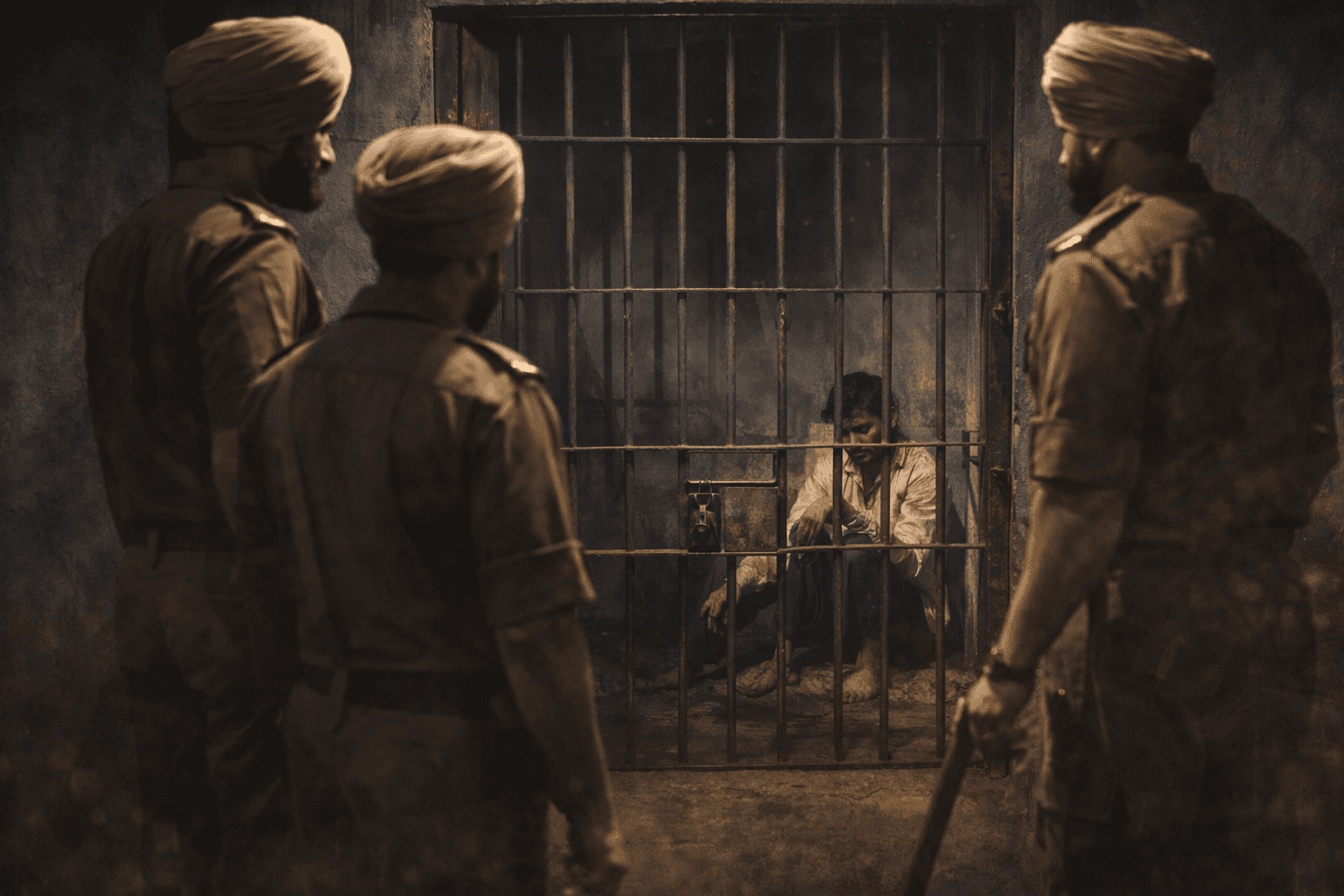
A bail order is rarely the final word, but it often becomes a mirror. In the Kupwara custodial torture case, the court has granted bail to eight accused, including six policemen, while imposing conditions on travel, attendance, and interference with evidence. These conditions matter. Yet the bigger discomfort lies elsewhere: why does India still repeatedly reach a point where “custody” becomes synonymous with coercion, injury, and fear? Custodial violence is not merely a law-and-order aberration. It is a governance failure that erodes rule of law, delegitimises policing, and corrodes public trust in the state’s monopoly over force.
What’s in the news
A court in Jammu and Kashmir has granted bail to eight persons, including six policemen, in connection with alleged custodial torture of a policeman in Kupwara in February 2023. Bail has been accompanied by restrictions such as passport deposit, limits on leaving territorial jurisdiction without permission, mandatory appearance before the trial court, and warnings against intimidation or evidence tampering.
Background and context
Custodial violence in India persists because the incentives often favour quick “results” over lawful investigation. Arrest becomes a tool of leverage. Interrogation slips into punishment. And institutional solidarity can sometimes outrun institutional accountability.
The tragedy is that India is not short on guardrails. The Supreme Court’s DK Basu guidelines, statutory protections in criminal procedure, and later directions on CCTV coverage of police stations exist precisely to prevent abuse. But safeguards fail when three things remain weak: independent oversight, evidence integrity, and certain punishment.
Key details
Bail is not acquittal
Bail reflects a court’s assessment of custody needs during trial, not innocence. Conditions like travel restrictions and anti-tampering warnings recognise two realities: witness vulnerability and evidence fragility.
The special risk in custodial cases
Custodial violence cases are uniquely sensitive because the accused are often from the very institution that controls records, access, and narratives. This raises the premium on neutral investigation, medical documentation, and protected testimony.
Why it matters
1) Rule of law and legitimacy
The state is allowed to use force only within law. When custody becomes a site of torture, the moral authority of policing collapses. Citizens begin to treat institutions as threats, not protectors.
2) Criminal justice outcomes get worse, not better
Torture-driven confessions are unreliable. They lead to weak prosecutions, wrongful arrests, and the real culprits walking free. The system looks “efficient” for a week, then becomes ineffective for years.
3) Economic and social spillovers
Custodial violence fuels anger, protests, and cycles of retaliation. It also increases litigation, compensation claims, and public costs. More importantly, it deepens alienation in already sensitive regions and communities.
4) Police morale and professionalism
A force that tolerates torture becomes internally cynical. Good officers get demotivated, public cooperation declines, and policing turns reactive and force-heavy. That is a losing model for a modern India.
Arguments for and against
The “tough policing” argument
A common defence is that hard methods are necessary to control crime and extract truth quickly. This is often framed as practicality.
Why this argument fails: coercion is not truth. Torture is a shortcut that damages evidence, collapses community trust, and weakens convictions. Professional investigation is slower upfront but stronger in court.
The “few bad apples” argument
Custodial violence is often dismissed as isolated misconduct.
Why this is incomplete: patterns persist across States and decades. That points to structural issues: incentives, weak supervision, poor training, low forensic capacity, and insufficient external scrutiny.
The “procedures already exist” argument
Yes, procedures exist.
The real problem: compliance is uneven, documentation is poor, medical and magistrate processes are delayed, and consequences are uncertain.
Constitutional / legal angle
Custodial torture strikes at the heart of Article 21: the right to life and personal liberty includes dignity and protection from cruel or degrading treatment. Arrest does not suspend constitutional rights.
India’s legal ecosystem already contains multiple hooks to prevent custodial abuse:
-
Due process safeguards at arrest and detention stages (information to family, medical checks, production before magistrate, and custody remand scrutiny).
-
Magisterial inquiry requirements in custodial death scenarios under criminal procedure provisions.
-
Penal provisions that criminalise hurt to extort confession and illegal confinement.
Yet India lacks one major pillar that many democracies treat as foundational: a comprehensive, modern anti-torture statute aligned to global standards. India signed the UN Convention against Torture decades ago, but the gap between commitment and enforceable domestic law remains a persistent critique.
Consequences of custodial violence
-
Wrongful convictions and miscarriages of justice
Coerced confessions distort investigations and contaminate trials. -
Institutional corrosion
Once coercion becomes normalised, supervision weakens and silence becomes routine. -
Public distrust and underreporting
Victims fear retaliation. Communities stop cooperating, which makes policing harder. -
Radicalisation and unrest risks
In conflict-prone regions, custodial abuse can become a trigger for cycles of violence.
Steps taken in India so far
Judicial safeguards
-
DK Basu guidelines: documentation, arrest memo, information to relatives, medical examination, and accountability measures.
-
CCTV coverage directions (notably strengthened by the Supreme Court in later years): expansion of surveillance in police stations and investigative offices, with preservation norms.
Administrative and regulatory measures
-
Police training modules on human rights and investigation, though quality varies.
-
Increased push toward forensic-led investigation in some States, still uneven.
Compensation jurisprudence
Courts have, over time, recognised compensation as a remedy for custodial violations. This provides some relief, but it is not a substitute for deterrence through criminal accountability.
Steps still needed
1) Make evidence tamper-proof
Custodial cases often fail because evidence is weak or compromised. India needs:
-
Mandatory, time-stamped video recording of interrogations in serious offences.
-
Stronger chain-of-custody norms for station diaries, medical records, and CCTV footage.
-
Independent forensic documentation for injuries at first production before a magistrate.
2) Independent complaints and investigation
Internal inquiries are not enough. A credible model needs:
-
Strengthened Police Complaints Authorities with resources and enforcement teeth.
-
Independent investigation protocols when allegations involve custodial torture, including automatic transfer out of local influence zones in sensitive cases.
3) Real supervision, not paper supervision
Station House Officers and supervisory officers must be held responsible for:
-
Missing CCTV footage, delayed medical exams, and procedural breaches.
-
Patterns of complaints, not just individual incidents.
4) Capacity upgrade: reduce the “confession culture”
Torture thrives where investigation is weak. The antidote is competence:
-
More forensic support, better witness handling, and stronger case-building skills.
-
Measurable performance indicators that reward conviction quality and due process, not “fast confession”.
5) Enact a robust anti-torture law
A modern statute should clearly define torture, prescribe proportional punishment, create command responsibility where appropriate, and align procedures for investigation and prosecution. This is a credibility upgrade for both rights and policing.
Other country examples
United Kingdom
The Police and Criminal Evidence framework built a culture where interviews are recorded, custody procedures are standardised, and evidentiary rules punish misconduct. The result is not “soft policing” but legally resilient policing.
United States
The Miranda framework strengthened safeguards around self-incrimination, while widespread body-camera adoption in many jurisdictions improved evidence integrity. Outcomes vary by state, but the direction is clear: record the interaction, reduce dispute.
Canada
Several provinces use independent investigative bodies for incidents involving police, especially deaths and serious injury. The principle is separation: police should not be the sole investigators of police.
Australia
Independent oversight mechanisms and long-standing public scrutiny on deaths in custody have pushed procedural reforms. The lesson is that transparency and external review are essential, especially for marginalised communities.
The shared thread across these examples is not perfection, but architecture: independent scrutiny, recorded interactions, and strong consequences for procedural breach.
Implications
-
For policing: the choice is stark. Modernise into evidence-led professionalism or remain stuck in coercion that weakens convictions.
-
For courts: custodial cases will keep testing the balance between bail rights and witness protection, especially when state actors are accused.
-
For citizens: every custodial torture allegation chips away at confidence in institutions, making governance harder and more expensive.
Way ahead
India does not need moral lectures. It needs enforceable design.
-
Treat custody as a regulated space, like an ICU: everything logged, recorded, auditable.
-
Shift from confession-led to evidence-led policing by investing in forensics, training, and supervision.
-
Create credible external oversight so that victims believe complaints will be heard without retaliation.
-
Make consequences certain: missing CCTV, delayed medical exams, and intimidation attempts should trigger swift departmental and criminal accountability.
A republic that aspires to be a rule-of-law power cannot allow custody to remain a blind spot. The Kupwara bail order is not the end of the story. It is a timely reminder that deterrence is built not on rhetoric, but on systems that make abuse difficult and accountability inevitable.
Source credits
The Hindu; Supreme Court of India; National Human Rights Commission; National Crime Records Bureau; Law Commission of India; Ministry of Home Affairs; United Nations Convention against Torture; Police and Criminal Evidence framework (UK); Independent police oversight bodies (Canada, Australia).