

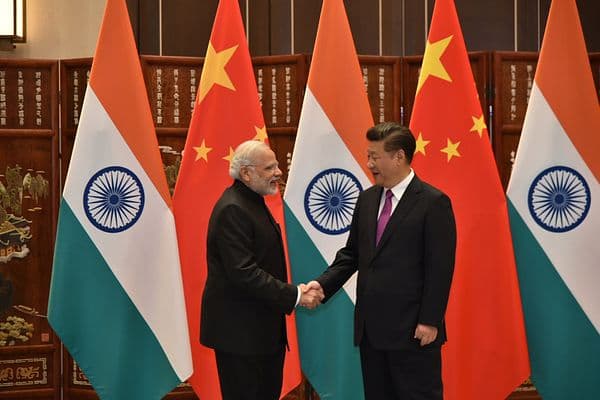
Qin Jie’s essay frames China–India ties as the hinge for a fairer global order and spotlights Xi’s “Global Governance Initiative” (GGI). The vision hits agreeable notes—sovereign equality, UN-centric multilateralism, people-first development. But slogans don’t settle the hard questions that actually decide India’s choices: borders, rules, economic symmetry, and agency in institutions where power is shifting, not shared. Credits: The UPSC Times editorial desk, responding to Qin Jie’s article.
What the op-ed argues
-
History & optics: 75 years of ties, 18 leader-level meetings (2014–2024), and a “positive trajectory” after recent Xi–Modi exchanges.
-
Thesis: China and India are “partners, not rivals”; combined leadership can strengthen multilateralism and reform global governance.
-
Vehicle: Xi’s Global Governance Initiative (GGI)—five principles: sovereign equality, international rule of law, multilateralism, people-centred development, and results-oriented delivery.
-
Ask from India: Deepen coordination in SCO/BRICS, step into SCZONE-like platforms, and co-champion reform without “overturning” the current system.
What’s attractive (and why)
-
Language India already uses: Sovereign equality, UN Charter centrality, and Global South uplift parallel India’s own talking points (Voice of Global South, reformed multilateralism, development finance).
-
Issue alignment pockets: Debt relief frameworks, climate finance, technology commons, standards for AI and health security—all benefit from Beijing–New Delhi coordination if rules are neutral and benefits tangible.
-
Multipolar ballast: A functioning China–India lane can dilute zero-sum bloc politics and reduce “regulatory colonialism” in trade and tech.
What’s missing (and matters most)
-
Border reality: Calls for trust ring hollow without verifiable de-escalation and restoration of border peace and tranquillity mechanisms. Strategic trust is not a communiqué; it’s patrol patterns, buffer zones, and incident-free seasons.
-
Economic asymmetry: India’s deficit with China, non-tariff barriers, market access gaps, and supply-chain dependencies are governance issues, not mere “bilateral irritants.”
-
Rule-of-law consistency: “International law without double standards” must cover maritime conduct, cyber operations, and trade remedies—everywhere, always.
-
Institutional behaviour: In UN agencies, standard-setting bodies, and development banks, leadership is proved by transparent behaviour, not rhetoric.
India’s interests test (four filters to apply to any China–India “global governance” offer)
-
Security first: No strategic co-design of global rules while the LAC is unstable. Progress at the border unlocks progress elsewhere—sequence matters.
-
Reciprocity in markets: Any new initiative (GGI task forces, SCO pilots, SCZONE parks) should be paired with time-bound market-access swaps, standards recognition, and IP protections.
-
Neutral plumbing: Supply-chain, payments, and data rules must be interoperable and vendor-agnostic, not de facto captive ecosystems.
-
Multilateral convergence, not capture: Co-sponsor reforms at the UN, WTO, IMF/World Bank, WHO that raise voice/quotas for emerging economies without hardwiring any single power’s veto.
Reading the GGI: from principles to practice (what India can back, where to be cautious)
-
Back strongly:
-
UN-centric disaster, health, and climate mechanisms with predictable finance.
-
Standards for digital public infrastructure (identity, payments, data exchange) that are open-spec and privacy-preserving.
-
Development bank reforms to expand callable capital, speed disbursements, and lower green-project risk.
-
-
Back with guardrails:
-
Technology corridors (AI, telecom, EVs, semicon packaging) only with trusted-supply baselines, joint labs in India, and export-control clarity.
-
Connectivity projects that avoid debt distress: transparent tenders, lifecycle cost disclosures, and independent feasibility tests.
-
-
Decline or slow-roll:
-
Any arrangement that dilutes data sovereignty, deepens single-country dependence, or bypasses India’s privacy and security laws.
-
A realistic India–China agenda that helps the world (and survives politics)
-
Border stabilisation first: Structured disengagement audits + hotline norms + seasonal incident dashboards made public.
-
Trade normalisation pilot: Narrow sectors (API pharma, agro-inputs, critical minerals) with mutual tariff-rate quotas, SPS/TBT fast lanes, and dispute-hotlines.
-
Global South financing: Joint proposal to triple MDB lending headroom, with a dedicated Resilience & Green window; co-chair governance reforms on voice/quotas.
-
Standards diplomacy: Co-sponsor open standards for clean hydrogen, battery recycling, cross-border payments that plug into India’s DPI and remain vendor-neutral.
-
Health security pact: Joint manufacturing + IP-pooling for vaccines/antivirals with WHO prequalification and time-bound tech transfer targets.
The editorial take
Partnership talk is welcome; proof is policy. If Beijing wants joint stewardship of global governance with New Delhi, the starting price is predictable borders, reciprocal markets, neutral standards, and transparent behaviour in global institutions. India should engage the ideas—UN-centric reform, Global South voice, results-oriented delivery—but implement through multilateral lanes where rules are shared and enforceable.
Bottom line:
An Asian century will be judged not by communiqués but by credible rules, safer borders, and fairer markets. India should bring moral clarity and practical conditions to any China-led initiative—co-lead where interests align, and say no where they don’t.