

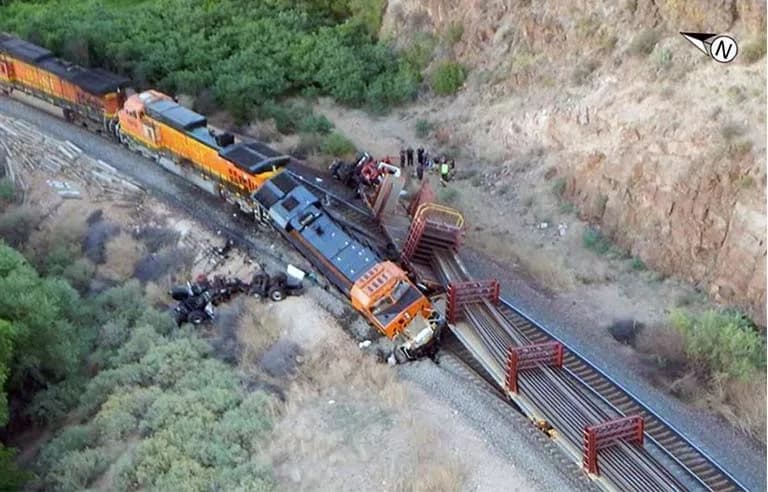
An official inquiry into the November 4 Bilaspur train collision in Chhattisgarh has concluded that the loco pilot of the Mainline Electrical Multiple Unit (MEMU) commuter train was “not fit” to operate it and lacked basic knowledge of safety rules. The train, which overshot a red signal and rammed into a stationary goods train near Bilaspur railway station, left 12 people dead, including the loco pilot, and 19 injured. The report paints a disturbing picture of inadequate aptitude, weak rule comprehension and poor decision-making at multiple levels of railway operation.
The Story
The investigation was conducted by Brijesh Kumar Mishra, Commissioner of Railway Safety, who examined the sequence of events leading to the fatal collision in the Bilaspur Division of the South East Central Railway. His findings focus sharply on human error and institutional failure rather than mechanical defect.
According to the report, the MEMU train ran past a signal that had been placed at caution (yellow) and then failed to stop at the next signal that was at danger (red). Under standard railway safety rules, a caution signal requires the loco pilot to reduce speed and be prepared to halt at the next signal. In this case, the crucial second step—stopping at the red—did not happen.
The Commissioner notes that the loco pilot lacked “the qualities required” to handle a MEMU train, including rule knowledge and timely decision-making. This was not a sudden deterioration but a pattern visible in his record. He had failed an aptitude test held on 9 June. In a performance assessment on 22 November last year, he scored only 2 out of 7 in the “knowledge of safety” parameter—an alarmingly low grade for someone in charge of a passenger service.
The gaps were visible even on the day of the accident. While the train was in motion, the loco pilot made two telephonic calls to the Chief Loco Inspector seeking clarifications on minor operational issues related to MEMU working. The Commissioner notes that these were routine matters which any competent loco pilot should have been able to resolve independently. The calls, therefore, are interpreted not as diligence but as evidence of shaky knowledge and low confidence.
Crucially, the report underlines that responsibility does not rest with the loco pilot alone. The assistant loco pilot had both the authority and the responsibility to apply emergency brakes if the train was overspeeding or at risk of passing a signal at danger. Despite this, the assistant did not intervene when the caution aspect was passed and the red signal approached. The Commissioner concludes that there was no timely action by either the loco pilot or the assistant to control the train after passing the caution signal.
The train manager (guard) also comes in for criticism. Although he held a competency certificate dated November 1, 2025 for working in automatic signalling territories, his knowledge was found to be “very poor”. The report suggests that the certificate may have been issued without proper examination of his readiness to work on such trains.
Taken together, the findings indicate a chain of human lapses: an unfit pilot kept in service despite red flags, a passive assistant who failed to exercise emergency powers, and a train manager with weak understanding of operating in automatic signal territory.
Why It Matters
This inquiry is not just about one tragic crash; it is a window into systemic weaknesses in rail safety culture. When a loco pilot with failed aptitude tests and low safety scores is still rostered to run a MEMU train, it raises serious questions about:
-
Screening and certification – Are aptitude tests and safety assessments being treated as formalities rather than hard cut-offs?
-
Training quality – Are loco pilots and assistants receiving adequate, repeated training for automatic signalling territories and emergency protocols?
-
Safety culture – Is there a culture where subordinates (like assistant loco pilots) feel empowered and obligated to override the pilot for safety?
For a network as vast and heavily used as Indian Railways, even one weak link in this chain can translate into mass casualties.
Background / Context
India’s railway system increasingly relies on dense traffic, automatic signalling and high-frequency commuter services such as MEMU trains. In such settings, human factors—alertness, rule knowledge, decision-making under pressure—become as critical as tracks and signalling hardware.
Railway safety frameworks typically rest on three pillars:
-
Rules and signalling – Clear codification of speed, braking, and signal observance.
-
People and processes – Aptitude testing, medical fitness, recurrent training, and supervision.
-
Technology and oversight – Data loggers, automatic train protection systems, and regular safety audits.
The Bilaspur report shows that even when signals and rules are correctly configured, the system can fail if human and institutional safeguards are weak or poorly enforced.
Key Findings from the Inquiry
-
The MEMU train overshot a caution (yellow) signal and failed to stop at the subsequent red signal, directly leading to the collision.
-
The loco pilot had:
-
Failed an aptitude test on 9 June.
-
Scored just 2/7 on “knowledge of safety” in a November 2024 assessment.
-
Sought help by phone for routine operational issues during the run, indicating low confidence and rule familiarity.
-
-
The assistant loco pilot did not apply emergency brakes, despite having the authority to do so when over-speeding or danger was imminent.
-
The train manager’s knowledge was also found to be “very poor” despite recent certification, suggesting lax evaluation procedures.
Implications for Policy and Governance
From a governance and UPSC perspective, the Bilaspur crash touches several important areas:
-
Human Resource Management in Critical Sectors
The case underlines why high-risk roles require strictly enforced competency standards. Failed aptitude tests and poor safety scores should trigger remedial training, close supervision, or removal from duty—not routine rostering. -
Regulatory Oversight and Accountability
The Commissioner of Railway Safety functions as an independent safety investigator. His findings now put the onus on the Railway Board and zonal management to review recruitment, training, certification and monitoring processes for loco running staff. -
Safety Culture vs. Blame Culture
While individual lapses must be recorded, sustainable safety improvement demands moving beyond simply blaming the last person in the chain. The report’s references to poor knowledge and questionable certification highlight institutional accountability, not just personal fault. -
Technological Backstops
The incident reinforces calls for wider deployment of automatic train protection (ATP) systems that can override human error by automatically braking trains that are about to cross a red signal. Until such systems are universal, the system depends heavily on flawless human performance—which is unrealistic.
Lessons for Rail Safety Reform
The Bilaspur crash report, if acted upon seriously, could become a turning point in how safety is managed on Indian Railways:
-
Stricter enforcement of aptitude and safety tests: Failed or low-scoring candidates must be re-trained or reassigned to non-running duties until they clearly meet standards.
-
Continuous training and simulation: Regular refresher courses, including simulated signal failure and emergency braking scenarios, can sharpen responses.
-
Clear empowerment of assistants: Assistant loco pilots must be trained and encouraged to use emergency brakes without hesitation when rules demand it, with institutional backing.
-
Audit of competency certificates: Random audits of how and when competency certificates are issued can deter “paper compliance” and ensure genuine assessment.
Conclusion
The Bilaspur MEMU–goods train collision is a stark reminder that safety on the rails is only as strong as the weakest human decision in the chain. The Commissioner’s report goes beyond narrating a tragic sequence; it exposes structural gaps in training, certification and supervision.
For policy-makers, railway managers and safety regulators, the real test lies not in accepting the findings on paper, but in systematically tightening recruitment filters, deepening training, empowering staff to act for safety, and deploying technology that can step in when human judgment fails. For citizens and exam aspirants alike, the episode offers a real-world case study of how public systems must balance scale, speed and safety—especially when lives depend on every signal obeyed and every brake applied in time.