

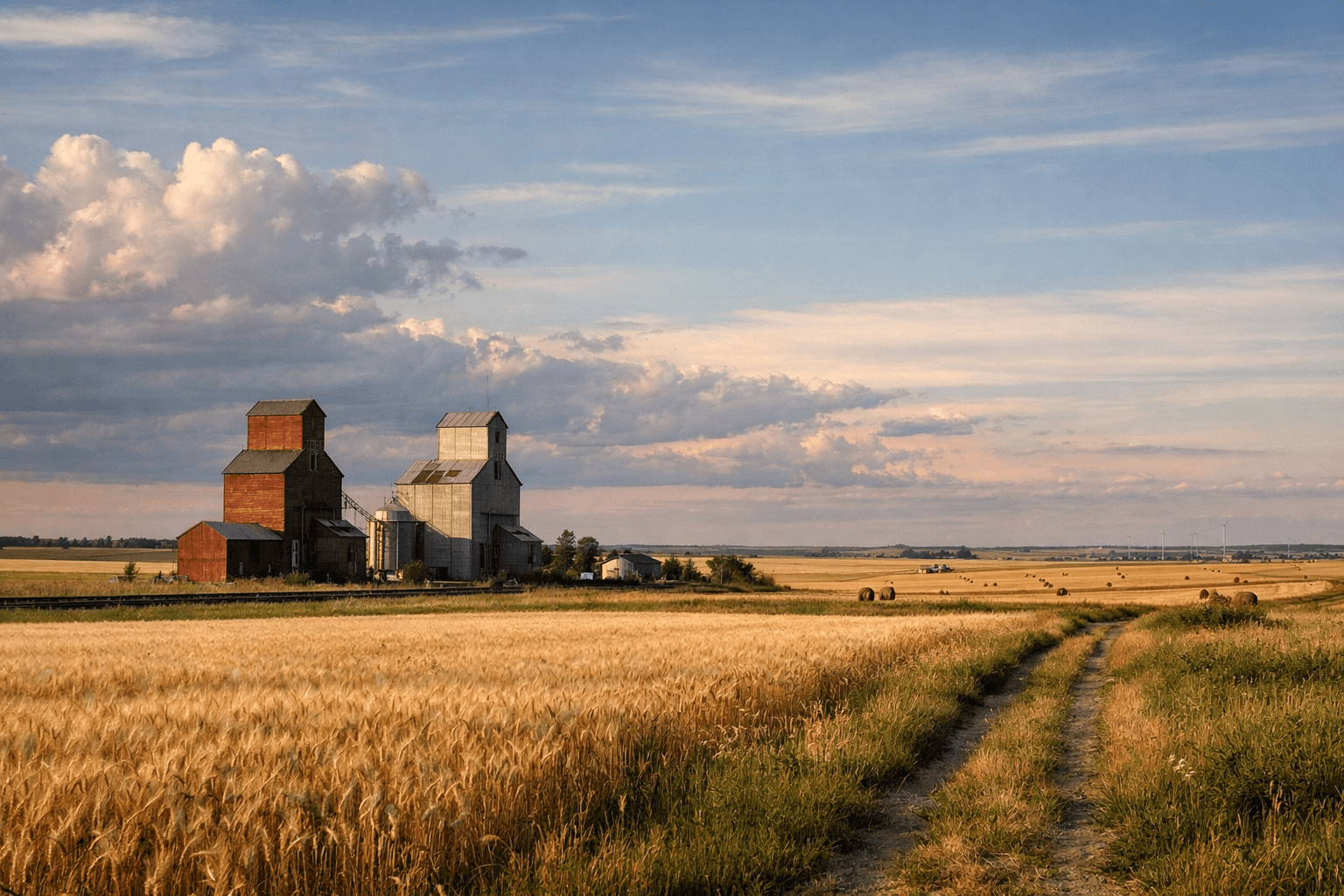
The Canadian prairies have never been easy farmland. Short growing seasons, low rainfall, and wind that can strip topsoil make western Canada a place where agriculture survives through discipline, not luck. Climate change has raised the difficulty level further—bringing a punishing alternation of flooding and drought, and turning “normal” weather into a shrinking comfort zone. And yet, the region is producing record harvests. For many farmers, this is not a miracle year. It is the result of a quiet revolution built on incremental upgrades: soil protection, smarter drainage, precision inputs, tougher seeds, and professional agronomy. The story is both hopeful and sobering—because the same toolbox that is helping farms stay ahead of climate shocks is also expensive, data-hungry, and unevenly accessible.
What’s in the news
Across western Canada, farmers reported stronger-than-expected crop outcomes despite a season marked by flooding followed by a long drought. National data for 2025 has indicated record harvests in key crops such as spring wheat and canola. Yields have risen sharply compared to three decades ago, even as extreme weather events have become more frequent.
Background and context
A harsh farming geography, made harsher
The central prairies typically receive far less rainfall than North America’s most productive farm belts and operate within a tight seasonal window. Climate volatility has intensified this challenge: snowfall—often a critical source of spring moisture—has declined, while summers swing between intense downpours and extended dry spells.
Record yields, but not “easy” yields
Yields cited for 2025 underline the scale of the shift: spring wheat output touched 58.8 bushels per acre, while canola reached 44.7 bushels per acre—levels that earlier generations would have considered exceptional. The key point is not only the record itself, but the method: a layered adaptation stack rather than a single silver bullet.
What is driving the adaptation surge
Soil-first farming is doing heavy lifting
Minimum till and no-till practices are emerging as the backbone of resilience. By leaving stubble on the field and disturbing the soil less, farmers retain moisture, reduce erosion, and protect soil structure. In dry years, that moisture retention becomes yield insurance. In wet years, healthier soil can absorb water better and reduce surface run-off damage.
Drainage has become a climate tool, not just a convenience
Tile drainage—perforated piping laid underground—helps prevent waterlogging and crop failure in flood-prone seasons. What began as small experiments on some farms has expanded into large-scale infrastructure. It is capital intensive, but for regions experiencing heavier rainfall bursts, it can decide whether the season is lost early or remains salvageable.
Precision inputs are reducing waste and raising reliability
Slow-release fertiliser pellets, careful placement of fertiliser alongside seeding, and calibrated chemical use are helping crops compete better under stress. These techniques aim to protect the soil surface while ensuring nutrients reach the root zone efficiently. In years when rainfall is erratic, efficiency becomes more important than abundance.
Better seeds, broader insurance against stress
Crop genetics—through conventional breeding and genetic modification—has steadily raised resilience: quicker establishment, stronger root development, and built-in resistance to pests and diseases. Genetics does not cancel the weather, but it improves the odds when weather turns hostile.
“Little tweaks” add up to structural gains
What stands out in farmer accounts is not a dramatic transformation in one year, but relentless tuning: changing rotations, adjusting weed management, experimenting with intercropping, and consulting agronomists to refine decisions. This is adaptation as a daily operational mindset.
The economics: resilience is becoming a balance-sheet decision
Technology is lifting yields—and pushing up barriers to entry
Modern “smart” farm equipment can cost in the millions of Canadian dollars when tractors, seeding drills, sprayers and combines are considered together. These investments can reduce herbicide and pesticide use, cut fuel consumption, and improve water efficiency—but the upfront price tag is steep.
This creates a dividing line in rural economies:
-
Larger or better-capitalised farms can adopt faster and stabilise output.
-
Younger farmers may lack capital and remain exposed to climate shocks.
-
Older farmers may resist digital workflows even when the economics are compelling.
Broadband is now part of farm productivity
Precision systems depend on data flows and connectivity. In many rural stretches, broadband remains patchy and cellular coverage unreliable. That limits the ability to stream machine data, access real-time agronomic insights, and coordinate logistics during critical windows. In climate-stressed agriculture, delays are not minor—they can erase margins.
Why this matters beyond Canada
Global food prices and affordability
Canada is a major exporter, and much of its grain is shipped abroad. Higher yields in export-heavy producers can depress global prices, improving food affordability for importers—but also squeezing farm incomes everywhere. The same harvest that stabilises supply can intensify the pressure on farmers operating with tighter margins or weaker support systems.
A signal for climate adaptation debates
Climate models often warn of long-run yield damage, especially for staple crops. Canada’s experience adds a crucial nuance: adaptation can meaningfully offset losses in some temperate regions, at least for now. But it also demonstrates that adaptation is not automatic—it is purchased through investment, capability, and institutional support.
The limits: adaptation is not evenly distributed
Not everyone will make the transition
Even within Canada, the expectation is uneven outcomes. Some farmers will adapt and thrive, some will adapt and still fail, and some will exit the sector. The risk is that the future of food production becomes more concentrated—fewer, larger operators with higher tech intensity—shaping rural livelihoods, land prices, and market power.
Climate volatility can outpace innovation
No-till and drainage reduce risk; they do not remove it. When droughts become multi-year and rainfall arrives in destructive bursts, even the best-managed systems can be overwhelmed. Adaptation is best understood as raising the floor, not eliminating the ceiling.
What to watch next
The next frontier is “accessible adaptation”
The critical policy and market question is shifting: not whether adaptation works, but whether it can be scaled without deepening inequality. That will depend on:
-
affordable finance for equipment and soil infrastructure
-
dependable rural broadband
-
advisory services that reach smaller farms
-
seed innovation focused on drought tolerance and rapid establishment
-
risk tools that protect farmers during transition years
Source credits
Reuters report datelined Wawanesa, Manitoba; Canadian government crop output and yield data referenced in the report; statements attributed to farmers, agronomists and industry representatives quoted in the report; Environment and Climate Change Canada observations referenced in the report.