

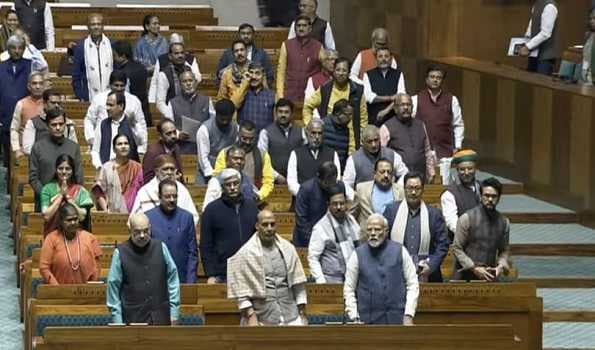
Higher education regulation in India has always been more than a technical issue. It decides who has the power to recognise institutions, set standards, enforce compliance, and—most crucially—shape public funding flows. That is why the Viksit Bharat Shiksha Adhishthan (VBSA) Bill, 2025, introduced as a replacement for the UGC-era framework, has sparked sharp objections across Opposition benches and among teacher-student collectives. The government’s proposal to send the Bill to a Joint Parliamentary Committee (JPC) signals that the legislation is politically sensitive and structurally consequential.
What’s in the news
The Union government has proposed that the VBSA Bill, 2025 be sent to a Joint Parliamentary Committee comprising members from both Houses of Parliament. The move came after MPs across Opposition parties raised objections, describing the Bill as an instance of executive overreach and arguing that it would place higher educational institutions under pervasive central control.
Alongside parliamentary objections, a coalition of teacher and student bodies has also criticised the Bill, describing it as a revived version of an earlier higher education reform proposal that had faced heavy backlash.
Background and context
Why the UGC framework matters
The UGC structure historically combined two powerful roles:
-
it laid down standards and regulatory conditions, and
-
it was tied to grant-making and funding channels.
This link between regulation and funding created both coordination and controversy. Coordination, because standards could be aligned with funding priorities. Controversy, because funding can also become a pressure instrument.
Why consolidation is attractive to governments
Multiple regulators often create overlaps, conflicting norms, and slow approvals. A unified framework promises:
-
simpler compliance for institutions,
-
clearer rulebooks,
-
faster decision-making,
-
and a “single window” model of governance.
The real question is whether “single window” becomes “single lever”—and who holds it.
What the VBSA Bill seeks to change
One umbrella commission, multiple councils
The Bill proposes a 12-member umbrella commission under which regulatory, accreditation, and standards functions will operate. The idea is to create a central architecture that can set norms, monitor compliance, and steer quality benchmarks.
It subsumes existing regulators
The Bill seeks to absorb and replace the functions of UGC, AICTE, and NCTE. In effect, it shifts the regulatory centre of gravity from three separate statutory bodies to one integrated structure.
Funding is separated from the regulator
This is among the most debated aspects. The Bill divorces the traditional grants-disbursal role from the regulator and shifts grant allocation to mechanisms devised by the Ministry of Education. Critics argue this can make funding more bureaucratic and potentially more discretionary, while the government’s likely argument is that separation reduces conflict of interest and sharpens accountability.
Why the opposition is intense
Autonomy concerns: “graded autonomy” and intrusive compliance
Opposition MPs argue the Bill increases compliance requirements, adds intrusive oversight, and gives wider closure powers and penalties, potentially chilling institutional autonomy. The fear is that universities will spend more energy “remaining compliant” than “remaining academic.”
Federalism concerns: education as shared space
Many States see higher education as a domain where they must retain meaningful authority—especially for State universities. A framework that centralises composition, policy direction, and implementation choices can be perceived as weakening the federal balance.
Language and symbolism: the naming debate
MPs from some non-Hindi speaking States objected to the nomenclature, arguing that naming the Bill and new authorities in Hindi signals cultural imposition rather than administrative reform. Even when symbolic, such debates matter because education is identity-sensitive terrain.
The larger policy trade-off
Potential gains: uniform standards and faster regulation
If designed with genuine independence and transparency, an integrated regulator can:
-
reduce duplication,
-
standardise accreditation outcomes,
-
improve portability of degrees and credits,
-
and raise baseline quality through consistent norms.
Potential risks: centralised discretion and funding leverage
If composition and decision-making remain heavily executive-controlled, then:
-
accreditation can become a control lever,
-
grants can become a compliance lever,
-
and institutional leadership may become risk-averse.
The deeper concern is not regulation itself, but regulation that can be used to discipline institutional dissent or constrain academic freedom.
What a Joint Parliamentary Committee scrutiny should test
1) Who appoints and who checks the regulator
A credible regulator needs independence. The committee will likely be pressed to examine composition, appointment processes, term security, conflict-of-interest rules, and accountability mechanisms.
2) Whether States have meaningful representation
If State universities are heavily affected, then the States’ role cannot be cosmetic. The committee will need to evaluate whether State representation is substantive in decision-making, not just present in form.
3) How grant-making will work post-delinking
If funding shifts to ministry-devised mechanisms, the design must be rule-based, transparent, and appealable—otherwise it risks becoming a tool of discretion.
4) Penalties and closure powers: proportionality and safeguards
Strict penalties without procedural safeguards can trigger institutional fear. The committee should scrutinise:
-
thresholds for penalties,
-
due process before action,
-
and protection against arbitrary closure or de-recognition.
Conclusion
The VBSA Bill is not merely a regulatory rewrite. It is a redistribution of power across Centre, States, regulators, and institutions—touching funding, autonomy, and the philosophy of governance in higher education. Sending it to a Joint Parliamentary Committee can either become a genuine democratic filter that strengthens trust, or a procedural pause that changes little. The credibility of this reform will finally depend on one thing: whether it can improve quality while preserving autonomy and federal balance.