

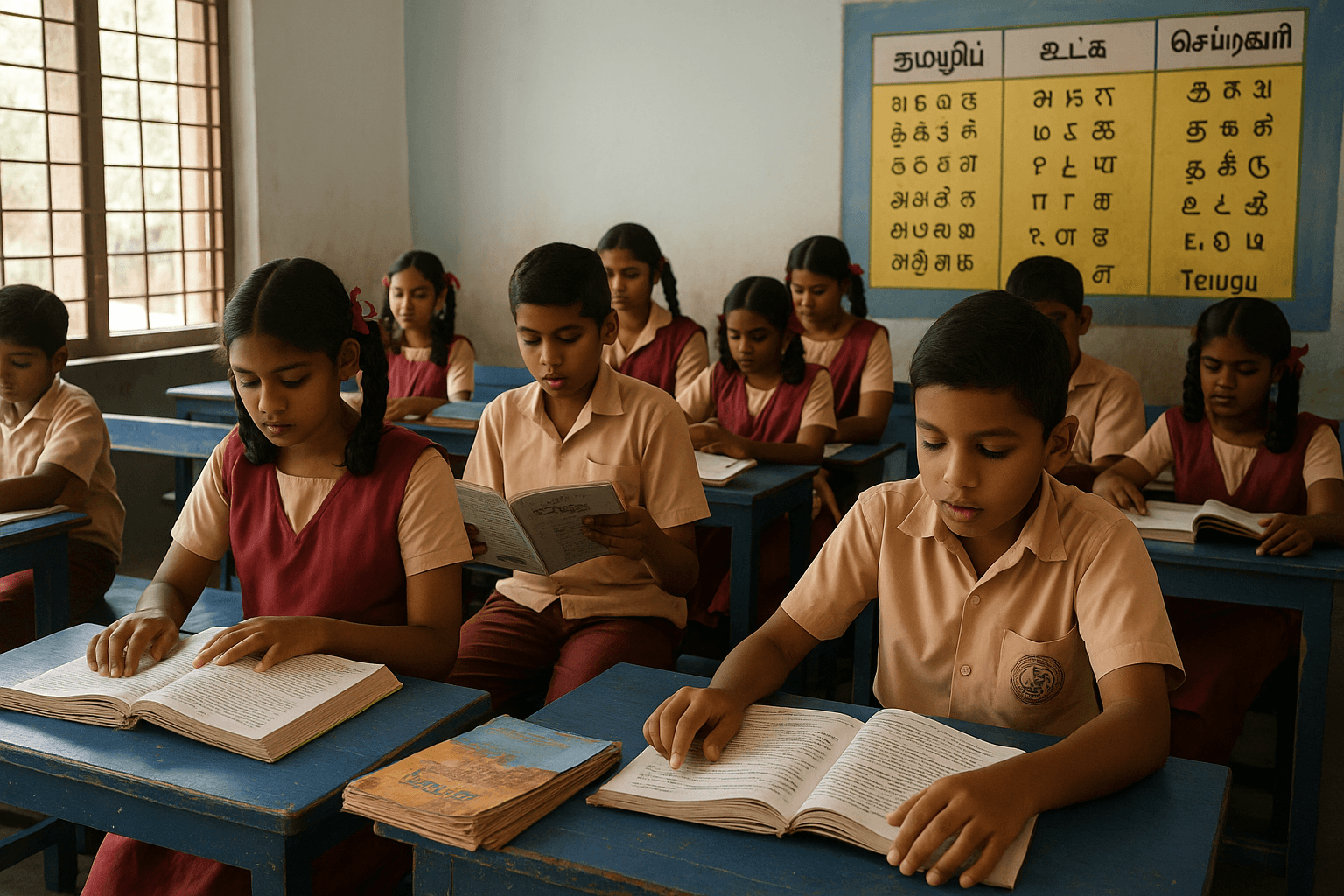
Union Education Minister Dharmendra Pradhan on Sunday reiterated that Tamil Nadu must accept the Centre’s memorandum of understanding (MoU) to access funds under the Samagra Shiksha programme. The MoU mandates adoption of the three-language formula, which the State has long opposed in favour of its two-language policy.
The Story
Speaking at IIT Madras, Pradhan emphasised that “political priorities” should not come at the cost of students’ welfare. “You have to accept the MoU offered by the Government of India. There has to be discipline and mutual respect,” he said, adding that the Samagra Shiksha funds cannot be released unless Tamil Nadu signs.
The Minister clarified that the National Education Policy (NEP) does not impose any particular language on States but encourages multilingual learning. He dismissed Tamil Nadu’s concerns as “politically motivated,” accusing the State government of creating a “fear psychosis.”
The remarks follow prolonged tensions between the Centre and Tamil Nadu over education policy. The State has consistently rejected the three-language formula, insisting on its two-language model — Tamil and English — in schools.
Why It Matters
At stake is not only funding for schools but also the broader issue of federal balance in education. For Tamil Nadu, language has historically been a sensitive identity marker, with memories of anti-Hindi agitations of the 1960s still shaping politics. For the Centre, uniform adoption of the NEP and the three-language formula is presented as essential to national integration and competitiveness in a globalised world.
Background / Context
What is the three-language formula?
-
First proposed in 1968 and reaffirmed in later education policies, it requires students to learn:
-
The regional language,
-
Hindi, and
-
English (or another modern Indian/foreign language).
-
The idea was to promote national unity, cultural exchange, and multilingual competence.
Why Tamil Nadu rejects it:
-
The State follows a two-language policy (Tamil and English).
-
Resistance stems from fears of Hindi imposition. The Dravidian movement, influential in Tamil Nadu politics, opposed compulsory Hindi education in the 20th century.
-
Protests in 1965 against making Hindi compulsory turned violent, leaving a lasting legacy.
Why the Centre insists:
-
The NEP 2020 reaffirms the three-language approach, though it says “no language will be imposed.”
-
Advocates argue it gives students wider opportunities in higher education, jobs, and mobility across India.
-
The Centre links it to the larger vision of multilingual education and cultural inclusivity.
Implications
-
For Tamil Nadu schools: Risk of losing central Samagra Shiksha funds, which support teacher training, infrastructure, and learning resources.
-
For federalism: Revives debates on Centre–State relations and whether States can opt out of national education frameworks.
-
For students: While proponents say three-language learning boosts skills, critics argue it burdens children and undermines Tamil identity.
-
For politics: Tamil Nadu’s resistance is tied to the Dravidian legacy of opposing Hindi imposition, making compromise politically costly.
Conclusion
The standoff between the Centre and Tamil Nadu over the three-language formula reflects a deeper clash between national policy goals and regional identity politics. Whether the State concedes to access school funds or holds its ground will test the balance between federal authority and cultural autonomy in India’s education system.