

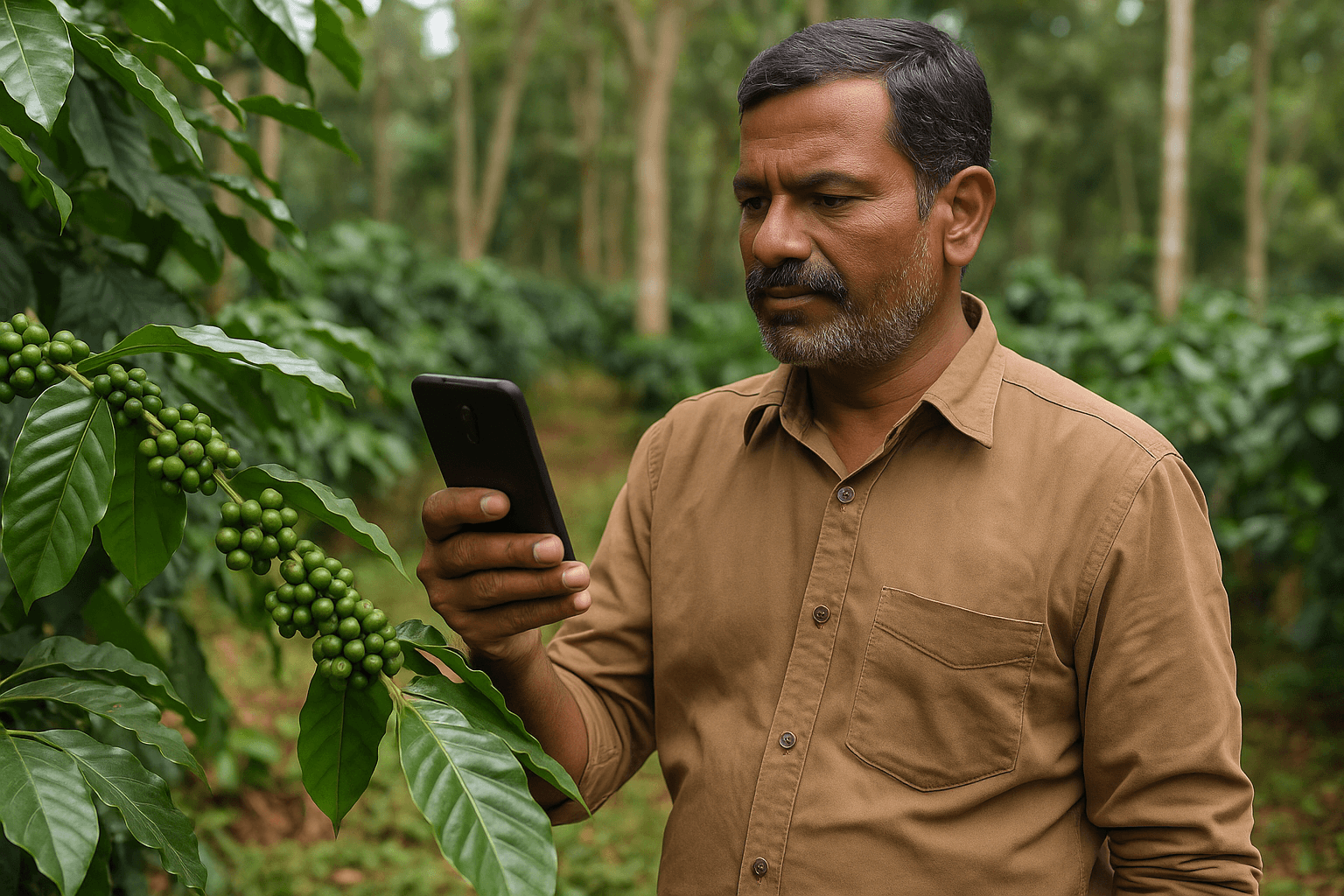
The Coffee Board of India will hold extensive awareness and capacity-building programmes to help growers register for compliance with the European Union’s Deforestation Regulation (EUDR), CEO and Secretary Kurma Rao said in Coimbatore on 26 September 2025.
The Story
The EUDR, which comes into force on 30 December 2025 for large exporters and from 30 June 2026 for small growers, requires proof that coffee exported to the EU is not linked to deforestation after 31 December 2020.
To enable compliance, the Coffee Board has added a feature to its mobile application where exporters and growers can register and upload geo-location data of their farms.
Mr. Rao said the Board is working with associations and stakeholders to spread awareness. Of the country’s 4.41 lakh growers, only around 9,000 have registered so far. “We are intensifying outreach to ensure registrations pick up pace,” he said.
Coffee exports have crossed $1,000 million for the fourth consecutive year, reaching $1,803 million in 2024–25 with a slight rise in volumes. In the domestic market, the Board is also planning campaigns to increase per-capita consumption. Events such as “Walk With Coffee” will be held across India on International Coffee Day on 1 October.
Why It Matters
-
EU access: The European Union is a major market for Indian coffee. Non-compliance risks losing export share.
-
Traceability: Geo-location data links each batch of coffee to deforestation-free land, aligning with global sustainability norms.
-
Farmer impact: With most growers being smallholders, awareness and digital registration are critical for participation in EU-bound exports.
Background / Context
-
EUDR: Adopted in 2023, it applies to commodities like coffee, cocoa, and timber, ensuring they are not sourced from deforested land.
-
Global push: Sustainability requirements are increasing worldwide, with deforestation-free supply chains gaining priority in trade.
-
India’s coffee sector: About 70% of India’s coffee is exported, with the EU as a key destination.
Implications
-
For exporters: Compliance will be mandatory for continued access to EU markets.
-
For small growers: Additional support and awareness are vital, as registration and geo-mapping can be challenging.
-
For India: Successful compliance could enhance India’s reputation as a sustainable coffee supplier.
Conclusion
The Coffee Board’s awareness campaign marks the first step in aligning Indian growers with the EU’s deforestation-free rules. With exports heavily reliant on the EU market, scaling up registrations will be critical to safeguard trade and boost India’s coffee sector competitiveness.