

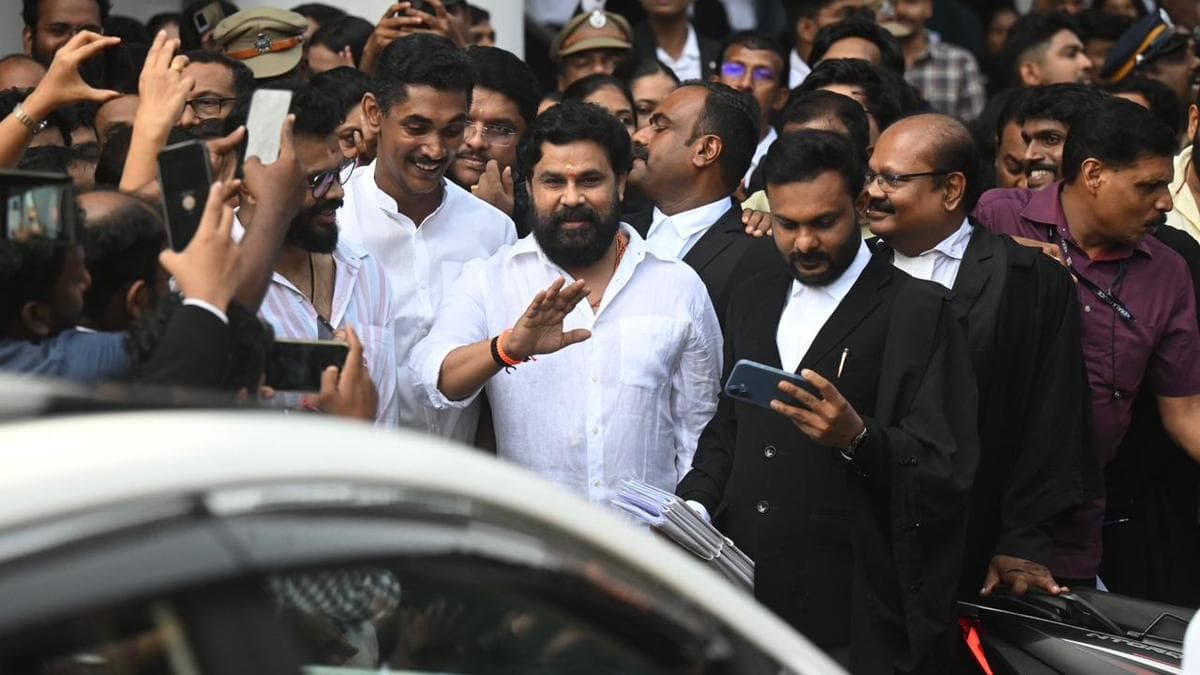
In a landmark verdict that has once again split opinion in Kerala’s public sphere and film industry, the Ernakulam Principal Sessions Court on Monday acquitted Malayalam actor Dileep in the 2017 actor assault case, while convicting six others for abducting and sexually assaulting a fellow actor in a moving vehicle near Kochi on February 17, 2017. Judge Honey M. Varghese held that the charges against the first six accused — including prime accused Sunil N.S., alias Pulsar Suni — stood proved beyond reasonable doubt, but the case of criminal conspiracy alleged against Dileep did not meet the evidentiary threshold.
The prosecution case was that a group led by Pulsar Suni intercepted the survivor’s car while she was travelling from Thrissur to Kochi in February 2017, confined her in the vehicle, sexually assaulted her, and recorded the assault on a mobile phone.
According to the chargesheet, Dileep was arrayed as the eighth accused. The prosecution alleged that he harboured a grudge against the survivor over personal and professional issues in the Malayalam film industry and conspired with Pulsar Suni, offering him ₹1.5 crore to orchestrate and record the assault to humiliate her. Dileep was arrested in July 2017, spent nearly three months in custody, and was later released on bail.
On Monday, in a packed Ernakulam District and Sessions Court, the judge convicted:
-
N.S. Sunil alias Pulsar Suni
-
Martin Antony
-
B. Manikandan
-
V.P. Vijeesh
-
H. Salim alias Vadiwal Salim
-
Pradeep
They were found guilty under multiple provisions, including gang rape, criminal conspiracy, kidnapping, wrongful confinement, outraging the modesty of a woman, destruction of evidence, and taking and distributing obscene images, under the Indian Penal Code and Information Technology Act.
Three others — Charlie Thomas, Sanil Kumar alias Mestri Sanil, and Sarath Nair — were acquitted after the court held that the offences against them were not proved. The court has indicated that the detailed reasoning and the quantum of sentence for the six convicted will be set out when the judgment is uploaded and sentencing is taken up on December 12.
Outside the court, Dileep termed the case “fabricated” and alleged a larger conspiracy to destroy his career, while groups that have backed the survivor expressed disappointment and vowed to continue the legal battle in higher courts.
Why It Matters
This case has, for nearly nine years, been one of the most closely watched criminal trials in Kerala — not only because of the brutality of the crime, but also because of the involvement of a powerful male star, the mobilisation of women in the industry, and the questions it raised about power, gender, and justice in regional cinema.
Key reasons it matters for law and governance:
-
Conspiracy vs. direct perpetration: The court has accepted that the survivor’s abduction and sexual assault are proved, but has declined to hold Dileep guilty of conspiracy, underlining how difficult it is to secure convictions for alleged “masterminds” when direct documentary or electronic evidence is limited.
-
Victim-centric justice: The case has tested how India’s criminal justice system handles high-profile sexual violence complaints, including issues of media scrutiny, witness protection, trial delays, and the emotional toll on survivors.
-
Industry reform: The incident catalysed the formation of the Women in Cinema Collective (WCC) and the Justice K. Hema committee, pushing conversations about workplace safety, harassment, and structural reforms in the Malayalam film industry.
Background / Context
The 2017 incident shocked Kerala: a leading female actor was abducted, assaulted in a moving car, and filmed, with the video later forming crucial evidence. Within days, Pulsar Suni was arrested and, over the next months, investigators explored whether the assault was part of a wider conspiracy, eventually naming Dileep as the alleged conspirator.
The trial itself was protracted and contentious. Judge Honey M. Varghese faced multiple transfer petitions filed by the survivor, who alleged that the conduct of the proceedings left her re-traumatised. The case was also marked by disputes over forensic evidence, including reports that the memory card containing the assault visuals had been accessed while in custody, raising concerns about evidentiary integrity.
Over the years, the case became a focal point in Kerala’s public discourse: political parties, film bodies like AMMA (Association of Malayalam Movie Artists), WCC members, and civil society repeatedly clashed over support for the survivor versus support for Dileep, reflecting deep fault lines around gender justice and celebrity power.
Implications
-
Likely Appeal and Higher-Court Scrutiny
The prosecution has already indicated that it will move the Kerala High Court against the acquittal of Dileep and some of the other accused. That appeal will re-open questions about evaluation of evidence, standards for proving conspiracy, and the handling of digital/forensic material in sensitive cases. -
Signal to the Film Industry
The verdict arrives in an industry that has already seen the emergence of WCC and the Hema panel report on workplace conditions and gendered abuse. Irrespective of the legal outcome, the survivor’s fight and public solidarity (“Avalkoppam/with her”) have altered how harassment, casting power, and informal networks in the Malayalam film world are viewed and discussed. -
Debate on Survivor Confidence in the System
Reactions from WCC members and other artists after the verdict highlight a larger concern — whether survivors of sexual violence, especially in cases involving influential accused, can retain faith in the system. The eventual reasoning in the written judgment, and how the High Court later deals with the appeal, will be watched as indicators of the system’s ability to balance due process with survivor-centric justice.
Conclusion
Dileep’s acquittal and the conviction of six co-accused mark a critical, but not final, chapter in the 2017 Kerala actor assault case. The court has affirmed the survivor’s ordeal and punished the direct perpetrators, while declining to hold the star-accused guilty of conspiracy. With sentencing due on December 12 and an appeal almost certain, the case will continue to shape debates on evidence, power and accountability — both inside Kerala’s courtrooms and within its influential film industry.