

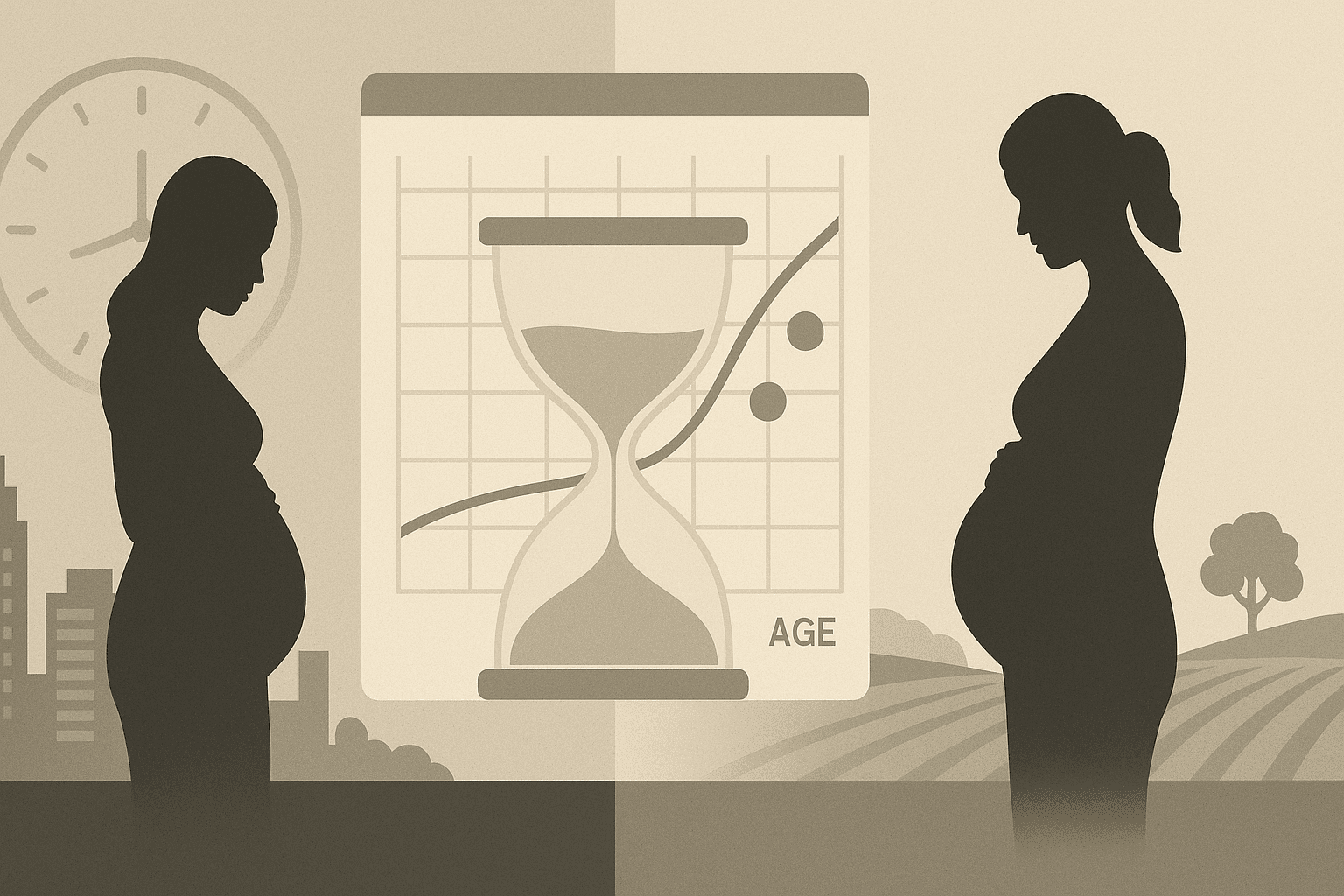
Headlines touting a TFR of 1.9 can feed anxiety about ageing and underpopulation. But TFR is a snapshot built on today’s age-pattern of births, not a crystal ball. In a society where women are marrying later, studying longer, and working more, timing distorts the picture—often making fertility look lower than it will ultimately be.
TFR, in plain terms
-
What it is: Sum of age-specific fertility rates (ASFRs) across seven five-year age bands (15–19 … 45–49), assuming today’s age-pattern persists through a woman’s life.
-
What it assumes: A synthetic cohort—that today’s 15–19 group will eventually behave like today’s 20–24, 25–29, … 45–49 groups as they age.
-
Where it slips: Real cohorts change norms. Education, jobs, marriage age, and costs shift over time, so today’s 20-year-olds won’t necessarily behave like today’s 40-year-olds later.
The big distortion: the tempo effect
-
Definition: When women delay births (e.g., marry later, space births), the same lifetime number of children is spread into older age bands.
-
Why it matters: TFR, being a current-year construct, misses postponed births and can understate eventual family size.
-
India’s signal: Urban ASFRs show declines at 15–24 and increases at 25–34 (and some 35–39)—classic postponement. Rural ASFRs also shift from 15–19 toward 20–34, though older cohorts (≥35) show real declines—suggesting a mix of delay and some completed-fertility reduction.
Other measurement blind spots
-
Under-15 and over-49 births: Excluded by design. Usually negligible, but in settings with early marriage or late, medically assisted births, omissions can bias totals downward or miss edge cases.
-
Under-reporting: Social/legal sensitivities around underage births and survey-era discomfort can lead to non-response or concealment, nudging measured TFR lower than reality.
Interpreting India’s 1.9—what’s signal vs. noise?
-
Signal: India has clearly transitioned to low fertility, with smaller desired family sizes than a decade ago.
-
Noise: A chunk of the drop reflects later timing, not only fewer children. Where postponement dominates, TFR tends to rebound modestly as delayed first/second births occur in later age bands.
Should India “raise” TFR for growth?
-
Ageing worries are real but manageable: Sub-replacement fertility hasn’t halted prosperity in advanced economies; growth hinges more on productivity, female labor force participation, skills, and institutions.
-
Missed dividend lesson: High youth unemployment and skill mismatches already blunted India’s demographic dividend. Chasing a higher TFR won’t fix jobs, skills, and productivity gaps.
-
Policy priorities:
-
Ease family formation: affordable childcare, safe transport, flexible work, housing near jobs—so delays are choice, not constraint.
-
Invest in human capital: health, education, skilling to lift productivity per worker as population growth slows.
-
Prepare for ageing: pensions, long-term care, geriatric health—independent of year-to-year fertility wiggles.
-
Better measurement: tempo-adjusted indicators (e.g., tempo-adjusted TFR, parity progression ratios, completed cohort fertility) to separate delay from decline.
-
Bottom line
India’s TFR = 1.9 captures a pivotal shift, but not the whole story. Much of the apparent fall reflects when births happen, not only how many. Policy should read beyond the headline: support families that want children, empower women’s work–family balance, and double down on productivity and ageing readiness—regardless of small annual moves in TFR.