

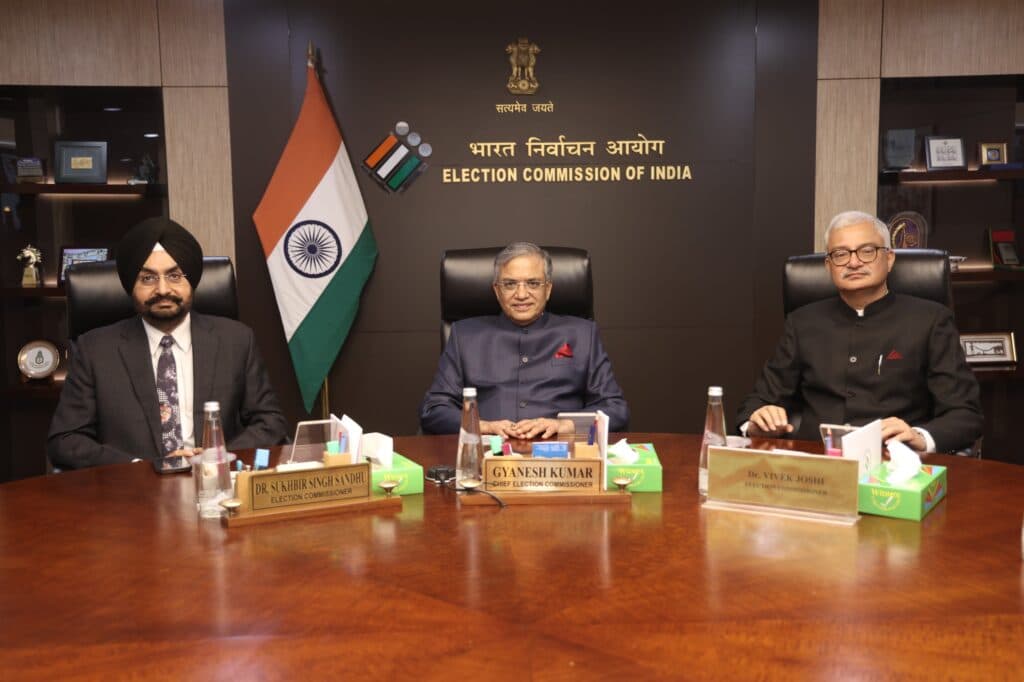
With Bihar Assembly elections around the corner, the Election Commission (EC) has issued an advisory to all parties on responsible use and disclosure of synthetic/AI content in campaigns. The core message: deepfakes and hyper-realistic edits can distort voter perception, tilt the playing field, and thus undermine electoral integrity. Parties, candidates, and their campaign teams must prominently label any AI-generated or AI-altered image, audio, or video used in campaigning (e.g., “AI-Generated”).
What exactly counts as “synthetic” or AI-generated content?
-
Full generative outputs: an entire speech or image produced by an AI model.
-
AI-altered media: voice cloning, lip-syncing, face swaps, edited crowd shots, or modified quotes/audio that change meaning.
-
Composites and restorations: stitched clips or enhanced audio that could mislead by adding, omitting, or re-timing material.
Test to apply: Would a reasonable voter likely take this as authentic if not warned? If yes, it must be clearly and legibly labelled.
The legal/administrative backbone (how EC can act)
-
Article 324 (Constitution): EC’s plenary authority to ensure free and fair elections—used to issue advisories, directions, and remedial orders.
-
Model Code of Conduct (MCC): Once in force, bars unfair propaganda, personal vilification, communal appeals, and misleading material.
-
Representation of the People Act, 1951 (RPA): False statements touching a candidate’s character or conduct, appeals that inflame divisions, and undue influence can trigger complaints and prosecution.
-
Information Technology framework: Parties and their agencies remain responsible for content they originate or promote. Intermediaries must act on lawful takedown directions and enforce due-diligence rules against misinformation/deepfakes.
-
Other criminal/civil liabilities: Defamation, impersonation, identity/likeness misuse, and privacy breaches may separately attract action.
Practical consequences EC may trigger: notices and censure; direction to take down content; withdrawal of star-campaigner status; FIRs via state machinery; and public naming to deter repeat violations.
What the EC expects now (operational checklist for parties/candidates)
1) Prominent labelling
-
Put “AI-Generated” or “AI-Altered” as a visible on-screen label (video) and watermark/caption(image/audio).
-
Labels must be clear, prominent, and legible on every platform where the asset appears (not just the original post).
2) Disclosure & traceability
-
Maintain an internal content log: source file, tools used (voice clone/TTS/image model), date/time, responsible team/agency, and purpose.
-
Keep unaltered originals and change records (edits, prompts, scripts) to prove provenance if EC seeks verification.
3) Substantiation and consent
-
Do not fabricate quotes or depict rivals saying things they never said.
-
For likeness/voice portrayals—even satire—use consent or clear disclaimers; avoid deceptive similarity that could pass as real.
4) Guardrails for third-party agencies
-
Contracts with creatives/influencers must forbid deceptive deepfakes, mandate labelling, and require timely takedown if flagged.
-
Use pre-publication reviews for high-risk assets (leader speeches, sensitive issues).
5) Rapid response protocol
-
Set up a 24×7 escalation path during campaign weeks to:
-
pull down flagged content within minutes;
-
publish clarifications/corrections in the same channels;
-
preserve logs for regulators.
-
Red lines (high-risk behaviours that will draw action)
-
Voice-cloned speeches that look and sound real without labelling.
-
Doctored videos of rivals making inflammatory or caste/communal remarks.
-
Edited crowd scenes implying fake popularity or violence.
-
Synthetic endorsements from non-consenting public figures.
-
Coordinated bot/amplification to spread labelled content in a misleading way (e.g., burying the label, cropping it out).
For platforms and campaign tech teams (good practice)
-
Implement hashing and watermark checks; don’t strip metadata.
-
Use automated cues (face/voice-clone detectors) to flag uploads for manual review.
-
Preserve chain-of-custody logs: who uploaded, when, and from where.
-
Provide fast, well-staffed escalation when EC or parties raise verified complaints.
For voters (how to spot likely deepfakes quickly)
-
Watch the mouth/eye sync: unnatural blinks or lip movements vs audio.
-
Check ambience: reflections, shadows, or crowd reactions that don’t match.
-
Listen for room tone: cloned voices often lack natural breath/noise dynamics.
-
Compare across outlets: major announcements rarely appear on a single sketchy handle first.
Why this matters
-
Level playing field: Elections reward persuasion, not fabrication. Deepfakes erode voter trust and can trigger polarisation or law-and-order issues.
-
Accountability by design: Labelling/disclosure creates traceability, making it costlier to cheat.
-
Future-proofing: Clear standards now will shape norms for synthetic media, AR/VR campaigning, and botsin future cycles.
Quick primer
-
Who’s covered? Parties, candidates, consultants, creators, influencers—anyone producing or disseminating campaign material.
-
What’s mandatory? Clear labelling for AI-generated/altered content; responsible use and swift correction of misleading assets.
-
How enforced? EC directives under Article 324, MCC action, RPA complaints/prosecution, and IT-led takedowns.
-
What to keep? Audit trails (originals, edit histories, tool notes, approvals).
Credits: The UPSC Times elections desk; based on EC advisories, the Model Code of Conduct, Representation of the People Act provisions, and current IT due-diligence norms.