

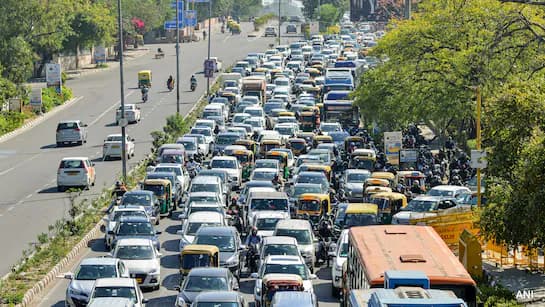
The Commission for Air Quality Management (CAQM) has warned the Supreme Court that Delhi’s fight against vehicular pollution is being blunted by the continued presence of over 63 lakh end-of-life vehicles Delhi–NCR. Despite formal bans on 15-year-old petrol vehicles and 10-year-old diesel vehicles, these overage vehicles Delhi NCR still ply on the capital’s roads, aided by weak enforcement and an earlier Supreme Court order easing restrictions.
The Story
In a status report to the Supreme Court, the air quality management commission NCR, represented by the Additional Solicitor General, has drawn a direct link between vehicular pollution Delhi NCR and the large fleet of end-of-life vehicles that continue to operate. The CAQM notes that progress in removing these vehicles has been “far from satisfactory” in all NCR States and the NCT of Delhi.
According to the Commission, more than 63 lakh overage vehicles Delhi NCR are still in use. These include BS III vehicles whose 15-year life has already ended, BS II vehicles that have crossed 20 years, and BS I vehicles in circulation for nearly 24 years. Even when such vehicles are “fit” on paper, they conform only to their original BS standard, meaning BS III vehicles pollution and BS II vehicles Delhi roads continue to emit at much higher levels than newer BS VI-compliant vehicles.
The CAQM points out that one of the key determinants of vehicle fitness is its emissions profile. In an already stressed airshed, especially during winter air pollution Delhi NCR episodes when meteorological conditions trap pollutants, allowing old emission-standard vehicles to operate undermines any serious air pollution control measures NCR governments might adopt.
The Commission underlines that about 93% of vehicles in Delhi–NCR are light motor vehicles and two-wheelers, making Delhi NCR transport emissions a central piece of the region’s air quality puzzle. Yet, despite a nominal 15 year old petrol vehicles ban and 10 year old diesel vehicles ban, enforcement on the ground has not matched the scale of the problem. The number of impounded vehicles in Delhi—35,558 till June 2025 versus 22,397 in 2024—remains a small fraction of the total end-of-life fleet.
The report also flags the impact of an August 12 Supreme Court order, which temporarily eased earlier restrictions on such vehicles, weakening the deterrent effect and complicating any NCR polluting vehicles crackdown.
On the public transport and commercial side, the CAQM has issued fresh directives. From November 1, 2026, no buses other than CNG, electric or BS VI diesel (CNG and EV buses Delhi 2026) will be allowed to enter Delhi, including those under All India Tourist Permit, though buses already registered in Delhi are exempt.
The Commission is also pushing for a structural shift away from fossil fuels in the urban services economy. It has asked Delhi and other NCR States to instruct motor vehicle aggregators clean mobility, delivery companies and e-commerce players to move urgently away from conventional petrol and diesel fleets. This is aimed at directly targeting e commerce delivery pollution Delhi and the rapidly growing platform-based transport segment.
In parallel, State governments have been told to phase out existing diesel auto-rickshaws by 2026 in a staggered but time-bound manner (diesel autorickshaw phase out NCR), aligning with broader Delhi vehicle scrappage policy efforts.
Why It Matters
The CAQM’s submission underlines a critical lesson: rule-making alone does not clean the air. Unless enforcement is strict and consistent, end-of-life vehicles and weak regulation will keep Delhi–NCR locked into a high-emissions path.
For citizens, the continued presence of old, poorly regulated vehicles means that even costly moves—CNG conversion, EV subsidies, graded response action plans—are partly neutralised. For governance, the report is a reminder that judicial orders, executive intent and field-level implementation must be aligned; otherwise, a Supreme Court order on old vehicles or partial relief can unintentionally dilute long-term environmental goals.
Background / Context
Delhi–NCR has long struggled with multi-source pollution:
-
Transport emissions
-
Industrial and construction dust
-
Biomass and waste burning
-
Seasonal stubble burning in upwind States
Within this mix, Delhi NCR transport emissions remain a year-round contributor, especially from old diesel fleets and two-wheelers. Earlier court-driven measures, such as the CNG conversion of public transport and restrictions on new diesel registrations, helped but did not fully address legacy fleets and informal usage.
The current framework attempts to tighten this by:
-
Prohibiting the use of 10-year-old diesel and 15-year-old petrol vehicles;
-
Moving to BS VI emission norms for new vehicles;
-
Promoting EVs and CNG through fiscal incentives;
-
Exploring a Delhi vehicle scrappage policy that nudges owners to retire old vehicles.
The CAQM report indicates that implementation of these measures is uneven and, in practice, end-of-life vehicles Delhi NCR still enjoy de facto tolerance.
Implications and Way Forward
From a policy perspective, the CAQM’s candid assessment calls for several corrective steps:
-
Stronger Enforcement Architecture
-
Dedicated joint teams of transport, police and municipal officials to enforce the 10/15-year rule.
-
Real-time linkage of registration databases, PUC records and enforcement drives to target violators.
-
-
Rational, Incentivised Scrappage
-
A clear, financially viable Delhi vehicle scrappage policy that combines disincentives for old vehicles with rebates for cleaner replacements.
-
Partnerships with certified scrapping centres to ensure environmental compliance.
-
-
Targeting Commercial Fleets and Platforms
-
Time-bound “green fleet targets” for motor vehicle aggregators clean mobility and logistics companies to reduce e commerce delivery pollution Delhi.
-
Priority parking, permits and financing support for clean cabs, e-two-wheelers and cargo EVs.
-
-
Technology and Monitoring
-
Use of ANPR cameras and roadside remote-sensing devices to automatically identify old, non-compliant vehicles.
-
Public dashboards showing enforcement statistics to maintain pressure for sustained action.
-
-
Regional Coordination
-
Since 93% of vehicles are light motor vehicles and two-wheelers that freely move across State lines, all NCR States must harmonise rules and avoid “pollution havens” where old vehicles are quietly relocated.
-
For UPSC aspirants, this case is a powerful illustration of how environmental governance intersects with urban planning, transport policy, judicial intervention and federal coordination. It can be cited in questions on “urbanisation and environmental challenges”, “regulatory institutions” and “policy implementation gaps”.
Conclusion
The CAQM’s report to the Supreme Court strips away any illusion that Delhi–NCR can breathe clean air while lakhs of end-of-life vehicles and weak enforcement stay on the roads. A credible NCR polluting vehicles crackdown will demand not just notifications but visible, sustained coercive action, backed by smart incentives and technology.
A future-ready mobility ecosystem for Delhi–NCR will hinge on three shifts: phasing out legacy fleets, accelerating CNG and EV buses Delhi 2026 and beyond, and cleaning up high-frequency commercial traffic, from autos to last-mile delivery vehicles. If these steps are pursued with seriousness, Delhi’s air can gradually move from annual crisis headlines to a more stable, healthier normal.