

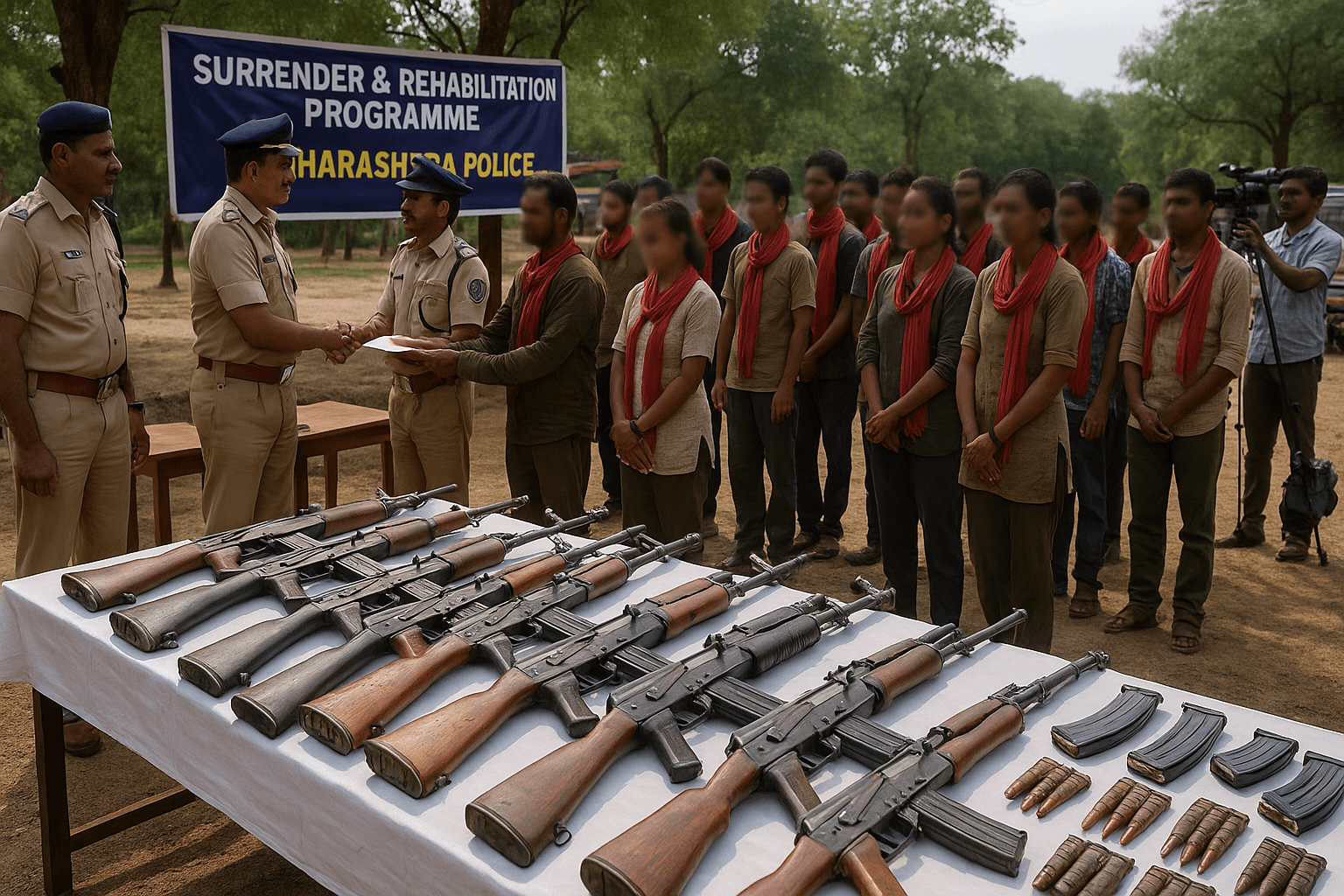
One of the CPI (Maoist)’s most senior strategists, Mallojula Venugopal Rao—“Bhupati”—and 60 others surrendered in Gadchiroli district, handing over assault rifles and signalling a leadership crack in the Dandakaranya theatre. It’s a tactical coup for Maharashtra—and a moment to lock in durable peace, not just an operational win.
What happened
-
61 Maoists surrendered at Fodewada (Bhamragad), Gadchiroli—an LWE hotspot straddling the Maharashtra–Chhattisgarh border.
-
The cohort includes a Central Committee member (Bhupati), two State zonal leaders, 10 divisional leaders, and multiple cadres.
-
54 weapons were deposited (AK-47s, SLRs, INSAS).
-
Officials say Bhupati, long seen as an ideologue and organiser (and brother of slain leader Kishenji), had grown disillusioned with the movement’s direction.
Why this surrender is significant
-
Leadership attrition
Central Committee/PB-level leaders rarely surrender. Their exit erodes ideological coherence, logistics networks, and inter-state coordination. -
Dandakaranya theatre under pressure
Gadchiroli–Bhamragad abuts Maoist strongholds in south Gadchiroli and Abujhmad. A high-profile surrender here dents the perception of Maoist sanctuary along the border belt. -
Momentum effect
Bhupati’s family members had already surrendered. Such signals often catalyse further exits among fence-sitters and influence area committees. -
Arms depletion and intelligence gains
Weapons caches surrendered reduce operational capacity; more importantly, debriefs can map couriers, IED cells, medics, and finance channels.
Why surrenders are rising in some theatres
-
Targeted operations + roads/communications have shrunk safe space; night mobility and supply lines get riskier.
-
Leadership aging and health stress in forest conditions.
-
Frictions within the party over strategy, civilian casualties, and extortion.
-
State rehabilitation policies offering financial grants, housing, education, skill support, and legal relief for those without grave crimes.
What could go wrong (the risks)
-
Fragmentation and reprisals: Local “militia” units may retaliate to deter future surrenders.
-
Cross-border displacement: Cadres may slip into adjacent districts in Chhattisgarh/Telangana, raising inter-state coordination needs.
-
Community trust gap: Heavy-handed tactics or slow civilian benefits can revive sympathy for insurgents.
-
Justice & integration balance: Mishandled amnesty vs prosecution choices could fuel grievances on either side.
What policy should do now
A. Protect and integrate the returnees
-
Fast-track identity restoration, stipend, skill training, and victim compensation where due; ensure witness protection for high-value debriefs.
-
Community-level restorative mechanisms to reduce retaliation risk.
B. Hold the security–development line together
-
Sustain area domination with civic action: schools, PDS access, mobile networks, solar power, health camps, and MGNREGA works—visible in surrendered leaders’ home areas.
-
Roads and telecom to break isolation (without displacing communities).
C. Police–forest–welfare coordination
-
Joint control rooms during the post-surrender window; single-point grievance redress for villagers to blunt extortion’s return.
D. Inter-state playbook
-
Daily intelligence fusion with Chhattisgarh/Telangana; coordinated operations to prevent rebound migration of cadres.
E. Narrative and legality
-
Clear public communication distinguishing rank-and-file who lay down arms from hardcore perpetrators; steady, fair trials for grave offences to preserve rule of law.
What to watch next
-
Follow-on surrenders/arrests in south Gadchiroli–Abujhmad.
-
IED incidents and ambush attempts as potential backlash.
-
Speed of rehabilitation disbursals and relocation of vulnerable families.
-
Development project rollout in former strongholds without ecological or tribal-rights violations.
Bottom line
This surrender dents CPI (Maoist)’s command-and-control in a key theatre. Converting it into a strategic gain requires more than photographs and weapons displays: seamless rehabilitation, trust-building with tribal communities, inter-state coordination, and relentless focus on livelihoods and justice.
Source: The Hindu