
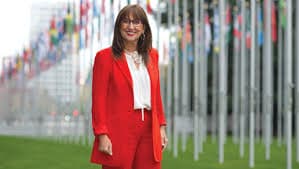
Rebeca Grynspan—Costa Rica’s nominee and head of UNCTAD—welcomed the surge of qualified women in contention for Secretary-General but insisted the selection be strictly merit-based: equal rules, no discrimination, and no “special treatment.”
What’s the news
-
Grynspan affirmed she seeks no preferential treatment for women, only a process that doesn’t discriminate.
-
The field is expected to include prominent women from Latin America and the Caribbean—often cited as the region “due” under informal geographic rotation.
How the UN Secretary-General is chosen (in practice)
-
Article 97: The SG is appointed by the General Assembly on the Security Council’s recommendation.
-
In reality, the P5’s (U.S., U.K., France, Russia, China) preferences—and veto power—shape the shortlist.
-
Informal regional rotation and political trade-offs influence outcomes; there has never been a woman SG.
Why gender is in focus—without quotas
-
For parity advocates, picking a woman would correct a 80-year anomaly and reinforce UN credibility on SDG5 (gender equality).
-
Grynspan’s framing is proceduralist: the best way to get a woman SG is not to bias the process but to ensure it isn’t biased against women.
-
-
The Latin America & Caribbean (GRULAC) angle
-
Since 1945, only one Latin American has led the UN (Javier Pérez de Cuéllar, 1982–91).
-
Names in circulation include Michelle Bachelet, Mia Mottley, Alicia Bárcena, and Rebeca Grynspan—all with heavyweight portfolios in governance, climate, or multilateral institutions.
-
What will decide the race
-
Geopolitics: P5 consensus in a fractured world (Ukraine, Middle East, U.S.–China tensions).
-
Profile fit: Crisis manager, climate-finance mobiliser, South–North bridge-builder, and reform credibility on UN effectiveness.
-
Process transparency: Open hearings and public CVs (as in 2016) vs back-room bargaining.
Why this matters
The next SG will navigate climate finance, development debt stress, AI governance, and conflict mediation. Latin American leadership with broad Global South credibility—and a gender-fair process—could strengthen UN legitimacy without slipping into tokenism.
Source: The Hindu