

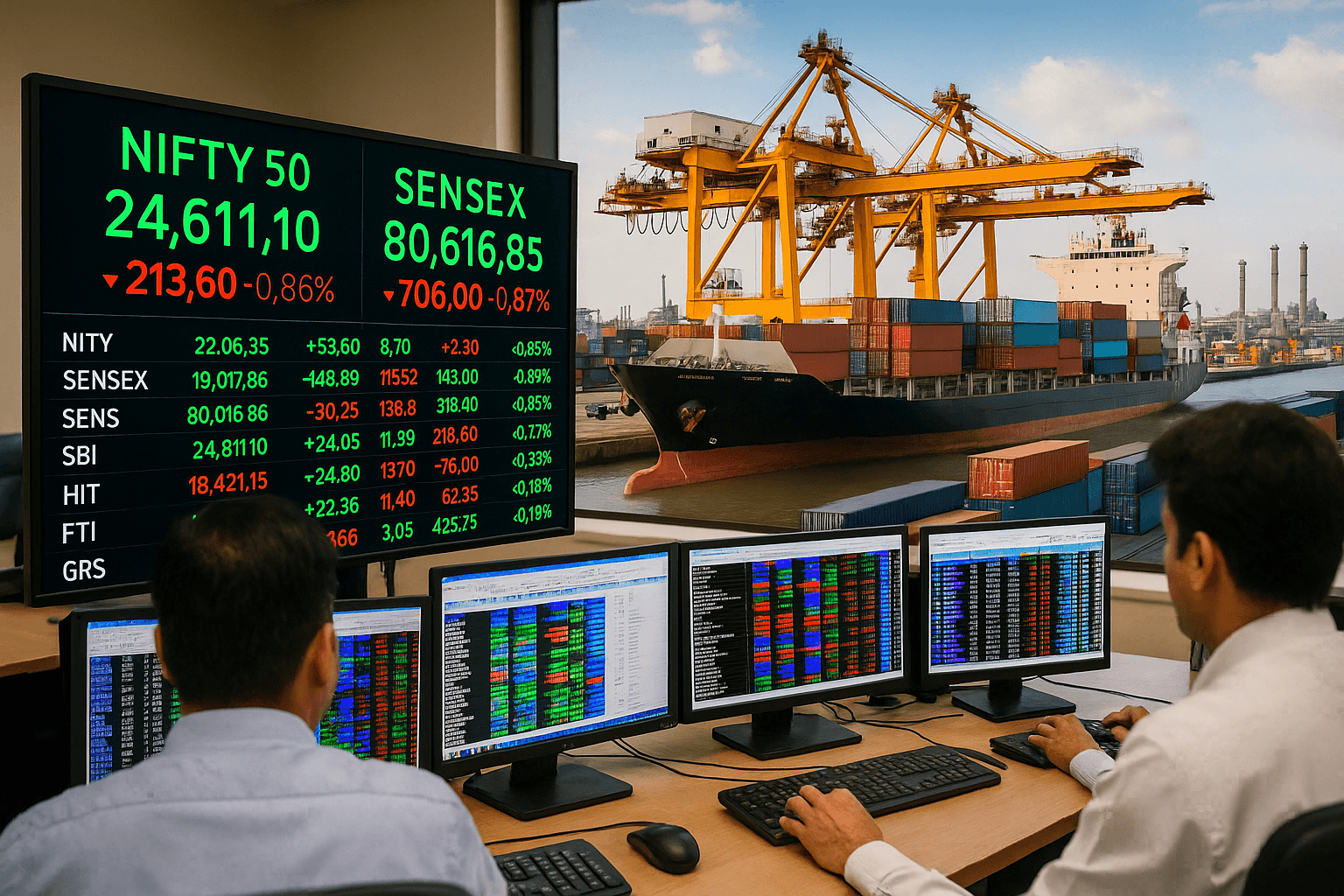
Foreign Portfolio Investors (FPIs) sold Indian equities again in September, extending a three-month streak of outflows amid tariff uncertainty, rich valuations, and a weaker rupee. The headlines raise a perennial question: how should India view foreign capital—both the “hot” flows that jolt markets and the “patient” investments that build factories? This explainer clarifies the main routes of foreign money, where to find the data, why developing economies court it, what can go wrong, and what China and Vietnam did differently—especially in a world reshaped by U.S. trade and tech policies.
The Story
What is FPI?
Foreign Portfolio Investment (FPI) is investment in listed securities—equities, debt, ETFs, derivatives—without management control. In India, regulated FPIs register with SEBI (post-2019, primarily Category I and II). Flows are fast, market-priced, and highly sensitive to global rates, currency moves, earnings cycles, policy signals, and risk sentiment. FPIs provide liquidity and price discovery—but can reverse abruptly, driving volatility.
What is FDI?
Foreign Direct Investment (FDI) involves lasting interest and control (typically ≥10% equity, plus board/management say). It funds greenfield plants, brownfield acquisitions, joint ventures, and technology transfer. In India, FDI is governed by the consolidated FDI Policy (sectoral caps) via the automatic route (no prior approval) or the government/approval route (screening needed). FDI is slower to arrive but more durable, adding capacity, jobs, technology, and exports.
Other important foreign capital routes
-
External Commercial Borrowings (ECBs): Foreign loans to Indian firms; cheaper capital but carry currency/refinancing risk.
-
FPI in debt (including government and corporate bonds): Broadens the investor base, influences yields and rupee dynamics.
-
American/Global Depository Receipts (ADR/GDR): Foreign-listed receipts backed by Indian shares.
-
Foreign Venture Capital/Private Equity: Unlisted equity in startups and growth firms; brings expertise but can be sensitive to global funding cycles.
-
Masala bonds/rupee bonds offshore: INR-denominated debt issued abroad; currency risk borne by investors.
-
Overseas Direct Investment (ODI) by Indian firms: Outbound investment; relevant for balance-of-payments dynamics.
The data: where it lives
-
FPI flows and holdings: NSDL/CDSL and SEBI publish daily/monthly aggregates by asset class and sector.
-
FDI: DPIIT (formerly DIPP) releases quarterly and annual FDI equity inflows by country, sector, and state; RBI compiles BoP and IIP (International Investment Position).
-
Debt, ECB, and depository data: RBI bulletins and regulator portals.
These sources together let analysts track whether India is attracting “patient” greenfield investment or primarily portfolio churn.
Why Foreign Investment Matters for Developing Countries
Foreign capital, when well-designed and well-governed, accelerates development in five ways:
-
Investment and jobs: FDI builds capacity in manufacturing and services, raising productivity and wages.
-
Technology and know-how: Multinationals diffuse processes, standards, and managerial practices that spill over to domestic firms.
-
Exports and scale: Anchor investors plug local suppliers into global value chains (GVCs), boosting foreign exchange earnings.
-
Market depth and governance: FPI improves liquidity and corporate discipline; disclosure and governance standards rise.
-
Public finance and infrastructure: Capital market depth lowers the sovereign’s cost of borrowing and supports PPPs.
Yet, unmanaged inflows can overheat asset prices, fuel current-account pressures, and entrench external dependence. The objective is quality, not simply quantity—stable FDI, diversified FPIs, and prudent external debt.
China and Vietnam: What They Did—and Didn’t
China (2001–2016, and beyond)
-
Playbook: WTO accession (2001), Special Economic Zones, “processing trade” incentives, disciplined land/power/logistics, and relentless export orientation. Global firms invested to serve the world from China; deep local supplier ecosystems emerged.
-
Capital mix: FDI dominated—large, manufacturing-heavy, with strong backward linkages. FPIs were gradually liberalised but never allowed to dominate macro stability.
-
Outcome: Rapid productivity gains, huge export surpluses, and currency/industrial policy calibrated to retain competitiveness.
-
Turn in the tide: U.S.-China trade tensions (2018 onward), technology controls, and supply-chain de-risking nudged some production to Southeast Asia. China remains central, but the “China-plus-one” era opened space for peers.
Vietnam (2007–present)
-
Playbook: Doi Moi reforms, FTAs (including CPTPP, EVFTA), aggressive industrial parks, customs digitalisation, and investor after-care. A simple proposition: predictable policy + plug-and-play parks + export focus.
-
Capital mix: High-quality FDI in electronics (Samsung, Apple suppliers), apparel, and furniture; rising supporting industries.
-
Outcome: Soaring exports, tight integration into GVCs, and improving logistics rankings—despite a small domestic market.
-
Lesson: Process reliability and last-mile execution outweigh headline incentives.
What U.S. policy shifts changed
-
Tariffs on China (Section 301) and tech controls pushed multinationals to diversify. Vietnam and Mexico gained quickest due to ready industrial land and trade deals; India saw rising interest but capacity creation is uneven across states.
-
Visa fee hikes/H-1B costs and sector-specific tariffs can alter service exports’ competitiveness and shift portfolio preferences, affecting FPI appetite for Indian IT/pharma at the margin.
-
Global rates cycle (higher U.S. yields) tightens risk capital globally, making FPIs more selective and return-sensitive.
Positives and Negatives of Foreign Investment
Positives
-
Growth, jobs, and productivity: FDI lifts total factor productivity via technology, training, and competition.
-
Exports and resilience: Diverse foreign manufacturers reduce import dependence and broaden export baskets.
-
Capital market development: FPIs aid price discovery, deepen debt markets, and expand investor bases.
Negatives / Risks
-
Volatility (“hot money”): FPI reversals can strain the rupee, raise yields, and force monetary/FX interventions.
-
Asset bubbles and misallocation: Easy capital can inflate equities/real estate; correction can be painful.
-
Macro imbalances: Sudden surges widen current-account deficits if import-intensive; reversals stress BoP.
-
Policy capture and race to the bottom: Over-generous incentives or weak regulation can erode fiscal space and labour/environment standards.
-
Uneven spillovers: Without supplier development, FDI may remain an enclave with limited local value-add.
India’s Current Moment: Signals Behind the Flows
-
Earnings vs valuations: If multi-quarter earnings disappoint while valuations remain stretched, FPIs trim exposure.
-
Tariff and policy uncertainty: Abrupt changes (or fear of them) widen risk premia; global funds re-weight to markets with clearer rulebooks.
-
Currency arithmetic: A weakening rupee reduces dollar returns, lowering foreign risk appetite even if the local index is flat.
-
Global reallocations: When China screens as “cheap with catalysts” and India as “expensive with momentum,” GEM managers rotate. This can reverse when India’s earnings/growth surprise on the upside or when policy clarity improves.
Policy Priorities: Converting Interest into Investment
-
Make FDI turnkey
Provide serviced industrial land, power reliability, and green clearances on a single digital window. The investor should face one counterparty and time-bound approvals. -
Stabilise the rulebook
Predictable tariffs, data/localisation norms, and sectoral caps; avoid retrospective surprises. Publish multi-year glide paths for duties and incentives to anchor boardroom decisions. -
Deepen capital markets
Faster inclusion in global bond indices, steady foreign room in government and corporate debt, and bankruptcy resolution timelines that creditors trust. -
Local supplier ecosystems
Condition marquee FDI on vendor development, skill programmes, and domestic tooling; link PLI-style incentives to actual local value-addition and export milestones. -
Hedge the volatility
Maintain adequate FX reserves, flexible inflation targeting, and macro-prudential rules that lean against leverage cycles; encourage corporate hedging of external debt. -
ESG and labour upgradation
Compete on standards, not only subsidies: clean energy PPAs, water reuse, and credible labour compliance shorten due diligence and accelerate FDI closures.
Implications
If India tilts the mix toward patient FDI while keeping FPI diversified and stable, it can finance a high-investment growth path without recurring BoP scares. The risk is the opposite: relying on hot money to fund current-account gaps while factory creation lags. China and Vietnam show that what ultimately anchors foreign capital is not the pitch but the predictability of delivery—land, logistics, labour, and law, in that order. In a world of shifting trade blocks and technology controls, countries that move from policy intent to execution reliability will win the next wave of supply-chain realignment.
Conclusion
FPI outflows bruise markets, but they are not a verdict on India’s long-term promise. The strategic task is to turn interest into investment: court FDI that builds capacity, keep FPI rules simple and steady, and prove—factory by factory, supplier by supplier—that India can deliver at scale. When the rulebook is predictable and the last mile works, global capital stays not for a quarter, but for a generation.