

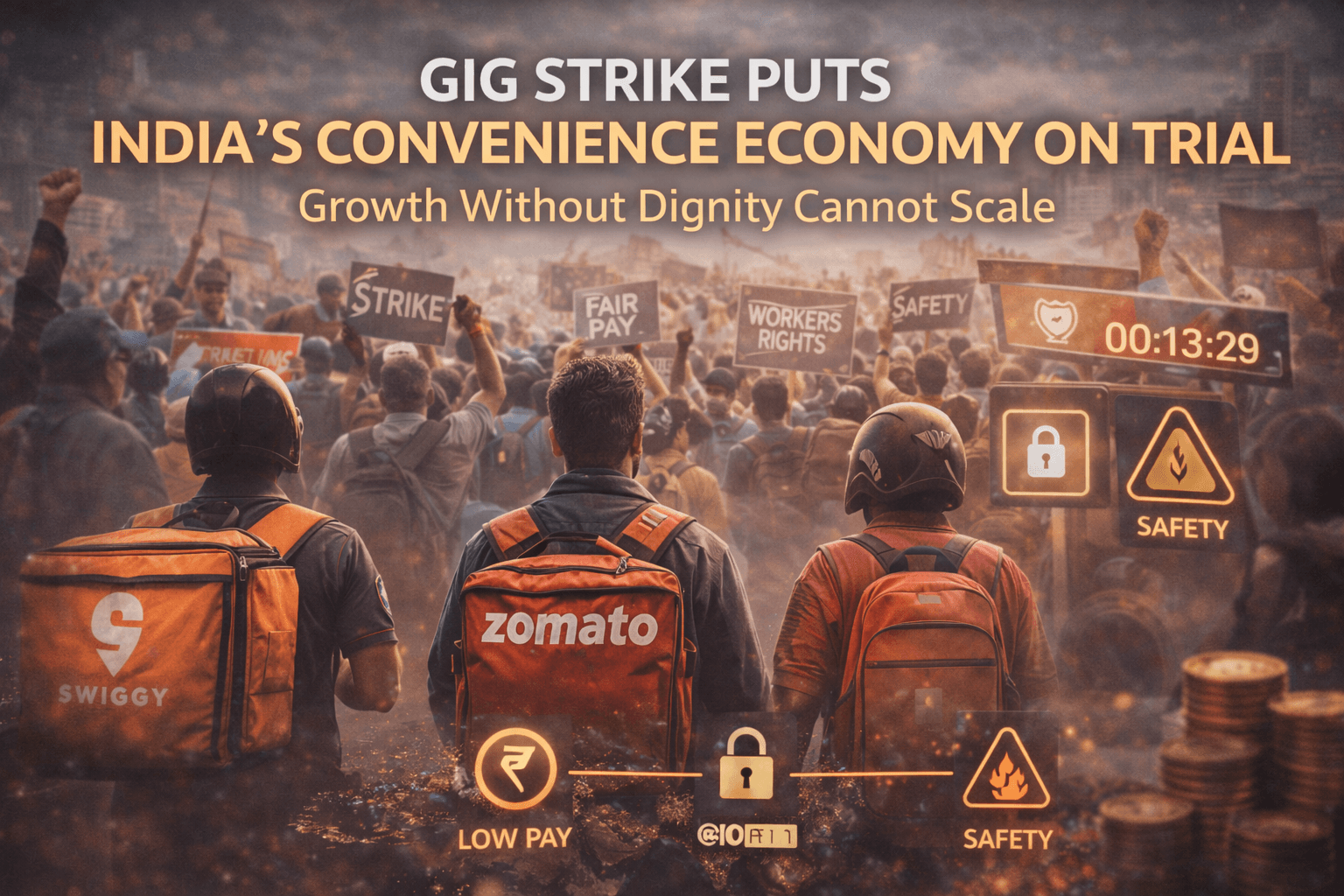
India’s gig economy is not a side story anymore. It is the daily machinery behind food delivery, ride-hailing, and quick commerce. When platform workers strike, it is not just a labour headline. It is a signal that the convenience economy is hitting its governance limits. The core question is no longer whether gig work will grow. It will. The question is whether it will grow as a dignified labour market or as a permanent “no-questions-asked” buffer for unemployment, low bargaining power, and a mass education system that often fails to deliver job-ready capability.
What’s in the news
Gig and platform worker unions have announced a strike, alleging “systemic exclusion from core labour entitlements”, harassment and insecurity in platform work. Their charter includes discontinuing ultra-fast delivery mandates for safety, minimum per-kilometre rates, protections for women workers including maternity safeguards, limits on arbitrary ID blocking and punitive rating systems, and a minimum monthly earnings threshold.
Background and context
Platform work expanded because it solved three problems at once.
First, it matched India’s vast underemployed workforce with immediate earning opportunities.
Second, it used smartphones, UPI, and maps to make logistics cheap and scalable.
Third, it trained consumers to treat speed as a default expectation.
But this model also created a new labour structure: workers are “on the system” but not “in the system”. They face granular control through ratings, incentives, penalties, and deactivations, without the full set of protections usually associated with regular employment. This is not a moral argument. It is a structural one. When risk is pushed downward and competition is intense, the easiest variable to squeeze is the worker’s time, safety, and pay predictability.
Key details
1) The “quick delivery” safety dilemma
Ultra-fast delivery is not merely a customer feature. It reshapes the entire work cycle: route choices, rest breaks, risk-taking, and how workers respond to traffic and weather. Even if platforms do not explicitly ask riders to speed, the incentive structure can effectively do so.
2) Algorithmic control without transparent due process
“ID blocking” or deactivation is the modern equivalent of termination, often triggered by opaque signals: customer complaints, fraud suspicion, rating drops, or “behavioural” flags. Without a clear appeal system, this becomes a livelihood cliff.
3) Earnings: high gross, unstable net
Gig work can look attractive on good days, but net earnings depend on fuel, vehicle maintenance, unpaid waiting time, surge volatility, and platform commissions. Workers end up bearing business volatility that traditional employment absorbs.
4) Women workers face compounded risks
Safety, hours, sanitation access, harassment, and maternity protection are not add-ons. They decide whether women can sustainably participate at all.
Why it matters
A) The gig boom is partly a growth story, partly a jobs story
Yes, gig platforms are efficient businesses that expanded markets and created consumer surplus. They also improved last-mile delivery for MSMEs, restaurants, and local commerce.
But the scale of supply also reflects India’s labour reality: too many young people chase too few quality, formal jobs. In many households, gig work is not a choice between two attractive careers. It is the least-worst option that pays weekly, without gatekeeping.
B) The education and skills pipeline is a hidden driver
The debate is not “education bad”. The problem is mismatch and drop-off. Many students exit with weak foundational skills, limited employability, and poor access to apprenticeships. When the transition from education to work is broken, platforms become the default labour market.
C) Social consequences travel fast
When a large workforce lives on unpredictable income, it affects credit behaviour, family stability, road safety, and long-term mobility. A nation cannot build a durable middle class on work that has no grievance pathway and no security.
Arguments for and against
The “pragmatic capitalism” case: let profits scale first
This view says platform-led capitalism is overdue and necessary. Low-cost services expand demand, bring investment, and create network effects. Overregulation could slow innovation, push up prices, and reduce opportunities for workers who prefer flexibility.
What it gets right: India needs scale, productivity, and competitive businesses. Platforms have built real capabilities.
What it ignores: without a minimum floor, the system can drift toward a race to the bottom, where profits rise but trust collapses, and workforce churn becomes permanently high. That is not efficient capitalism. That is fragile capitalism.
The “living wage and rights first” case: growth must be fair by design
This view argues that workers are foundational to the model, so the model must guarantee fair pay, safety, and protection against arbitrary action.
What it gets right: the platform economy cannot be legit if it runs on insecurity. A predictable floor improves stability and can reduce hidden costs like accidents and attrition.
What it underestimates: implementation capacity, the risk of one-size-fits-all rules across cities, and the possibility that rigid cost structures push smaller players out, reducing competition and, ironically, lowering worker bargaining power.
A workable middle path: floor rights, flexible earnings
India does not need to choose between profit and dignity. It needs a modern labour compact: portability, transparency, and safety floors, while allowing innovation in pricing, demand creation, and service differentiation.
Constitutional / legal angle
At the heart of this debate is the meaning of dignity of labour in a digital marketplace. Platform work tests how India interprets social security, fair conditions of work, and effective remedies in a model where control is exercised through software rather than supervisors.
The big legal design question is classification and responsibility: when platforms shape pay, access to work, and penalties, how much accountability should follow? India’s emerging approach has leaned toward recognising gig and platform workers as a distinct category for social security, but the enforcement architecture, funding mechanism, and grievance pathways remain the real battlefield.
Other country examples
European approach: baseline rights and transparency
Several advanced economies have moved toward requiring more clarity on employment status, platform accountability, and algorithmic transparency. The emphasis is on minimum standards plus oversight, not on banning the model.
United Kingdom: “worker” protections in some platform contexts
Courts and regulators have pushed a middle category in certain settings where full employee status is not recognised but basic protections such as minimum wage-like floors and paid leave principles become relevant.
United States: state-by-state experimentation
Some jurisdictions have treated gig work as independent contracting with additional benefit obligations, while others push for reclassification. The lesson is that polar models create constant litigation. Hybrid solutions reduce uncertainty.
Singapore and others: portable benefits and trip-linked contributions
A practical route many systems explore is portable protection funded through small, transaction-linked contributions, combined with safety standards and dispute resolution.
The common thread is not ideological. It is administrative: define responsibility, mandate transparency, and fund portable protections without destroying flexibility.
Implications
For workers
More strikes and churn if insecurity persists. Over time, a large workforce trapped in unstable earnings can weaken upward mobility.
For platforms
Reputation and regulatory risk rises when safety incidents, opaque deactivations, or wage anger become routine. The business model starts paying an “instability premium” through attrition, disputes, and political backlash.
For consumers
Convenience may remain cheap for now, but social pressure and safety concerns can force abrupt corrections later. Gradual reform is usually cheaper than crisis-driven overhaul.
For India’s growth model
India can become a high-growth capitalist economy, but mature capitalism is rule-based. It does not outsource all risk to the weakest node and then call it efficiency.
Way ahead
1) Build a non-negotiable safety floor
Stop designing service promises that indirectly reward risky driving. Platforms should recalibrate ETAs, enforce rest breaks, and treat safety violations and accident response as core operations, not PR.
2) Create transparent deactivation justice
A simple standard can change the ecosystem: written reason codes, a time-bound appeal, and a human review layer for livelihood-impact decisions. No worker should lose access to work through a black box.
3) Move to portable benefits funded by the ecosystem
A pragmatic model is trip-order linked contributions into a worker welfare pool, portable across platforms, backed by a welfare board structure. This avoids the false binary of “employee vs contractor” while still delivering real protection.
4) Set a city-sensitive earning floor, not a headline number
Instead of one national figure, anchor minimum earnings to objective inputs: per-km and per-minute floors, waiting-time compensation, and periodic revision linked to urban cost conditions. This protects workers without freezing business innovation.
5) Protect women workers with enforceable design
Safety features, emergency support, harassment reporting, predictable hours options, maternity support, and access to sanitation are not optional. If women cannot stay, the labour market loses half its potential.
6) Fix the upstream problem: education-to-work transition
Gig work is a pressure valve, not a substitute for a capable education pipeline. Stronger foundational learning, credible skilling, apprenticeships, and local employer linkages reduce the desperation that drives acceptance of unfair terms.
The strategic choice is not “capitalism vs compassion”. India’s best path is competitive capitalism with credible labour floors. Profitability will grow more sustainably when workers are not treated as disposable inputs but as the backbone of service reliability.
Source credits
The Hindu; Ministry of Labour and Employment; worker unions and federations; Supreme Court of India; International Labour Organization; NITI Aayog; state labour departments; academic and policy research on platform work and algorithmic management.