

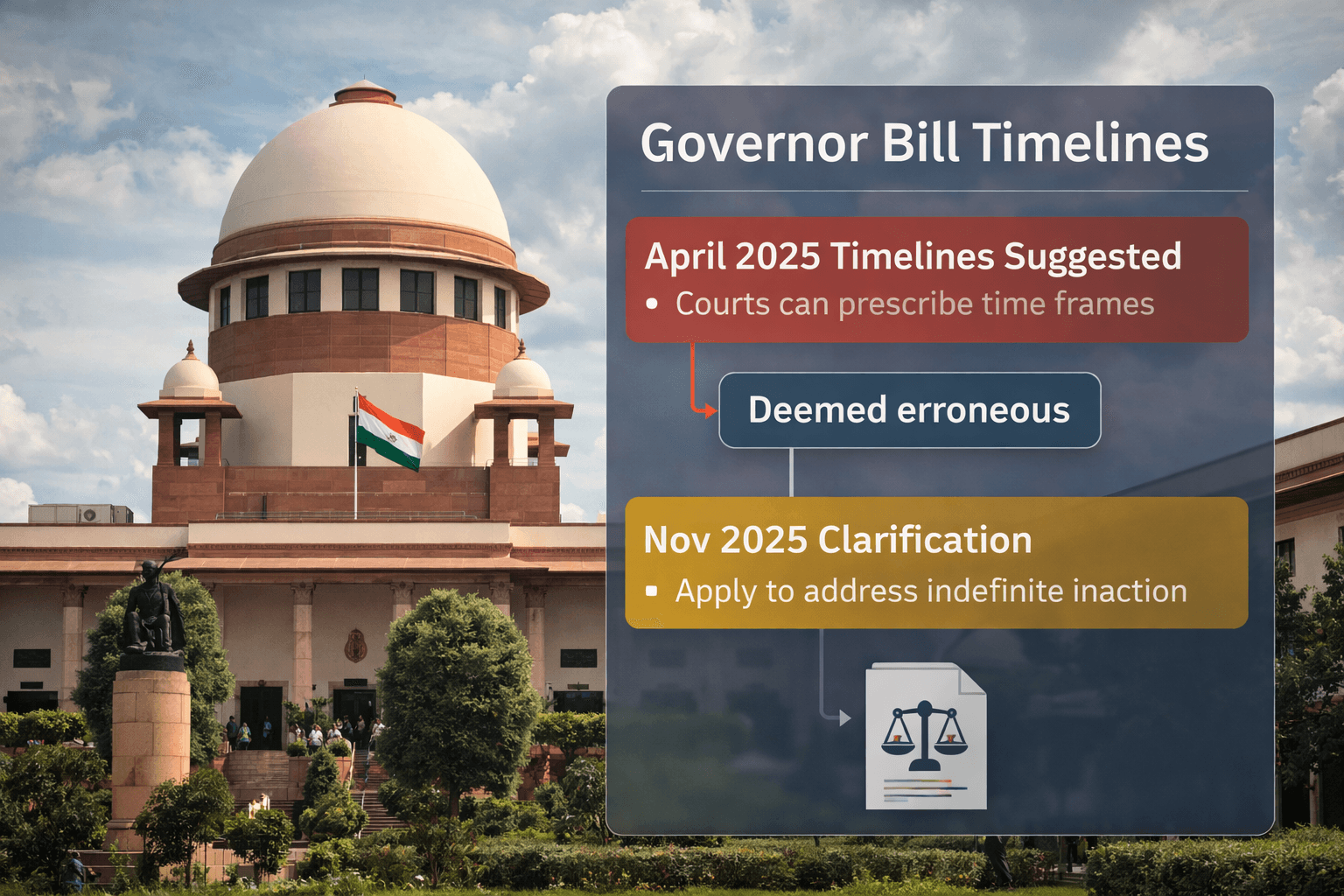
For years, a quiet constitutional conflict has played out in India’s States: elected legislatures pass Bills, but Raj Bhavans sit on them—sometimes for months, sometimes longer—without assent, return, or reservation. In April 2025, the Supreme Court appeared to shut that door by insisting Governors cannot convert silence into a veto and by signalling enforceable discipline through timelines and judicial remedies. The relief was short-lived. In an advisory opinion answering a Presidential Reference, the Court has now signalled a different constitutional philosophy—one that emphasises the Constitution’s text over judicially crafted deadlines, rejects “deemed assent”, and treats gubernatorial discretion as elastic enough to accommodate delays. Even if advisory opinions do not formally “overrule” judgments, they can reshape administrative behaviour. In constitutional politics, persuasive authority often travels faster than binding technicalities
What’s at stake
A procedural power that can paralyse policy
Assent is meant to be a procedural gateway in law-making, not an alternative law-making centre. When assent becomes a site of prolonged inaction, it can freeze entire policy agendas—university governance, local bodies, welfare design, policing reforms, and fiscal measures—without a vote in the House and without an accountable explanation in public.
A federal flashpoint
Because Governors are unelected and appointed, their intervention in State legislation is often read through the prism of Centre-State rivalry. When Opposition-ruled States face repeated delays, the power begins to look less like constitutional caution and more like political leverage.
The April 2025 turning point
Timelines as constitutional discipline
The April 2025 verdict (in the Tamil Nadu Governor matter) sought to end the “endless pendency” problem by imposing definable timelines for a Governor to act on Bills presented for assent. The logic was institutional: if constitutional functionaries can delay indefinitely, the democratic chain of accountability breaks.
“Deemed assent” as an enforcement tool
The judgment’s most consequential signal was remedial. If the Governor’s inaction breached constitutional discipline, courts could treat unexplained inaction as assent—preventing silence from becoming a weapon against legislative supremacy.
This framework did not treat Governors as irrelevant. It treated them as time-bound constitutional actors—able to raise concerns, but not able to stall indefinitely.
The Presidential Reference opinion and the new direction
Text over timelines
In responding to the Presidential Reference, the Court’s opinion treats the Constitution’s silence on timelines as decisive. It reasons that judicially created deadlines have no explicit textual anchor, and therefore sit uneasily with the constitutional scheme.
Rejection of “deemed assent”
The advisory opinion also rejects the concept of deemed assent, viewing it as incompatible with how the Constitution structures assent powers. This shifts judicial relief toward softer remedies—typically directions to “decide”—instead of outcomes that prevent prolonged obstruction.
Discretion that can stretch
Most importantly, the opinion is read as widening the Governor’s room to manoeuvre—especially by expanding the practical space for reserving Bills for the President, even in scenarios where States argue the Constitution expects the Governor to assent after re-passage.
Why the “dialogue” argument is contested
Dialogue needs reciprocity
A recurring defence of Article 200 practice is that it enables “constitutional dialogue” between the Governor and the legislature. Critics argue that dialogue cannot be one-sided. If a Governor can respond late, respond repeatedly, or respond by shifting the Bill into a different constitutional track, the “dialogue” becomes an instrument of control rather than consultation.
The second-stage problem after re-passage
A central fear in State capitals is the creation of a constitutional loop:
-
Bill passed → Governor returns it;
-
Assembly re-passes → Governor reserves it;
-
Bill enters a slow channel with no predictable end.
The concern is not theoretical. It creates a governance “black hole” where legislative intent can be neutralised without a formal veto and without political accountability.
The constitutional principles in tension
Legislative supremacy vs unelected gatekeeping
In a parliamentary democracy, law-making legitimacy flows from elected Houses. Assent powers exist, but they are meant to operate as constitutional checks—not as competing centres of political will.
Checks and balances vs “checks that block”
Invoking checks and balances can be attractive, but the test is proportionality. If the Governor’s assent power becomes a preliminary constitutional review, it begins to resemble an unelected veto disguised as “constitutional protection”, especially because the legislature has limited direct redress against denial or delay.
Judicial review is available for laws, not for non-laws
Courts can review the constitutionality of enacted laws. But a Bill that never becomes law cannot be tested on merits. This asymmetry matters: the more the assent stage becomes a filter, the more policy choices are decided outside the democratic process.
Practical implications
A likely return of strategic delays
If timelines and deemed assent are softened in effect, Governors inclined toward caution—or conflict—may find renewed room for delay. Even when courts eventually intervene, the cost is paid upfront by citizens through stalled policy.
Stronger Central leverage through reservation
If reservation to the President becomes easier to justify even after re-passage, the Union’s influence over State law-making can expand without a formal amendment of legislative lists—simply through procedural routing.
Greater uncertainty for States and investors
Regulatory reform Bills, university restructuring, industrial facilitation, and welfare delivery changes often depend on predictable legislative timelines. Uncertainty at the assent stage becomes a hidden risk premium in governance.
What “better discipline” could look like
Reasoned decisions as a constitutional minimum
A workable constitutional culture requires that assent decisions—assent, return, reservation—are reasoned, recorded, and communicated swiftly. Silence is not neutrality; it is power without reasons.
Narrow, exceptional use of reservation
Reservation to the President works best as an exception for limited categories—where constitutional conflict is clear and immediate—not as a routine exit route.
Transparency and institutional accountability
When assent decisions affect public policy, they deserve sunlight: dates of receipt, action taken, reasons for action, and the constitutional provision invoked. Opacity is the oxygen of delay.
Conclusion
The April 2025 judgment was read as a rare assertion that democratic legislatures cannot be held hostage by procedural silence. The later Presidential Reference opinion is now seen as restoring the “menace” of discretion—by rejecting timelines, disallowing deemed assent, and legitimising a wider bandwidth of gubernatorial choice.
In the real world, the fight is not only about constitutional interpretation. It is about whether constitutional power will be exercised with discipline and reasons—or with elasticity and silence.