

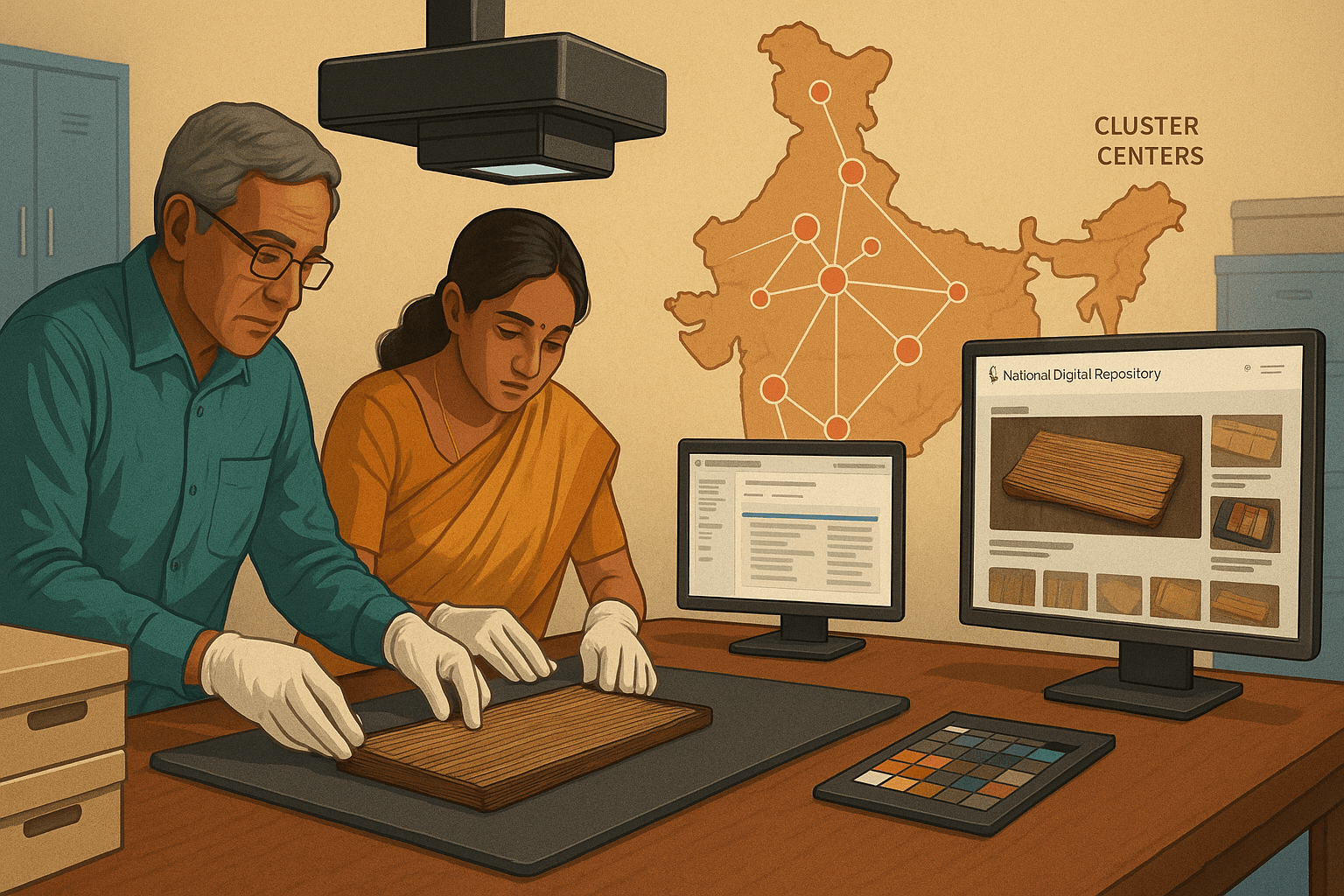
The Union Culture Ministry’s Gyan Bharatam Mission will on Saturday sign MoUs with ~20 institutes—with ~30 more to follow in days—for a nationwide push to identify, document, conserve, digitise and promote India’s manuscript heritage. Selected partners (Asiatic Society Kolkata, University of Kashmir, Hindi Sahitya Sammelan, Government Oriental Manuscript Library–Chennai, among others) will be designated as Cluster Centres or Independent Centres, feeding a new National Digital Repository (NDR) aimed at global access to India’s textual legacy.
What’s new in the model
1) Two-tier institutional roles
-
Cluster Centres: Lead a hub-and-spoke network; execute all manuscript-related activities for their own holdings and up to 20 partner centres in their cluster.
-
Independent Centres: Execute all activities only for their own collections.
2) Funding & oversight
-
Phased funding: 70% on approval of the annual budgeted work plan; 30% on progress reports, detailed financials, UCs and documentation.
-
Central backbone: Gyan Bharatam provides frameworks, standards, training, equipment and monitoring, with quality verification tied to milestones.
3) Dedicated execution units
-
Each partner must set up a Gyan Bharatam Cell with expertise across verticals, working in a spirit of seva/voluntary service, and acting as the single coordination channel with the Mission.
4) The full activity stack
-
Survey & cataloguing (collection mapping, condition assessment, metadata).
-
Conservation & capacity building (preventive and curative conservation; training).
-
Technology & digitisation (imaging, storage, preservation infrastructure).
-
Linguistics & translation (scripts/languages; transliteration; summaries).
-
Research & publication (critical editions, thematic anthologies).
-
Outreach (exhibitions, education, community engagement).
5) National Digital Repository (NDR)
-
A unified, standards-compliant digital platform for discovery, access and long-term preservation, ensuring open, authenticated viewing while respecting custodial rights and sensitivities.
Why this matters
-
Safeguarding civilisational assets: India’s manuscripts—on palm leaf, birch bark, handmade paper—span Vedic literature, philosophy, astronomy, mathematics, medicine, arts, law, regional histories. Many are fragile, unique and at risk from climate, pests and handling.
-
From holdings to knowledge: The step from inventory → conservation → high-fidelity imaging → scholarly use converts dormant collections into public and research value.
-
Standards and scale: A common catalogue, uniform metadata, and shared digitisation protocols avoid duplication and enable cross-archive search—crucial for serious scholarship.
-
Capacity building: India needs trained conservators, script experts, cataloguers and imaging technicians; the cluster model creates regional training hubs.
-
Public access with safeguards: The NDR can deliver multi-lingual interfaces, transcriptions, translations and curated pathways, balancing open access with IP/ethical considerations.
Implementation playbook (what Centres should do now)
Governance & planning
-
Constitute the Gyan Bharatam Cell with named leads for conservation, imaging, metadata, IT, linguistics, outreach.
-
Publish a one-year work plan with quarterly milestones; pre-identify priority collections by rarity/fragility/use.
Collections & conservation
-
Complete collection-level surveys (format, script, date/period, condition, rights status).
-
Set up preventive conservation: climate control (temp/RH), pest management, safe handling SOPs, acid-free enclosures.
Digitisation standards
-
Master files: uncompressed/archival-grade (e.g., TIFF), calibrated with colour target and scale; controlled light and focus stacking where needed.
-
Derivatives: web-optimised JPEG/JP2/PDF; OCR/HTR where scripts permit; IIIF-ready delivery for interoperable viewing.
-
Metadata: adopt controlled vocabularies (Title, Author, Script, Language, Subject, Provenance, Physical description, Condition, Rights).
Data & preservation
-
3–2–1 rule for storage (3 copies; 2 media; 1 offsite), with checksum-based fixity validation.
-
Persistent identifiers for stable citation; versioning for updated transcriptions/editions.
Scholarship & outreach
-
Commission critical editions/translations, thematic digital exhibits, lecture series, and schools–museums partnerships to build public literacy in scripts and textual cultures.
Risks to watch—and mitigations
-
Fragmented metadata across centres → enforce a national schema, run periodic metadata audits.
-
Bottlenecks in conservation labs → stagger work; use regional labs and mobile conservation units for highly fragile items.
-
Digitisation without QA → adopt two-person verification, calibration logs, and randomised quality checks.
-
Rights & access disputes → pre-clear use policies; allow tiered access (thumbnail/reading/hi-res) with attribution norms.
-
Skill gaps → continuous training-of-trainers; create regional rosters of conservators, photographers, cataloguers, and language experts.
What success should look like (KPIs the Mission can publish)
-
Coverage: % of mapped collections; no. of manuscripts digitised vs conserved.
-
Quality: QA pass rate, colour/focus calibration scores, fixity-check success.
-
Access & use: NDR pageviews, downloads, citations in research/teaching.
-
Capacity: No. of trained personnel; active clusters meeting milestones.
-
Community impact: No. of outreach events, school programmes, local-language translations.
Quick primer
-
Gyan Bharatam Mission: Culture Ministry flagship to identify, conserve, digitise, and promote manuscript heritage; builds a National Digital Repository; partners via Cluster and Independent Centres.
-
Funding cadence: 70% upfront on approved plan; 30% on verified progress, UCs and reports.
-
Core verticals: Survey/catalogue, conservation, capacity-building, digitisation/tech, linguistics/translation, research/publication, outreach.
Credits: The UPSC Times culture desk; based on official statements, institutional briefs, and standard conservation/digitisation practice