

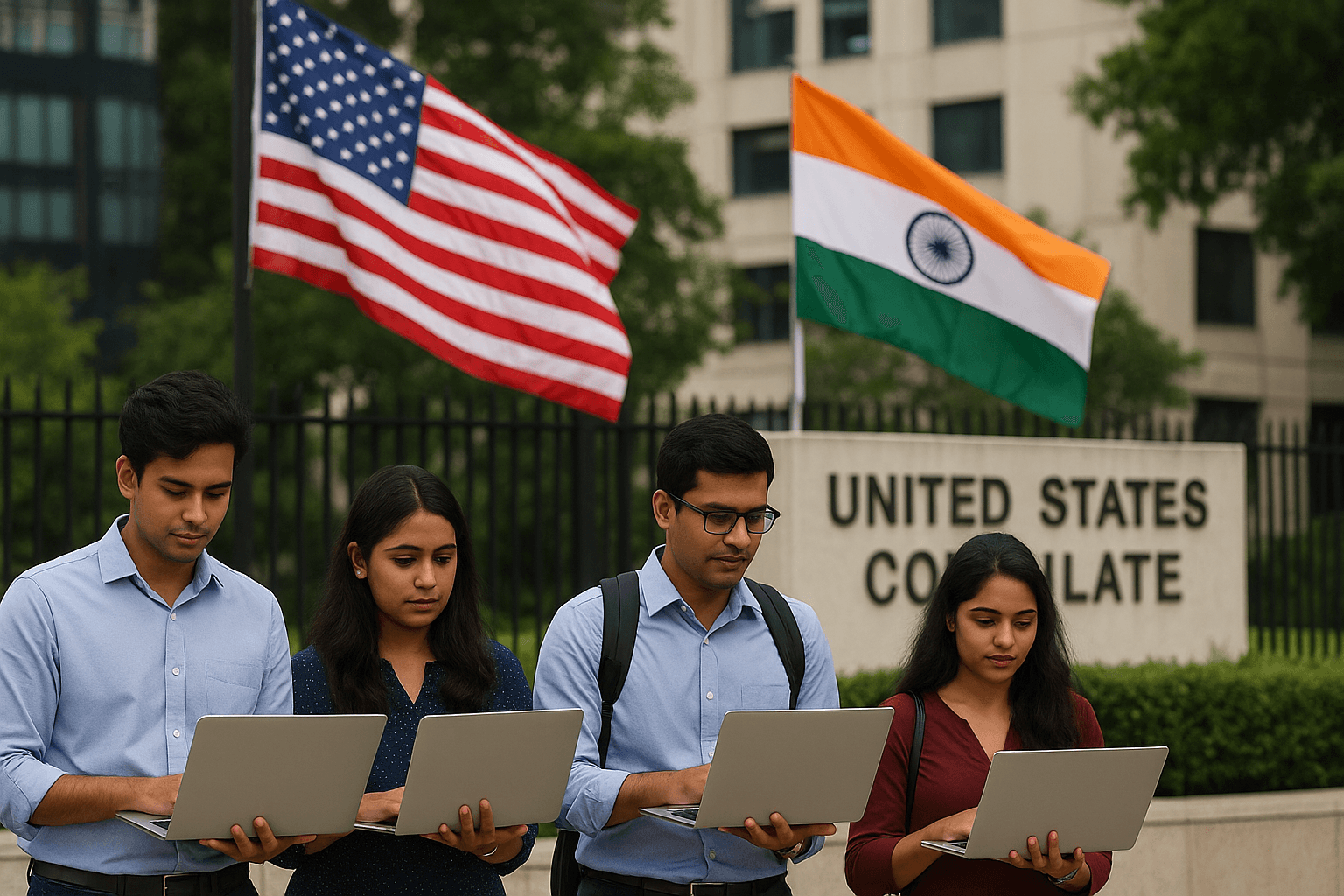
The U.S. has announced a one-time $100,000 fee for new H-1B visa applicants starting with the next lottery cycle. The clarification came after confusion over whether the fee would apply annually, triggering a rush of bookings among Indian workers abroad. The move underscores the H-1B visa’s central role in India–US economic and diplomatic ties.
The Story
President Donald Trump signed the proclamation last week, with Commerce Secretary Howard Lutnick initially suggesting the fee would be annual. This triggered panic among H-1B visa holders, particularly Indians, who form the largest group under the programme. Major firms like Microsoft, JPMorgan, and Amazon advised employees abroad to return before the proclamation took effect on September 21.
The White House later clarified the levy applies only once, to fresh applicants, and not to renewals or current holders. Press Secretary Karoline Leavitt reassured that re-entry rights remain unchanged. India’s Ministry of External Affairs expressed concern over humanitarian impacts, noting potential family disruptions.
The episode has reignited a wider debate: What is the H-1B visa, why does it matter so much, and how do U.S. policy shifts affect both Indian professionals and the global economy?
Basics & Context
What is the H-1B visa?
The H-1B is a temporary, non-immigrant visa that allows U.S. employers to hire foreign workers in specialty occupations requiring technical expertise, usually in IT, engineering, finance, or healthcare.
Historical background:
Introduced under the U.S. Immigration Act of 1990, the programme was designed to fill skill shortages in critical industries, especially during the rise of the tech sector.
Key sectors:
IT and software services dominate H-1B hiring, with Indian firms like Infosys, TCS, and Wipro accounting for a significant share. U.S. tech giants — Google, Microsoft, Amazon, and Meta — also depend on H-1B workers for innovation and competitiveness. Healthcare, finance, and research institutions are smaller but important users.
Policy & Legal Framework
-
Eligibility: Requires at least a bachelor’s degree (or equivalent), employer sponsorship, and proof the role needs specialised skills.
-
Duration: Initially valid for 3 years, extendable to 6 years. In some cases, extensions go further if a green card application is pending.
-
Cap system: Annual quota of 65,000 visas, plus 20,000 reserved for advanced U.S. degree holders.
-
Lottery: Due to oversubscription, visas are awarded via a random lottery. In 2024, over 750,000 applications competed for ~85,000 slots.
-
Reforms: Digital filing was introduced recently, reducing fraud. Lawmakers continue to debate raising caps or tightening conditions.
Economic Dimensions
Contribution to U.S. economy:
Studies by the National Foundation for American Policy estimate H-1B workers add billions to U.S. GDP annually, boosting innovation and patent creation.
Impact on Indian IT sector:
India supplies nearly 70% of all H-1B workers. Firms like Infosys and TCS rely on this channel to deliver outsourced services in the U.S., making it a cornerstone of India’s $250 billion IT industry.
Remittances:
Indian H-1B workers send significant earnings home, contributing to India’s $125+ billion annual remittance inflow, the world’s highest.
Brain Drain vs. Brain Gain:
Critics warn of talent loss, but returnees often bring skills, networks, and capital back to India, creating a “brain circulation” effect.
Geopolitical Angle
The H-1B visa is frequently a flashpoint in India–U.S. relations. Indian diplomats lobby Washington for friendlier terms, arguing the programme benefits both nations. The large Indian diaspora — now over 4 million strong in the U.S. — plays an active role in shaping policy debates.
Competition is rising: Canada and Australia have loosened immigration to attract skilled workers who might otherwise pursue U.S. visas, positioning themselves as alternatives.
Social & Human Angle
Behind the numbers lie human stories. H-1B workers often face long waits for green cards, uncertain job security, and restrictions on spousal employment (H-4 visa). Cultural adaptation challenges and the elusive “American Dream” weigh on families. Some return to India after visa denials, reversing years of settlement.
Criticism & Debates
-
U.S. domestic concerns: Critics argue H-1B visas displace American workers or suppress wages.
-
Exploitation: Some workers face dependency on employers, lower wages, or unfair contracts.
-
Outsourcing via visa: Policymakers accuse firms of misusing H-1B slots to send workers onshore cheaply instead of hiring Americans.
Contemporary Issues
-
Trump vs. Biden: Trump sought to restrict H-1B through higher fees, stricter rules, and reduced approvals. Biden reversed some measures, promising a “fair but efficient” system.
-
COVID-19: Travel bans and remote work reshaped demand, with many companies rethinking on-site roles.
-
Lottery reforms: The digital application system reduced multiple registrations from the same employer, but critics still call for more transparency.
UPSC-Relevant Angle
-
GS 1 (Society): Illustrates migration patterns, diaspora influence, and cultural adaptation.
-
GS 2 (International Relations): Highlights India–U.S. diplomacy and global migration governance.
-
GS 3 (Economy): Links to India’s IT services exports, remittances, and employment generation.
-
GS 4 (Ethics): Raises questions of fairness, justice, and human dignity in global labour mobility.
Implications of the New Fee
The $100,000 one-time fee will raise costs significantly for U.S. employers, especially outsourcing firms. Smaller companies may find H-1B hires unviable, while large corporations could absorb the cost. For Indian workers, the policy signals growing political scrutiny of the programme.
Whether this measure becomes precedent for future restrictions or remains a symbolic move will depend on U.S. domestic politics and lobbying by Indian and American business groups.
Conclusion
The H-1B visa remains more than just a legal pathway; it is a symbol of India’s globalised workforce and a test case of U.S. openness to talent. The latest fee controversy shows how one policy tweak can ripple across economies, families, and geopolitics. As India and the U.S. deepen ties, the fate of the H-1B will continue to shape both nations’ economic and social futures.