

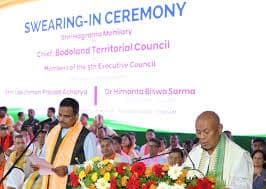
Bodoland People’s Front (BPF) president Hagrama Mohilary on 6 October took oath as the Chief Executive Member of the Bodoland Territorial Council (BTC) in Kokrajhar, Assam. The BTC—governing the Bodoland Territorial Region under the Sixth Schedule—regains its long-time leader after a five-year gap.
The Story
Assam Governor Lakshman Prasad Acharya administered the oath to Mr. Mohilary and Rihon Daimary, who became the Deputy Chief Executive Member, along with 10 Executive Members. The ceremony was held at the Bodoland Secretariat Field in Kokrajhar, attended by Chief Minister Himanta Biswa Sarma, Cabinet ministers, and Tripura’s Tipra Motha chief Pradyot Manikya Debbarma.
Prime Minister Narendra Modi congratulated Mr. Mohilary on assuming charge for the fourth time, affirming central and state support to realise the vision of Bodofa Upendranath Brahma, the spiritual leader of the Bodos. Mr. Mohilary pledged to advance peace, ethnic harmony, and socio-economic development in the Bodoland Territorial Region (BTR).
The Chief Minister assured continued cooperation, calling the BTC a vital institution for inclusive governance in Assam’s western districts bordering Bhutan.
Why It Matters
The swearing-in revives a crucial experiment in India’s Sixth Schedule autonomy, balancing tribal self-governance with state oversight. The BTC has been central to peace-building in a region once marred by decades of ethnic insurgency. Strengthening local institutions under constitutional protection remains key to sustaining stability and equitable growth.
Background / Context
The Sixth Schedule of the Constitution
The Sixth Schedule (Articles 244(2) and 275(1)) provides for autonomous district and regional councils in Assam, Meghalaya, Tripura, and Mizoram. It aims to safeguard the rights of tribal populations through self-rule, legislative powers, and control over land, forest, and customary laws.
The Bodoland Territorial Council, formed under the Bodoland Territorial Areas Districts (BTAD) Accord of 2003, was later renamed the Bodoland Territorial Region (BTR) under the 2020 Accord. The BTC comprises five districts—Kokrajhar, Chirang, Baksa, Tamulpur, and Udalguri—and exercises jurisdiction over key areas such as agriculture, education, forest, and cultural affairs.
The Fifth Schedule (for Comparison)
The Fifth Schedule applies to other tribal areas in India (excluding the Northeast) such as Jharkhand, Odisha, Madhya Pradesh, and Chhattisgarh. Unlike the Sixth Schedule, it vests greater control in state governors rather than elected councils. The Tribal Advisory Council (TAC) advises on welfare measures but lacks legislative authority.
| Feature | Fifth Schedule | Sixth Schedule |
|---|---|---|
| Regions Covered | Central & Eastern India | Northeast (Assam, Meghalaya, Tripura, Mizoram) |
| Key Authority | Governor & Tribal Advisory Council | Autonomous District/Regional Councils |
| Legislative Powers | Limited | Extensive (land, forests, customs, local laws) |
| Judiciary | Regular State Courts | Village & Council Courts under customary law |
| Objective | Protection from exploitation | Political autonomy & cultural preservation |
Scheduled Tribes and Constitutional Protection
Article 342 empowers the President to notify communities as Scheduled Tribes. The Scheduled Castes and Scheduled Tribes (Prevention of Atrocities) Act, 1989 further strengthens safeguards by penalising discrimination and violence against these groups.
In the context of Assam, recognition of Bodo, Rabha, Mising, Tiwa, and other indigenous groups has been essential for representation and peacebuilding.
Implications
The restoration of BPF leadership in the BTC could stabilise Bodo politics, which had seen a coalition experiment under the United People’s Party Liberal (UPPL). However, challenges persist: equitable distribution of resources among non-Bodo communities, balancing ethnic aspirations, and ensuring that Sixth Schedule autonomy does not widen governance gaps with the State.
The development trajectory of the Bodoland model could inform future demands for Sixth Schedule status in Ladakh and other tribal-majority regions seeking constitutional protection.
Conclusion
Hagrama Mohilary’s return as BTC chief reopens a new phase in Assam’s experiment with constitutional autonomy. The durability of the Sixth Schedule model—rooted in peace accords and tribal empowerment—will depend on inclusive administration, equitable growth, and preservation of Bodo identity within India’s federal framework.