

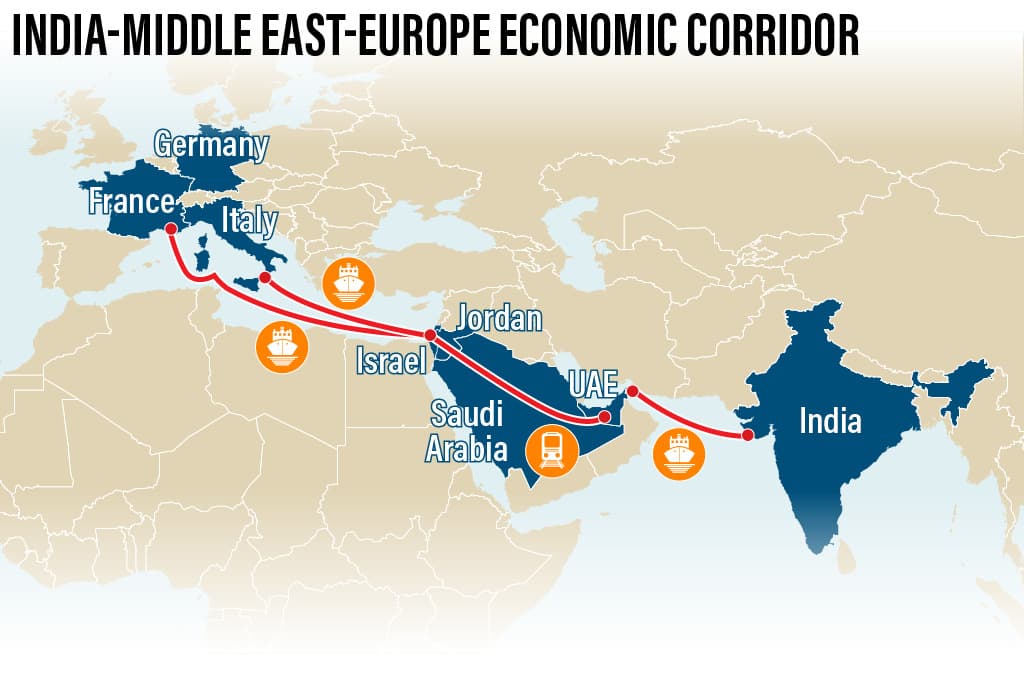
At the first India–Egypt Strategic Dialogue in New Delhi, Egypt’s Foreign Minister Badr Abdelatty said the India–Middle East–Europe Economic Corridor (IMEC) can’t progress without real steps on the Palestinian question—and invited India to plant an Indian industrial zone inside the Suez Canal Economic Zone (SCZONE). Translation: connectivity without conflict-resolution is fantasy; but if peace inches forward, Egypt offers India a ready-made gateway to Europe, Africa, and the Mediterranean.
What Cairo actually signalled (and why it matters)
-
IMEC is geopolitics, not just logistics: Egypt publicly linked corridor progress to Palestinian statehood movement/peace steps, making stability a de-facto precondition to revive the Haifa leg and Gulf–Levant rail plans.
- Offer on the table: An Indian zone in SCZONE, where China and Russia already run dedicated complexes—Egypt wants Indian capital and manufacturing to anchor there.
- Economic urgency for Egypt: War risk in the Red Sea already hit Suez Canal traffic and toll revenue; Cairo wants diversified FDI and supply-chain activity to offset shock.
he geography that makes (or breaks) IMEC
-
Suez = hinge of hemispheres: Every Asia–Europe sea route pinches at Suez + Red Sea choke points; disruptions raise insurance, stretch transit times, and reroute ships around Africa. IMEC’s sea legs still depend on these waters.
-
Haifa is non-optional in the original design: The New Delhi G20 plan runs India→UAE→Saudi→Jordan→Israel’s Haifa→Europe. Gaza war froze the Levant rail/political alignment that connects those dots
- SCZONE is geography turned into policy: Industrial parks on both sides of Suez (Port Said/Ain Sokhna) plug straight into canal traffic and Mediterranean ports—zero last-mile drama compared with a conflict-zone junction.
The economics India should run (quick math)
-
Market reach: From SCZONE, India gets preferential routes into Africa + EU + Arab markets; Delhi’s trade with Africa alone topped $100B in FY25—placing production at Suez cuts shipping time and taps FTAs Egypt has across regions.
- Hedging IMEC risk: Until Gaza cools, SCZONE is the practical “IMEC-lite”: assemble/finish at Suez, ship to EU/MENA while the Haifa node remains politically blocked.
-
Supply-chain resilience: An Indian hub in Egypt diversifies beyond the Gulf and gives redundancy against Red Sea insurance spikes—your plant is next to the canal, not dependent on overland Levant rail.
-
Trade trajectory: India–Egypt trade fluctuated around $5–6B recently, with both sides talking $10–12B medium-term; manufacturing FDI is the lever that gets you there.
How to unstick IMEC (realistic, sequenced playbook)
-
Peace pre-conditions (diplomatic lane): Back Cairo’s mediation to secure humanitarian access, ceasefire frameworks, and a credible political track—even partial movement lowers risk premia and revives investor interest.
- Modular IMEC: Start with India–Gulf–Egypt sea legs + SCZONE rail/port integration now; add the Levant link via Haifa only when the security/political threshold is met.
- Standards + customs first: While tracks are political, soft infrastructure—customs single windows, digital bills of lading, trusted-trader programs—can go live among India–UAE–Saudi–Egypt–EU clusters.
- Risk-sharing finance: Use MDB guarantees and export credit to de-risk early movers into SCZONE; replicate country-specific industrial concessions Egypt gave to China/Russia for an India Park.
- Energy + green lanes: Pair corridor cargo with green fuels (ammonia/methanol) pilots at Suez to align with EU carbon rules and attract European buyers.
Where India can move immediately (no-regret steps)
-
Anchor tenants: Identify 6–8 Indian champions (pharma, specialty chemicals, auto components, renewables, agri-machinery, IT hardware) to co-locate in an India Cluster @ SCZONE with common utilities and bonded warehousing.
- UAE bridge: Leverage CEPA gains with the UAE as the Gulf staging point for parts and financing, then forward-ship to Suez for EU/Africa distribution.
-
Digital + port ops: Deploy Indian logistics tech (port community systems, OCR yard ops) in SCZONE as lighthouse projects—fast wins that improve throughput even before heavy capex.
-
Rules of origin strategy: Structure processing at Suez to qualify for Egypt–EU/Arab trade preferences, reducing landed costs into Europe/MENA.
The bottom line (editorial)
Cairo just called the bluff on “infrastructure without politics.” IMEC’s original map runs through the Levant; until Gaza stabilizes, that line is ink on paper. But Egypt also offered India a workaround: build at Suez now, bank the gains, and keep IMEC modular so the Haifa link clicks back in when diplomacy catches up. For New Delhi, the smart play is twin-track: invest in SCZONE to capture near-term markets, while using India’s credibility with all sides to help midwife the political conditions IMEC ultimately needs. Anything else is brochureware.
With inputs from The Hindu.