

The current legal toolbox (and why it’s not enough)
-
No unified refugee law: India has no statutory definition of “refugee.”
-
Governing laws: Historically the Foreigners Act (1946), Registration of Foreigners Act (1939), and Passport (Entry into India) Act (1920) handled all non-citizens. Since April 2025, a consolidated Immigration and Foreigners Act replaced/subsumed these (including the Immigration (Carriers’ Liability) Act, 2000).
-
Citizenship Act, 1955: Treats undocumented entrants/overstayers as illegal migrants; there is no automatic carve-out for people fleeing persecution.
-
Executive relief & ad-hocism:
-
Tibetans: a 2014 rehabilitation framework.
-
Sri Lankan Tamils: large population but no parallel, codified policy; recent notifications have exempted certain registered Sri Lankan Tamil refugees (who entered on/before Jan 9, 2015) from penal provisions.
-
Other groups (Afghans, Myanmarese, Rohingya) face patchwork treatment—some rely on UNHCR cards; others on short-term visas or local orders.
-
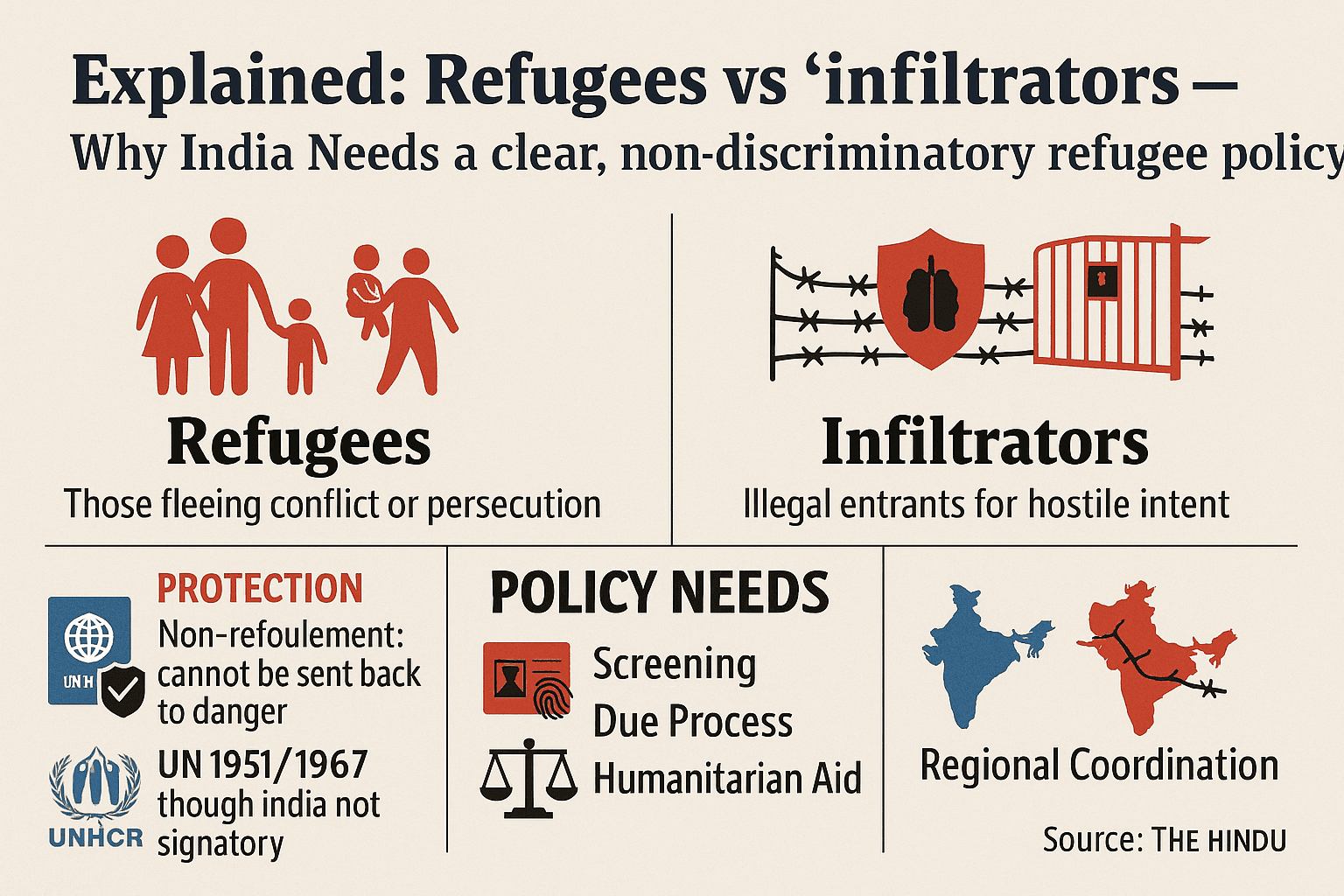
Problem: Without a refugee definition and status procedure, officials must shoehorn protection cases into immigration categories. That invites inconsistency and litigation, and can conflate genuine refugees with security threats.
Refugees vs “infiltrators”: the policy challenge
-
The Minister’s principle—distinguish bona fide refugees from unlawful entrants seeking economic gains or with hostile intent—is legitimate.
-
But making that distinction requires objective, transparent procedures—not ad-hoc discretion. Even in countries with refugee laws, errors occur; without one, the risk of arbitrary outcomes is higher.
International touchstones India already informally follows
-
Non-refoulement (do not return people to risk of persecution)—a customary principle many Indian courts have read into Article 21 (right to life) protections, even though India hasn’t acceded to the 1951 Convention/1967 Protocol.
-
UNHCR’s role in India: Registers some asylum seekers and issues Refugee Status Determination (RSD) decisions that Indian authorities sometimes consider in visa/renewal decisions—still non-binding.
What a fair, security-conscious refugee framework could look like
1) Define and screen
-
Statutory definition of “refugee” (well-founded fear of persecution; add complementary protection for war, generalized violence, disasters).
-
Front-door triage:
-
Identity capture & biometrics, security databases, watch-lists.
-
Credible-fear interviews with trained officers; appeal to an independent tribunal with strict timelines (e.g., 90–120 days).
-
2) Rights & obligations during stay
-
Documentation: Uniform photo-ID with QR verification; renewable.
-
Right to work & study: Limited, sector-notified access to employment and schooling reduces crime risks and dependency.
-
Access to basic services: Primary healthcare, immunisation, legal aid; targeted cash/in-kind support via DBT for the most vulnerable.
-
Movement & residence: Assigned districts/settlements with periodic reporting; permission needed for inter-State travel in sensitive zones.
3) Security safeguards
-
Criminality carve-outs: Deny/withdraw protection for those implicated in serious non-political crimes, terror, war crimes.
-
Continuous vetting: Periodic re-screening; joint intel cells (MHA–State–UNHCR) to flag risks.
-
Detention as last resort: Use alternatives to detention (reporting, guarantors, geo-fencing) for families and vulnerable persons.
4) Durable solutions—time-bound
-
Voluntary repatriation when safe (monitored by independent observers).
-
Local integration (long-term residency/Naturalisation) for protracted caseloads who are self-reliant and pose no risk.
-
Third-country resettlement where available (priority: survivors of violence, stateless persons).
5) Governance & transparency
-
National Refugee & Asylum Authority under MHA with State Refugee Cells.
-
Public dashboard: Monthly stats on arrivals, decisions, approvals/denials, repatriations; anonymised, city/district wise.
-
Parliamentary reporting: Annual white paper—caseloads, costs, incidents, outcomes.
-
Grievance redress: Helpline, legal aid, and fast-track review for wrongful detention/deportation risk.
Benefits of codifying policy
-
Rule-of-law clarity for police, FRROs, and courts; fewer conflicting orders.
-
Faster, safer decisions: security-first screening avoids blanket crackdowns and diplomatic friction.
-
Reduced fiscal leakages: predictable entitlements, better targeting, lower incentives for trafficking/forgery.
-
International credibility: stronger case to seek burden-sharing and development aid in host districts.
Addressing common concerns
-
Demographic anxiety: Cap settlement in pre-notified districts, maintain accurate registries, and plan fiscal transfers to host States.
-
Local job pressure: Allow work permits in shortage sectors; promote self-reliance (microcredit, skills), reduce competition in saturated urban markets.
-
Security threats: The framework explicitly enables exclusion and removal for criminals/terror suspects with judicial oversight.
Bottom line
A non-discriminatory refugee law—with clear definitions, fast screening, work rights, and tough security filters—would let India separate refugees from infiltrators in practice, not just in principle. It protects national security, upholds constitutional values, and replaces ad-hocism with predictable, humane governance.
Source: The Hindu