

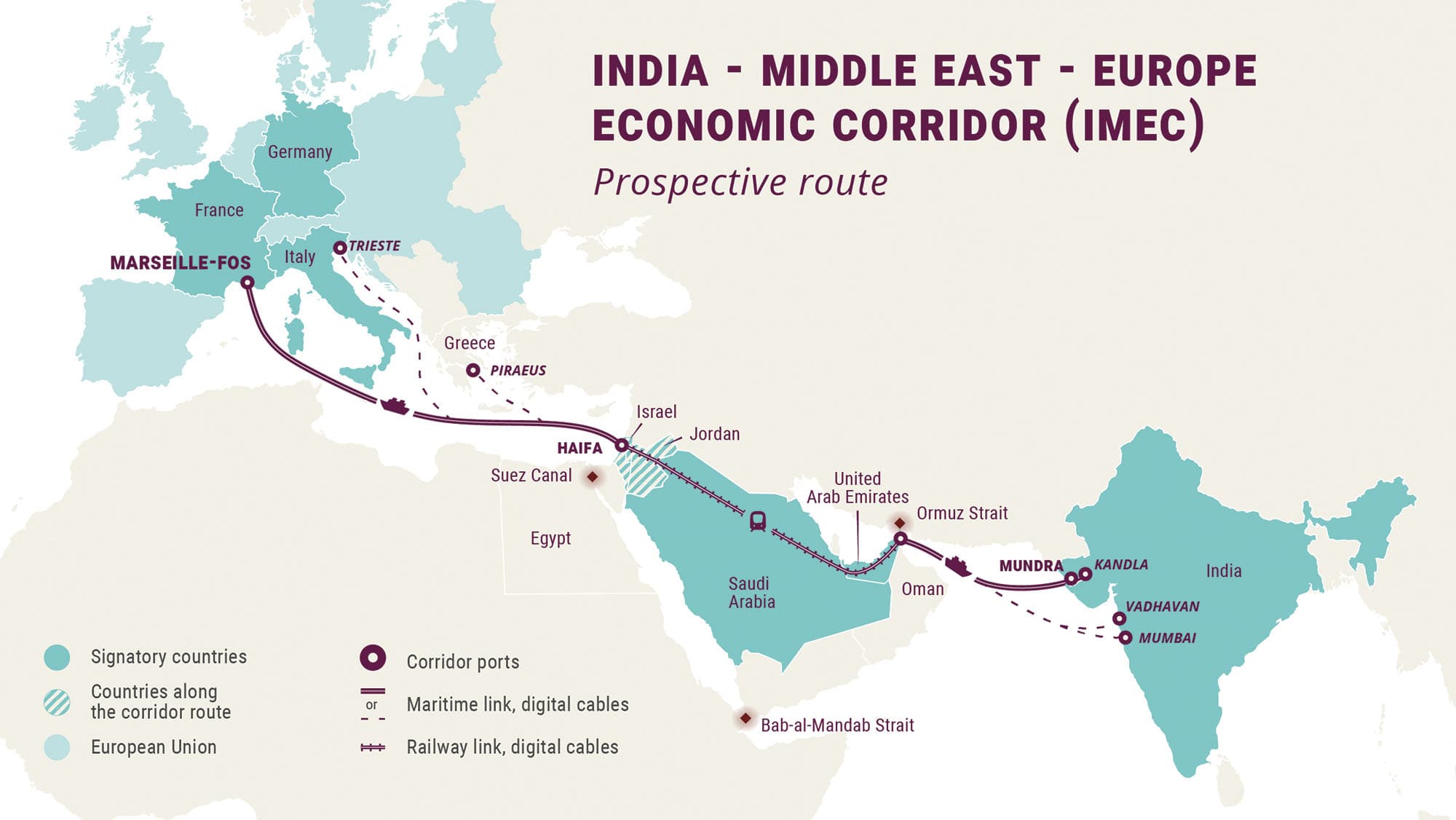
The India–Middle East–Europe Economic Corridor (IMEC) was unveiled as a fast, multimodal bridge from India’s west coast to Europe via Gulf ports and a rail spine to the Mediterranean, topped up with clean-energy and digital links. West Asia’s conflict and Red Sea volatility have complicated the original Haifa-centric route, but they haven’t killed the economics. IMEC can still work—if it becomes modular, adds alternate legs, and front-loads “soft” trade reforms.
Why IMEC still matters (context in brief)
-
EU is India’s largest trading partner; Mediterranean access remains India’s practical door to Europe despite talk of Arctic routes.
-
De-risking China/Suez exposure: A westward option complements INSTC/Chabahar and reduces single-point failure.
-
Beyond cargo: IMEC’s plan for a clean hydrogen pipeline, power interconnector, and subsea data cable diversifies critical infrastructure.
What changed after launch
-
Security shock: Post-Oct 2023 conflict strained Arab–Israeli normalisation, making cross-border rail the weakest link.
-
Maritime risk pricing: Houthi disruptions pushed traffic round the Cape of Good Hope, raising time and insurance costs.
-
Mediterranean stakes: Italy/France see IMEC as key to preserving southern European logistics relevance.
Route adaptations (practical options)
-
Dual Mediterranean legs
-
Primary (when feasible): UAE → Saudi → Jordan → Haifa → EU short-sea.
-
Alternate: UAE/Saudi → Egypt (Jeddah/Ain Sokhna/Alexandria) → Piraeus/Marseille/Trieste by short-sea.
-
-
Port redundancy in the Gulf: Distribute capacity across Jebel Ali, Khalifa, Dammam, Jeddah, Neom/Oxagon, supported by dry ports/ICDs.
-
Phased build-out
-
Phase 1: Maritime upgrades + customs digitisation + trusted trader programs.
-
Phase 2: In-kingdom rail/road feeders and inland logistics parks.
-
Phase 3: Cross-border rail once politics stabilises; then hydrogen/power/data trunk assets.
-
“Soft” infrastructure first (fast wins)
-
Single-window customs, e-BL/e-CMR, AEO expansion, mutual recognition of standards.
-
Port community systems & 24x7 clearances to shave days off transit without laying new track.
Financing & governance (to crowd in capital)
-
Blended finance: Sovereign/MDB loans + private equity; availability payments and minimum-throughput contracts.
-
High standards: ESG, labour, open-access rules to unlock EU money.
-
Security by design: Joint maritime tasking, cyber-hardening of ports/rail, insurance pools for conflict/piracy risk.
-
Trip-wires: Pre-agreed political/security KPIs that pause capex instead of stranding it.
Near-term India playbook
-
Upgrade west-coast gateways: JNPA/Mundra/Vizhinjam + rail to ICDs; reduce dwell times.
-
Pilot loops now: Time-tabled India–UAE–Egypt–EU services with guaranteed berths and digitised paperwork to prove time/cost gains.
-
Lock rules in FTAs: Use India–EU and India–GCC tracks for RoO, standards, data/DPIs, logistics cooperation.
-
Seed the add-ons: Bilateral pilots for green hydrogen offtake, power links, subsea cable on de-risked legs.
Risks to watch
-
Prolonged Israel–Arab chill delaying cross-border rail.
-
Insurance spikes from Red Sea events.
-
Fragmented standards creating friction at borders.
-
Over-reliance on one port/route (hub congestion risk).
Bottom line (UPSC-ready takeaway)
IMEC’s core logic—shorter, diversified India–Europe connectivity with clean-energy and digital backbones—remains sound. Treat it as a network, not a line: build redundancy via Egypt/Saudi legs, deliver quick “soft-infra” wins, and phase hard assets with security triggers. That is how a G-20 announcement becomes a corridor that works in bad weather as well as good.
Source: The Hindu