

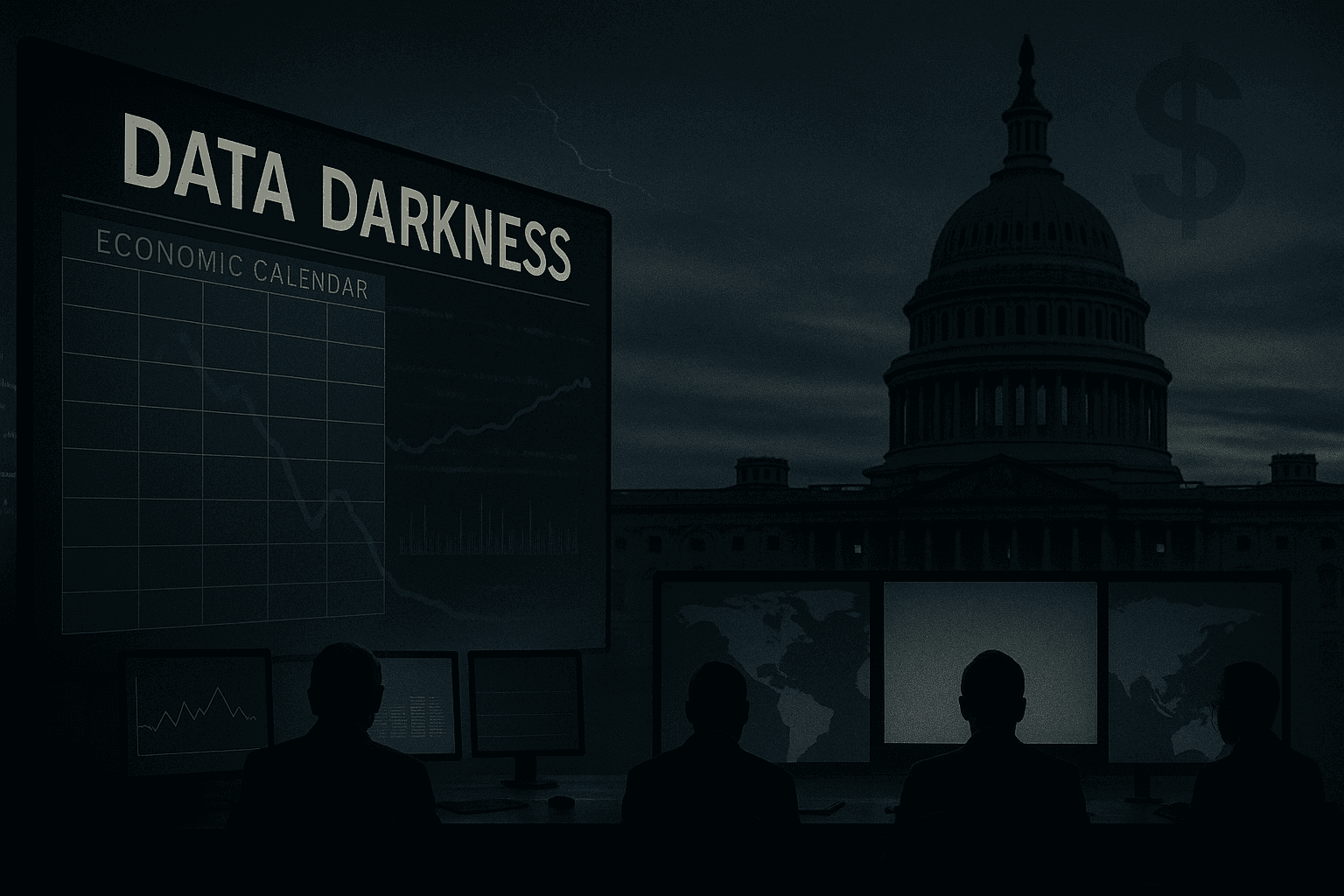
When Washington goes “data dark,” it doesn’t just blind American analysts. Central banks from Tokyo to London lose timely signals on growth, jobs, prices, and trade in the world’s largest economy. The immediate pain is workable, but the deeper worry is institutional: politicised statistics, pressure on the Fed, and eroding trust that ripples through currencies, reserves, and global policy choices.
What’s actually “dark” — and what isn’t
-
Interrupted: Official, high-frequency U.S. series (e.g., payrolls, CPI/PPI, retail sales, housing starts) published by shuttered departments.
-
Still available: Fed surveys (self-funded), private high-frequency trackers (card spending, mobility, job postings), some market-based gauges (breakevens, yields).
-
Why it matters: These releases anchor models worldwide (nowcasting GDP, inflation expectations, output gaps). Gaps raise forecast error and policy-lag risks.
The deeper risk (beyond one shutdown)
-
Institutional trust: Political interference in statistics (e.g., pressuring agencies, firing officials) undermines credibility of data that central banks and markets treat as baseline truth.
-
Policy independence: Attempts to influence the Federal Reserve threaten the “data-dependent” framework; if data or its interpretation is suspect, guidance loses meaning.
-
Dollar dominance over time: Confidence shocks are slow-burn—like “termites.” Reserve managers diversify at the margin; liquidity and network effects still favour the dollar, but risk premia can creep up.
How this hits global decision-making
-
Central banks: Wider forecast bands → cautious rate paths; higher odds of pro- or counter-cyclical mistakes.
-
FX & reserves: Short-term volatility around U.S. prints diminishes; medium-term hedging against governance risk increases (a nudge toward reserve diversification, gold).
-
Trade & capex: Firms delay orders/investment when U.S. demand signals blur; supply chains price in wider delivery and financing spreads.
What India should do (practical playbook)
-
Nowcasting redundancy
-
Blend satellite exports, GST e-way bills, UPI volumes, port turnarounds, power demand, card/FASTag data; stress-test models for missing U.S. inputs.
-
-
Exposure mapping
-
Sector-wise heatmap of U.S. demand dependence (IT, pharma, textiles, auto components) and dollar funding needs; pre-arrange hedges.
-
-
Reserves & liquidity
-
Maintain robust FX cover; diversify at the margin (duration laddering, gold share, multi-currency swaps) without signalling abrupt de-dollarisation.
-
-
Trade de-risking
-
Accelerate EU/UK FTAs, expand Gulf/Africa lanes; pilot IMEC/INSTC legs to cut transit risk.
-
-
Data governance at home
-
Statutory protections for Indian statistical agencies; predictable release calendars; independent oversight to avoid the very credibility risks worrying markets.
-
What to watch next
-
Shutdown duration and backlog treatment (are missed releases revised or skipped?).
-
Fed communications: Do minutes/outlooks lean more on private proxies and market signals?
-
IMF/WB messaging: Any escalation from “risk” language to concrete conditionality on data governance.
-
Market behaviour: Reserve managers’ gold buys, bid-ask spreads in U.S. rates around data resumption, and cross-currency basis moves.
Bottom line
A brief data outage is a nuisance; doubts about U.S. institutional reliability are a systemic risk. For the world—and India—the hedge is better redundancy in models, diversified market access, strong domestic data integrity, and steady reserves management. Confidence is a macro fundamental; once eroded, it is costly to rebuild.
Source: The Hindu