

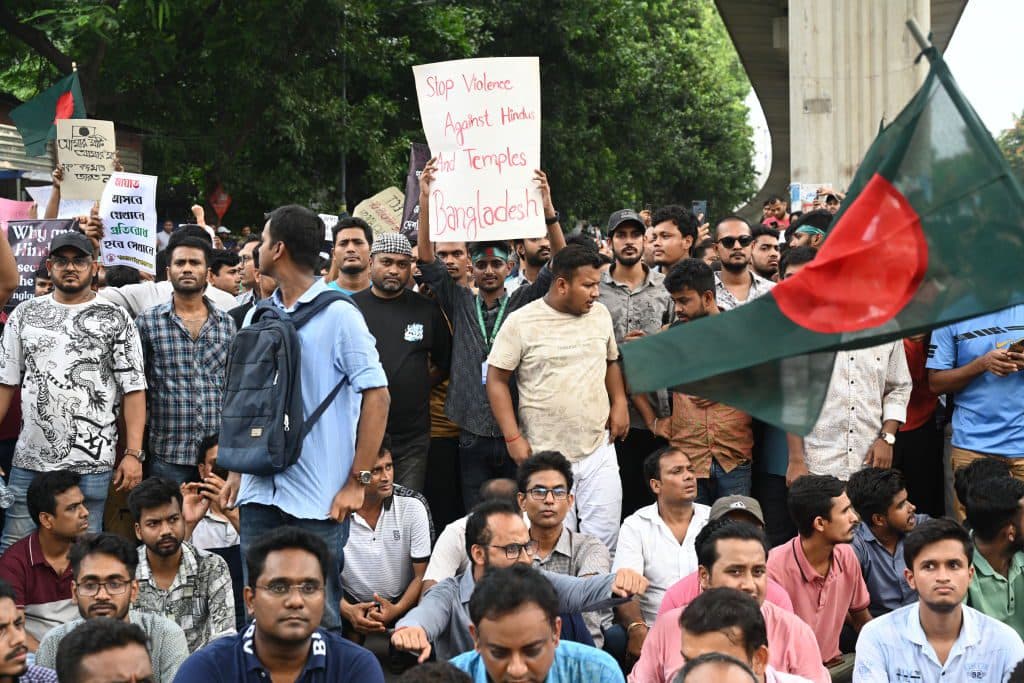
India has accused Pakistan and Bangladesh of systematic abuse of marginalised communities in Pakistan-occupied Kashmir and the Chittagong Hill Tracts, citing human rights violations, resource exploitation, and violent crackdowns, while rejecting Dhaka’s allegations of Indian involvement.
The News
India on Friday accused Pakistan and Bangladesh of systematic oppression of marginalised populations in Pakistan-occupied Kashmir (PoK) and the Chittagong Hill Tracts (CHT), respectively.
Responding to reports of police firing, internet shutdowns, and protests in Muzaffarabad, Ministry of External Affairs (MEA) spokesperson Randhir Jaiswal said Pakistan’s “oppressive approach and systemic plundering” of resources had caused unrest.
“Pakistan must be held accountable for its horrific human rights violations,” Jaiswal stated, linking the protests in PoK to deep-rooted economic exploitation and denial of autonomy.
Simultaneously, India rejected allegations by a Bangladesh interim government adviser that New Delhi was aiding protesters in the CHT.
“These are false and baseless. The interim government, unable to maintain law and order, routinely shifts blame elsewhere,” Jaiswal said.
He urged Dhaka to investigate violence against indigenous Marma and Mog communities, which erupted after alleged killings by Bangladeshi Army personnel last week.
1. The Situation in Pakistan-Occupied Kashmir (PoK)
Background
PoK refers to territories under Pakistani control since the 1947–48 war, comprising “Azad Jammu & Kashmir” (AJK) and Gilgit-Baltistan. India regards the entire region as part of its sovereign territory under Article 1 of the Indian Constitution and Parliament’s 1994 resolution.
Current Protests
-
Led by the Awami Action Committee (AAC) in Muzaffarabad.
-
Demands: subsidised food, lower electricity tariffs, free education and healthcare, and greater political reforms.
-
Reports indicate police firing, internet suspension, and at least 10 deaths, according to Dawn.
-
Protests are viewed as expressions of frustration against resource exploitation, where electricity generated in PoK is sold to Pakistan’s heartland at high profits, while locals face shortages and high tariffs.
India’s Stand
India calls the crisis a result of “systemic plundering” by Pakistan. It reiterates that:
-
Islamabad has denied the region democratic rights.
-
Resources are diverted without local consent.
-
The unrest highlights internal instability under Pakistan’s control.
India’s statements also seek to underscore the contrast with Jammu & Kashmir, where post-Article 370 reforms aim to strengthen democratic and development processes.
2. The Situation in Bangladesh’s Chittagong Hill Tracts (CHT)
Background
-
The CHT region, bordering India and Myanmar, is home to 11 indigenous ethnic groups — including Chakma, Marma, and Mog communities.
-
It has long sought autonomy and protection of land rights.
-
In 1997, the CHT Peace Accord was signed between the Bangladesh government (under Sheikh Hasina) and the Parbatya Chattagram Jana Samhati Samiti (PCJSS), ending two decades of insurgency.
Recent Unrest (2025)
-
On October 1, violence erupted after reports that Bangladesh Army personnel killed three indigenous civilians in Khagrachhari district.
-
Protesters allege land grab, militarisation, and cultural erasure.
-
The interim Bangladeshi government accused “India and fascist groups” of inciting unrest to disrupt Durga Puja, a major Hindu festival.
India’s Response
India dismissed the charge, calling it an attempt to divert attention from Dhaka’s governance failures.
“Instead of blaming others, the government should probe extremist violence and land grab against minorities,” the MEA said.
New Delhi’s statement mirrors growing unease with Dhaka’s interim regime, which replaced Sheikh Hasina’s government amid political unrest in August 2025.
3. Historical and Political Context
India–Pakistan–PoK Dynamics
-
The 1947 Partition and first Kashmir war led to Pakistan occupying about one-third of Jammu & Kashmir.
-
The Karachi Agreement (1949) created separate administrations for AJK and Gilgit-Baltistan.
-
Over decades, PoK residents have complained of disenfranchisement, lack of infrastructure, and resource extraction.
-
The China–Pakistan Economic Corridor (CPEC) runs through Gilgit-Baltistan, drawing India’s objections over sovereignty violations.
India–Bangladesh and the CHT Question
-
India played a pivotal role in Bangladesh’s 1971 Liberation War but relations periodically fluctuate.
-
India has cultural and ethnic linkages to the CHT’s Chakma and Buddhist communities, some of whom migrated to India’s Tripura and Mizoram after the 1980s violence.
-
The current turmoil exposes the unfinished implementation of the 1997 Peace Accord, which promised autonomy and withdrawal of military camps.
4. Human Rights and International Law Dimension
Both issues — PoK and CHT — touch upon minority rights, resource justice, and self-determination:
-
In PoK, denial of autonomy and exploitation of hydroelectric and mineral resources violate the ICCPR (International Covenant on Civil and Political Rights).
-
In CHT, forcible evictions and demographic engineering breach the UN Declaration on the Rights of Indigenous Peoples (UNDRIP, 2007).
India’s statements, while politically charged, are framed within the language of human rights advocacy, turning global scrutiny back on its neighbours.
5. Strategic Implications for South Asia
-
Diplomatic Signalling:
-
India’s sharp tone reflects a post-Assad shift in regional assertiveness, aiming to reclaim narrative leadership on rights and governance.
-
-
Regional Stability:
-
Both PoK and CHT border Indian territory — instability there poses security and refugee concerns for India’s northern and northeastern states.
-
-
Domestic Parity:
-
The remarks allow India to highlight contrasts: democratic institutions and elections in Jammu & Kashmir versus unrest and suppression in Pakistan-controlled regions.
-
-
Bangladesh Equation:
-
The interim regime’s allegations hint at growing fragility in Dhaka–New Delhi ties, once considered the cornerstone of India’s Act East policy.
-
6. The Way Forward
-
For Pakistan: Address local grievances in PoK through genuine political dialogue, resource-sharing, and demilitarisation.
-
For Bangladesh: Fully implement the CHT Accord, protect indigenous rights, and ensure transparency in military actions.
-
For India: Continue highlighting cross-border human rights violations through UN forums while maintaining engagement with Dhaka to prevent alienation.
-
For the Region: Build cooperative frameworks on border peace, migration, and minority protection under SAARC and BIMSTEC platforms.
Conclusion
India’s twin accusations against Pakistan and Bangladesh mark an assertive turn in its neighbourhood diplomacy — linking human rights to strategic discourse.
In PoK, Islamabad’s economic exploitation has triggered internal revolt; in CHT, Dhaka’s governance failures have revived old ethnic wounds.
While the statements are diplomatic, the subtext is geopolitical: India is positioning itself as a regional voice for accountable governance, contrasting its model of inclusion and federal reform against its neighbours’ crises.
Whether these claims lead to dialogue or deepen divisions will depend on how South Asia’s fragile democracies confront the tension between territorial control and human dignity.