

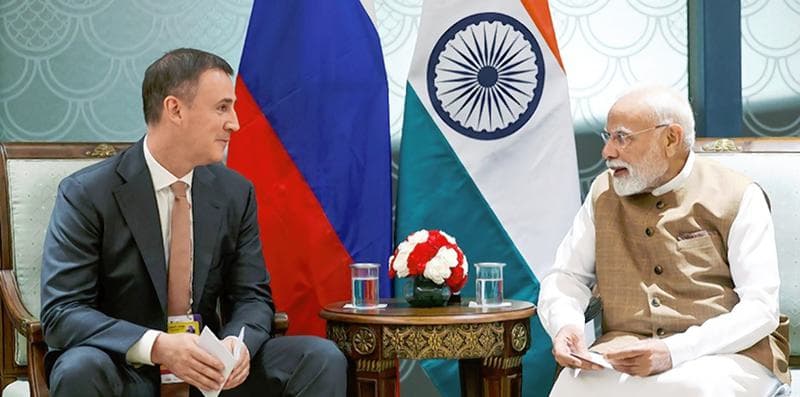
Prime Minister Narendra Modi on 25 September 2025 met Russian Deputy Prime Minister Dmitry Patrushev in New Delhi and discussed creating a BRICS agricultural grain exchange to strengthen trade ties among member countries. The meeting took place on the sidelines of the World Food India 2025 programme.
The Story
Mr. Modi conveyed greetings to Russian President Vladimir Putin and said he looks forward to hosting him for the 23rd India-Russia annual summit later this year. “Happy to meet Russia’s Deputy Prime Minister Dmitry Patrushev at the World Food India 2025. We discussed ways to strengthen our win-win cooperation in agriculture, fertilizers and food processing,” the Prime Minister said in a post on X.
The Russian Embassy confirmed that the two sides reviewed progress on a Free Trade Agreement (FTA) between India and the Eurasian Economic Union. The idea of a BRICS Grain Exchange was also raised. Such a platform would aim to facilitate smoother agricultural trade flows, price discovery, and reduce dependence on Western-dominated commodity markets.
Mr. Patrushev underlined the depth of bilateral relations. “Russia highly values its special and privileged partnership with India. India is one of Russia’s key allies in the international arena. Every year, Russian-Indian economic cooperation reaches impressive levels. In 2024, the trade turnover between our two countries reached a historic high,” he said.
Why It Matters
-
Food security: A BRICS Grain Exchange could help member countries — Brazil, Russia, India, China, and South Africa — secure stable supplies of wheat, rice, and other staples.
-
Trade diversification: It may reduce reliance on Western financial systems and commodity benchmarks dominated by Chicago and London exchanges.
-
India-Russia ties: Agricultural trade complements energy and defence, expanding cooperation amid Western sanctions on Russia.
Background / Context
-
India-Russia trade: Bilateral trade hit a record high in 2024, with energy, fertilizers, and agricultural commodities driving growth.
-
BRICS agenda: At recent BRICS summits, members have pushed for creating independent financial and commodity mechanisms to reduce vulnerability to Western markets.
-
Eurasian FTA: Negotiations are ongoing between India and the Eurasian Economic Union (Russia, Belarus, Kazakhstan, Armenia, Kyrgyzstan) to expand trade access.
Implications
-
For farmers: Could provide more predictable export markets and better price stability.
-
For governments: Enhances bargaining power in global food markets by pooling demand and supply.
-
For BRICS: Strengthens the grouping’s role as an economic bloc, adding agriculture to energy and finance cooperation.
Conclusion
The discussion on a BRICS Grain Exchange reflects India and Russia’s intent to deepen agricultural trade ties and reduce dependence on Western-led markets. If implemented, it could reshape food trade among emerging economies and bolster the BRICS agenda of greater economic self-reliance.