

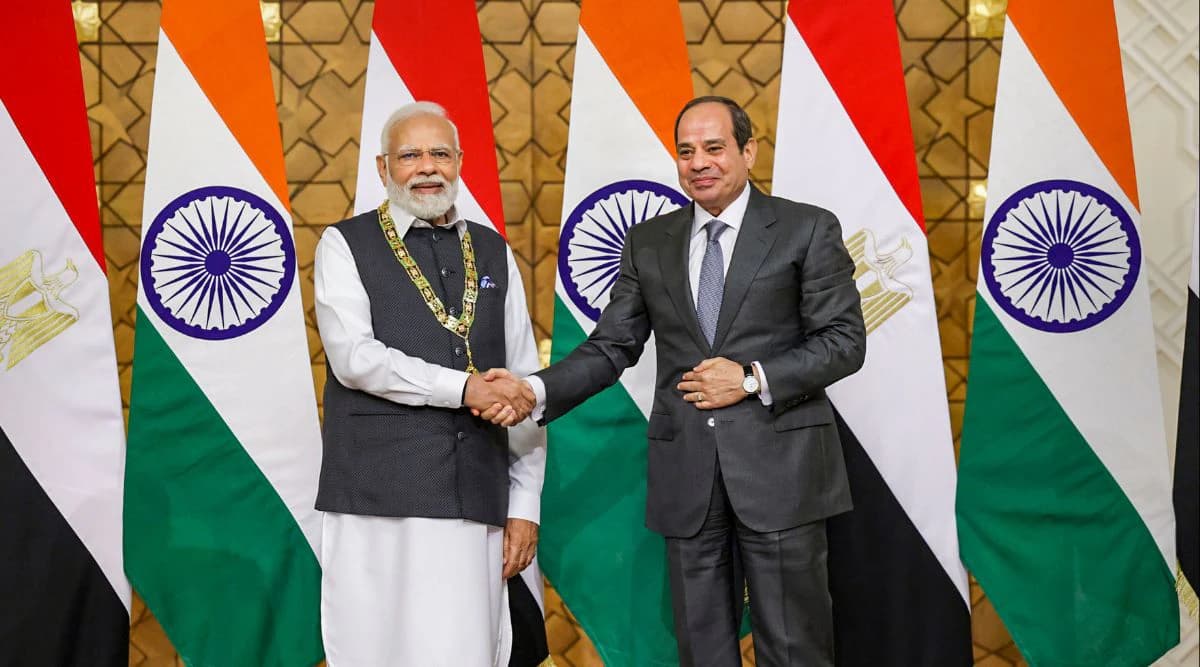
New Delhi will not be at the Gaza Peace Summit at the Head-of-Government level; instead, Minister of State Kirtivardhan Singh is flying to Sharm el-Sheikh for a fast-moving round of diplomacy that seeks to lock in a ceasefire, prisoner exchanges, and early steps on Gaza’s reconstruction. The decision preserves India’s seat at the table while keeping scheduling and protocol risks low.
In the news
More than 20 leaders are expected at the Sharm el-Sheikh “Summit for Peace,” co-hosted by Egypt and the U.S., to witness or finalise a truce framework between Israel and Hamas and to sketch the first phase of reconstruction. While PM Modi received an invitation conveyed by Egypt’s Ambassador, he declined on grounds of short notice. Separately, Egypt’s Foreign Minister Badr Abdelatty will be in Delhi for the India–Egypt Strategic Dialogue, his first visit since taking office, to brief on Gaza plans and advance bilateral priorities.
Why it matters for India
1) Stake in regional stability
India has citizens, energy, shipping, and diaspora exposure across West Asia. A durable Gaza ceasefire lowers risk premia on energy and maritime routes and reduces spillover security risks.
2) Balancing ties
New Delhi has cultivated deep strategic ties with Israel, while sustaining historic support for Palestinian welfare and statehood through development aid and UN positions. A minister-level presence signals engagement without over-personalising outcomes at a delicate moment.
3) Egypt as a pivotal partner
Cairo controls the Rafah/ Sinai access and is central to ceasefire logistics and reconstruction corridors. Since the 2023 strategic partnership upgrade, India–Egypt ties span defence production, connectivity, and food security—now layered with Gaza coordination.
4) Connectivity calculus
With security questions around the current IMEC alignment, Egypt is pitching alternative route concepts via Sharm el-Sheikh and the Red Sea rim. India’s long-term logistics strategy benefits from diversifying West Asia–Europe paths.
What India will likely push
-
Humanitarian access + reconstruction: Scalable aid lanes, fuel, hospitals, and a financing template that is politics-aware but delivery-focused.
-
Hostage–prisoner sequencing: Backing a verifiable pathway that stabilises the truce and de-risks sudden reversals.
-
Maritime and cargo safety: Assurances for Red Sea/Eastern Med flows, critical for Indian trade.
-
A balanced text: Language that supports Palestinian civilian relief and future governance steps without prejudging final-status questions.
Egypt FM’s Delhi visit: agenda signals
-
Strategic Dialogue: Defence industry cooperation, counter-terrorism, and joint training.
-
Gaza brief: Operational details on aid corridors and reconstruction governance.
-
Corridor talk: Exploring Egyptian nodes as fallbacks or complements to IMEC, given Haifa-linked uncertainties.
-
Bilateral deliverables: Following up on investments, food-grain logistics, and green energy.
Reading New Delhi’s choice of representation
Sending a Minister of State keeps India engaged while avoiding a last-minute PM-level appearance that could be read as endorsing any unresolved clauses. It also leaves room for calibrated follow-through after Abdelatty’s briefings in Delhi, aligning later high-level visits with concrete outcomes.
What to watch next
-
Truce text and timelines: Scope of prisoner exchanges, verification, and ceasefire monitoring.
-
Reconstruction modality: Who pays, who builds, and how Gaza’s civilian administration is handled to keep aid apolitical but accountable.
-
Corridor conversations: Whether Egypt and India announce working groups on Red Sea–Med alignments and port/rail interfaces.
-
Follow-up optics: Any subsequent PM-level engagement once details harden and domestic calendars permit.
Bottom line
By deputing MoS Kirtivardhan Singh and hosting Egypt’s Foreign Minister days later, India keeps its options open: back a workable ceasefire, shape early reconstruction choices, and quietly advance a redundancy-rich connectivity map—without over-investing political capital before the deal is nailed down.