

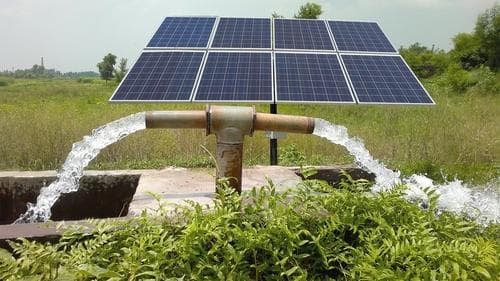
India is preparing to showcase its PM-KUSUM solar irrigation model and the PM Surya Ghar rooftop solar scheme in African and island nations through the International Solar Alliance (ISA). The move, announced by Union Renewable Energy Minister Pralhad Joshi, aligns with India’s growing leadership in South–South energy cooperation and the country’s broader goal of exporting low-cost clean energy solutions to developing economies facing power access challenges.
The Story
Speaking at a curtain-raiser for the 8th ISA General Assembly, Mr. Joshi said, “We are looking to showcase both the PM-KUSUM and PM Surya Ghar programme in countries with poor connectivity—particularly across Africa and small island developing states.”
The ₹34,000-crore PM-KUSUM scheme, launched in 2019, aims to boost solar power in the agricultural sector by enabling farmers to:
-
Install decentralised solar power plants on barren or fallow land.
-
Adopt grid-connected solar pumps to reduce diesel dependence.
-
Use standalone off-grid pumps in remote areas to improve irrigation efficiency.
Initially, the scheme targeted 308 GW of new capacity by 2022, later revised to 348 GW by March 2026, focusing on farm-level decentralised energy independence.
Progress So Far
According to official data (as of September 30, 2025):
-
Standalone solar pumps: 70% of the target (12.25 lakh of 17.5 lakh units) installed — the most successful component so far.
-
Decentralised renewable plants: Only 6% completion.
-
Grid-connected solar pumps: Around 16–25% progress.
While delays persist due to supply chain issues and financing constraints, India plans to use ISA partnerships to replicate the standalone pump model abroad, especially in Sub-Saharan Africa, where 600 million people still lack grid access.
Why It Matters
The initiative reinforces India’s role as a clean energy knowledge exporter and a voice for the Global South. By promoting farm-level solar autonomy, it addresses multiple Sustainable Development Goals (SDGs):
-
SDG 7 (Affordable and Clean Energy): Expands access to reliable, renewable power.
-
SDG 13 (Climate Action): Cuts diesel use and agricultural carbon emissions.
-
SDG 2 (Zero Hunger): Improves irrigation reliability and farm productivity.
For island nations and African economies, solar pumps are game-changing—providing energy-water-food security without costly grid extensions.
The International Solar Alliance (ISA) Platform
Founded jointly by India and France in 2015, the ISA now includes over 120 member countries. It serves as a global coalition to:
-
Facilitate solar infrastructure financing.
-
Develop policy toolkits and capacity building.
-
Support pilot installations of Indian-developed renewable systems.
At the upcoming 8th ISA General Assembly, India will highlight PM-KUSUM as a scalable and affordable model for smallholder farmers in developing nations.
Challenges and Road Ahead
-
Financing & Maintenance: High upfront costs and lack of credit access for small farmers limit uptake.
-
Technology Absorption: Many African regions require capacity building to maintain and repair solar systems.
-
Policy Replication: Each target country must adapt KUSUM’s cooperative-financing model to its own governance and energy landscape.
India is expected to leverage EXIM Bank, ISA’s Solar Technology Fund, and multilateral partnerships to enable pilot projects under a “Solar Pumps for Prosperity” initiative.
Broader Implications
-
For India’s Energy Diplomacy: Strengthens India’s credentials as a global clean-energy partner and ISA’s de facto leader.
-
For Farmers: Boosts agricultural income and cuts input costs by replacing diesel.
-
For Global Climate Policy: Demonstrates how decentralised solar can power sustainable rural economies without grid expansion.
Conclusion
By internationalising PM-KUSUM, India is turning a domestic renewable success story into a tool for global solidarity. The vision—solarising agriculture to empower farmers—now extends from Indian villages to African plains and Pacific islands, carrying both climate pragmatism and development diplomacy at its core.
Credit: Reporting inputs adapted from The Hindu.