

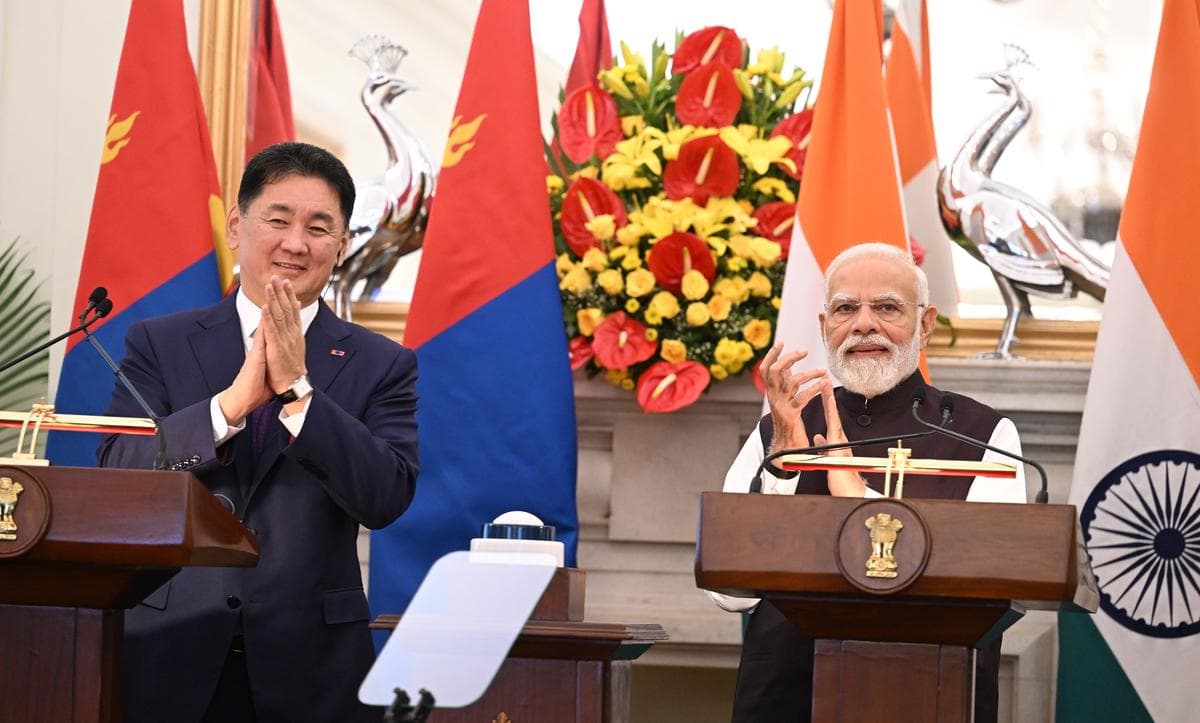
India is deepening ties with Mongolia on security and soft power in one sweep: military training and a new Defence Attaché on the one hand; free e-visas and a high-profile Buddhist relics tour on the other. The package signals a broadened relationship that goes beyond symbolism into steady capacity-building.
In the news
Prime Minister Narendra Modi welcomed President Khurelsukh Ukhnaa and announced:
-
A capacity-building programme for Mongolia’s border security forces.
-
Appointment of a Defence Attaché at India’s Embassy.
-
Free e-visas for Mongolian citizens.
-
The holy relics of Sariputra and Maudgalyayana to travel to Mongolia next year.
-
10 MoUs covering immigration, humanitarian aid/disaster response, geology & mineral resources, and yoga.
Why it matters
1) Strategic geography
Mongolia sits between Russia and China. For India, sustained training links and defence exchanges create a quiet but durable presence in Northeast/Central Asian security networks without alliance politics.
2) Border force training
Border agencies sit at the frontline of transnational threats—smuggling, wildlife crime, illegal mining logistics, and disaster response in extreme climates. Indian training (patrol tactics, surveillance, communications, HADR, peacekeeping standards) can be tailored to Mongolia’s vast, low-population borders.
3) Minerals & clean energy chain
MoUs on geology/minerals align with India’s search for critical minerals (e.g., copper, rare earths, coking coal). Training and trust on the security side can facilitate safer exploration logistics and project protection.
4) Soft power and mobility
Buddhist relics and visa-free e-entry amplify people-to-people ties, academic exchanges, and tourism—helpful for air-connectivity pilots and cultural corridors.
How defence cooperation could evolve
-
Courses & joint exercises: High-altitude survival, desert mobility, convoy protection, and UN peacekeeping modules.
-
Tech-lite enablers: Border mapping/GIS, night-ops equipment familiarisation, and interoperable radio protocols.
-
Institutional links: Staff-college seats, language training, and regular Attaché-led working groups.
The MoUs: what they unlock
-
Immigration & e-visas: Smoother travel for students, pilgrims, and business.
-
Humanitarian aid/DRR: Pre-agreed standard operating procedures for disaster relief (Mongolia’s dzud winters), warehousing, and medical teams.
-
Geology/minerals: Joint surveys, standards, and possible downstream processing tie-ups.
-
Yoga & culture: Low-cost, high-visibility outreach that reinforces the Buddhist civilisational thread.
What to watch next
-
Training calendar and the first cohorts of Mongolian border personnel in India.
-
Follow-on minerals projects (JV surveys, offtake agreements).
-
Direct air links/charter corridors tied to the relics tour and e-visa uptake.
-
A tri-sector pipeline: defence training → minerals logistics → cultural/education exchanges.
Bottom line
By pairing hard-edge capacity building with civilisational soft power and practical mobility measures, New Delhi and Ulaanbaatar are converting a friendly relationship into an operational partnership with payoffs in security, minerals, tourism, and trust.
Source: The Hindu