

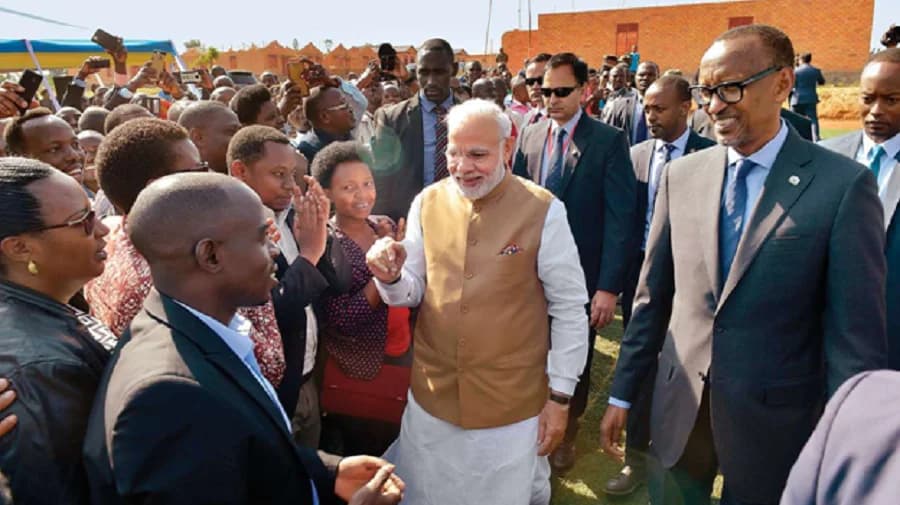
India and Africa share a relationship with history, warmth and political solidarity — but the next decade will judge relationships by outcomes, not nostalgia. If India wants to be a decisive economic power, Africa cannot remain a “promising frontier” in speeches while exports, investments, shipping lines and project finance remain slow on the ground. The uncomfortable truth is this: India is liked in Africa, but it is not yet embedded in Africa’s industrial future at the scale it aspires to be. China’s manufacturing-heavy exports, aggressive logistics integration, and project execution have already carved a deep groove. India’s advantage lies elsewhere — trust, affordability, medicines, digital capacity, skills, and a partnership style that can feel less extractive. But advantage becomes impact only when it is institutionalised.
What’s in the news
-
India’s renewed Africa outreach has been reinforced through recent high-level engagements, alongside the African Union’s enhanced global representation.
-
India has publicly articulated a larger trade ambition with Africa and has highlighted avenues beyond traditional commodity flows: manufacturing, services, digital trade, and connectivity.
Background and context
Why Africa matters more now than before
Africa is no longer a “future market”; it is a present-day arena of:
-
fast urbanisation and consumer demand,
-
industrial policy and regional trade integration (AfCFTA),
-
a global contest over ports, standards and supply chains,
-
critical minerals and energy transition value chains,
-
and digital leapfrogging (payments, identity, public service delivery).
At the same time, India’s export concentration in the U.S. and EU exposes it to slowdown risk and regulatory volatility. Africa offers diversification — not as a charity destination, but as a growth partner.
The China comparison India must face — without insecurity
China’s lead in Africa is not just about money; it is about industrial composition and logistics. When a large share of Africa-bound imports are machines, electrical equipment, and industrial inputs, it creates dependency and ecosystem lock-in. India cannot out-China China by mimicry. India must compete by selective strength: pharmaceuticals, affordable engineering, digital services, agriculture value chains, renewables, skills, and credible finance.
The real five-pillar strategy — and the missing sixth pillar
The article’s five pillars are directionally strong. But India needs one more: execution architecture.
Pillar 1: Trade facilitation and smart agreements
Preferential trade arrangements and regional engagement matter — but India must avoid negotiating purely with tariff templates. The practical focus should be:
-
standards alignment (pharma, food, engineering),
-
customs interoperability,
-
mutual recognition for professional services,
-
and predictable dispute mechanisms.
Hard reality: African regional blocs are diverse; one-size agreements will stall. India needs modular, sector-first pacts.
Pillar 2: Joint manufacturing, not just exporting
India’s exports to Africa still lean heavily on petroleum products and traditional items. The next leap requires:
-
joint ventures in agro-processing, light engineering, assembly and packaging,
-
industrial parks and plug-and-play units where African governments are offering incentives,
-
and “Made in Africa with Indian partners” supply chains that create local jobs.
The strategic prize: Local manufacturing also strengthens political legitimacy and reduces backlash against “import-only” partners.
Pillar 3: Trade finance for MSMEs — the neglected battlefield
Africa is where Indian MSMEs can actually compete — but they lose deals because:
-
credit is expensive,
-
political risk feels uninsurable,
-
payment cycles are uncertain,
-
and documentation is heavy.
India should treat trade finance as strategic infrastructure:
-
simpler access to Lines of Credit for smaller firms,
-
faster disbursal windows,
-
and practical risk coverage (political + commercial).
Opinionated point: Without a credible risk umbrella, “MSME opportunity” remains a brochure line.
Pillar 4: Logistics and maritime corridors — the silent deal-maker
Trade competitiveness is often decided by freight costs, port dwell time and routing reliability. India–Africa commerce needs:
-
predictable maritime lanes and trans-shipment strategy,
-
port partnerships,
-
better hinterland connectivity to African production centres,
-
and faster cargo processing on India’s side too.
Hard reality: Logistics reform is slow, but it is the one lever that benefits every sector at once.
Pillar 5: Services and digital trade — India’s natural advantage
India’s strongest comparative edge is not steel; it is software, systems and skills:
-
IT and cybersecurity services,
-
health services and affordable pharma ecosystems,
-
education and skilling partnerships,
-
digital public infrastructure-style solutions adapted to African contexts.
The caution: India must avoid exporting “templates” and start co-designing “platforms” with African states and firms, respecting sovereignty and local data governance.
The missing Pillar 6: Execution architecture (the difference between intent and impact)
India’s biggest gap in Africa is not ambition; it is delivery capacity at scale. What’s needed:
-
a dedicated India–Africa project and trade facilitation “war-room” that aligns MEA, Commerce, EXIM, shipping, and industry bodies,
-
standardised contract toolkits for African projects,
-
credible local legal and compliance support for Indian firms,
-
and an on-ground ecosystem of Indian and African chambers working like deal-closers, not seminar hosts.
Plain truth: Africa rewards partners who show up with solutions, financing, and after-sales support — not just MoUs.
Why it matters
1) Supply chains are being rewritten
As the world searches for “China+1” and resilient sourcing, Africa will become a manufacturing and processing destination. India can either be a first-mover partner — or a late entrant buying finished outcomes.
2) Energy transition will shift trade maps
Critical minerals, renewables, grid equipment, and green hydrogen corridors will redefine geopolitics. India’s Africa strategy must be industrial, not episodic.
3) India’s Global South credibility will be judged in Africa
A partnership narrative must translate into:
-
jobs created locally,
-
technology transferred responsibly,
-
and financing delivered transparently.
Arguments for and against a bigger India–Africa push
The case for pushing harder
-
Market diversification beyond Western uncertainty.
-
Strong complementarity: India’s affordable manufacturing + Africa’s resources and demand.
-
India’s services edge can unlock high-value ties with lower carbon intensity.
-
Strategic depth in the Indian Ocean and maritime stability.
The case for caution
-
Political instability risks and project disruption.
-
Financing costs can make Indian bids uncompetitive.
-
Bureaucratic delays and risk aversion among Indian firms.
-
The Mauritius-routing issue can inflate investment figures and weaken credibility if not cleaned up.
What India should do now — practical steps and hard constraints
Practical, India-ready moves
-
Build a joint risk-insurance pool for medium-term projects so MSMEs and banks can participate with confidence.
-
Create “Africa-ready” product and standards support for pharma, food, and engineering exporters.
-
Deploy sector-specific anchor projects (one each in health, digital governance, agro-processing, renewables) to create demonstration effects.
-
Use PSU strength strategically in mining, minerals, logistics and energy — with transparency and local value addition.
-
Scale skills partnerships linked to actual industry demand, not generic training.
Challenges India must be honest about
-
Fragmented coordination across ministries and financing institutions.
-
Limited on-ground commercial presence compared to competitors.
-
Risk perception and slow dispute resolution in some markets.
-
Domestic logistics and manufacturing competitiveness gaps that still need improvement.
Way ahead
India’s best Africa strategy is not to imitate China or compete on spectacle. It is to offer a partnership that is:
-
value-adding (local jobs, local industry, local capabilities),
-
finance-smart (de-risked, faster, MSME-friendly),
-
services-led (digital, health, education, professional services),
-
and maritime-connected (reliable corridors and lower logistics costs).
If India gets this right, Africa becomes not just a market, but a co-author of India’s economic rise — a partnership where growth is shared, and trust is converted into trade that lasts.
Source credits : Government of India statements and outcomes on recent Africa engagements; press reports on India–Africa trade and investment; industry and research reports on India–Africa economic cooperation; multilateral commentary on AU’s G20 membership and AfCFTA.