

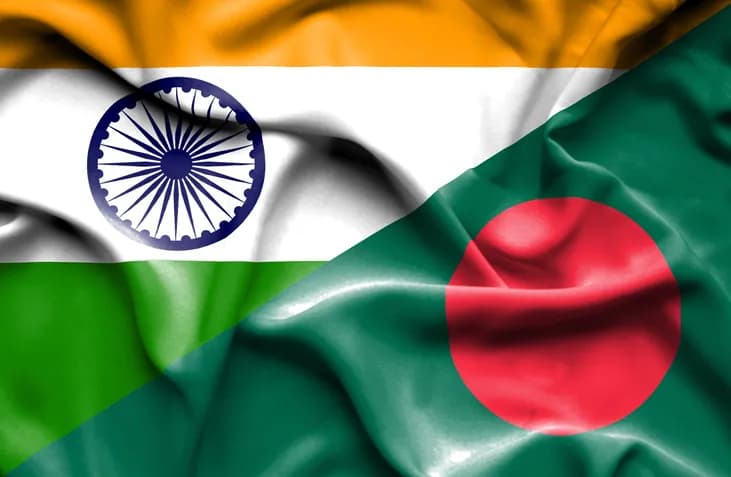
1971: India’s role in Bangladesh’s birth Political & military support: India sheltered ~10 million refugees, trained Mukti Bahini, and fought the December 1971 war that forced Pakistan’s surrender in Dhaka—cementing a foundational bond. Early diplomacy: The 1972 Indira–Mujib Treaty of Friendship set the tone for cooperation on security and development.
The arc since independence: cooperation with caveats
Security & border
-
Insurgency rollback: From the 2000s, Dhaka acted against anti-India insurgents using Bangladeshi soil; Delhi responded with capacity-building and intelligence cooperation.
-
Borders: The 2015 Land Boundary Agreement ended the enclave problem and clarified most of the 4,096-km land border—one of the relationship’s biggest successes.
-
Incidents: Civilian fatalities at the border and smuggling remain political flashpoints that need joint SOPs and non-lethal crowd control.
Water & rivers
-
Ganga water treaty (1996): Stable sharing at Farakka set a cooperative template.
-
Teesta remains unresolved: A domestic-politics knot on the Indian side and dry-season scarcity in North Bengal/Bangladesh keep this alive. Basin-wide management (Teesta–Jaldhaka–Dharla) and storage projects are the way forward.
Trade, transit & connectivity
-
Trade: India is among Bangladesh’s top partners; Dhaka runs a deficit, which surfaces periodically in politics.
-
Transit to India’s Northeast: Riverine, road and rail corridors via Bangladesh cut cost/time dramatically and knit the sub-region.
-
Power & energy: India exports electricity; cross-border transmission and fuel/power logistics (including potential LNG/ammonia chains) deepen interdependence.
-
Standards & finance: Lines of credit fund roads, rail, bridges; customs digitalisation and testing/standards cooperation reduce frictions for Bangladeshi exporters.
People-to-people & culture
-
Students, medical travel, films, tourism and a shared Bengali heritage sustain goodwill, even when politics is tense.
The Rohingya crisis: a shared but heavy burden
-
Scale: ~1 million Rohingya sheltered in Cox’s Bazar stress Bangladesh’s economy, security, and environment.
-
India’s stance: Humanitarian aid to camps, development support in Rakhine, and calls for safe, voluntary, dignified repatriation; limited acceptance of refugees at home has drawn rights-based criticism.
-
Regional angle: Without progress in Myanmar, trafficking, radicalisation risks, and maritime spillovers persist for both India and Bangladesh.
The last year: shifting sands in Dhaka, careful calibration in Delhi
-
Domestic churn: Student-led politics, pressure on the old two-party order (Awami League/BNP), and a prominent role for religious-conservative forces have unsettled the scene.
-
India’s approach: Prioritise state-to-state continuity—connectivity, power trade, border management—while avoiding overt partisanship.
-
Risks: Policy drift in Dhaka could slow projects; sharper polarisation could revive narratives on migration/border deaths and complicate security cooperation.
Persistent frictions
-
Teesta & basin hydrology—dry-season stress, climate variability.
-
Border incidents—fatalities, cattle/Phensedyl smuggling, riverine fencing gaps.
-
Migration politics—domestic debates in India (NRC/CAA) vs Bangladesh’s sensitivities.
-
Trade deficit perceptions—calls in Dhaka for wider Indian market access and faster NTB resolution.
-
Rohingya protraction—camp fatigue, security spillovers.
-
Great-power geometry—Chinese financing and Japanese infrastructure in Bangladesh; India must compete on quality, speed, and reliability, not rhetoric.
What should both sides do next (actionable)
Water & climate
-
Launch a Teesta Basin Compact: storage, revival of canals, joint hydrology data, climate adaptation finance; pilot aquifer recharge and micro-storage in the drought belt.
-
Expand Ganga–Brahmaputra sediment & flood early warning and embankment health monitoring.
Border & mobility
-
Time-bound border SOP: non-lethal responses, body-cams, joint incident reviews, and community liaison groups.
-
More Integrated Check Posts, electronic cargo seals, and trusted-trader lanes to shrink grey markets.
Trade & investment
-
Clear NTBs (testing, SPS/TBT), mutual recognition for key products (apparel, leather, agro-processed); promote Bangladeshi investment in India’s Northeast and vice-versa.
-
Fast-track special economic zones for Indian investors in Bangladesh with plug-and-play utilities.
Connectivity & power
-
Lock a sub-regional power market (BBIN): ancillary services, day-ahead trading, green corridors; extend inland waterways with modern terminals and dredging standards.
Rohingya management
-
Joint appeal for predictable funding; scale skills/education in camps; coordinated anti-trafficking and coastal patrols; keep diplomatic pressure on Naypyidaw for verifiable repatriation conditions.
People & perception
-
Expand e-medical visas, student scholarships, film/OTT co-production, and curated tourism circuits (Sufi/Baul, 1971 heritage).
-
Regular Track-II/Track-1.5 dialogues to dampen election-season rhetoric.
Outlook: opportunities with guardrails
If Dhaka’s politics enter a volatile phase ahead of 2026, the test will be to ring-fence critical cooperation—water data, power flows, transit, and border calm—from day-to-day turbulence. The relationship works best when it is practical, predictable, and people-centred. Delivering on Teesta, border safety, and market access would unlock the next dividend—while a stalemate on these fronts will feed mistrust and invite outside leverage.
Source: The Hindu