

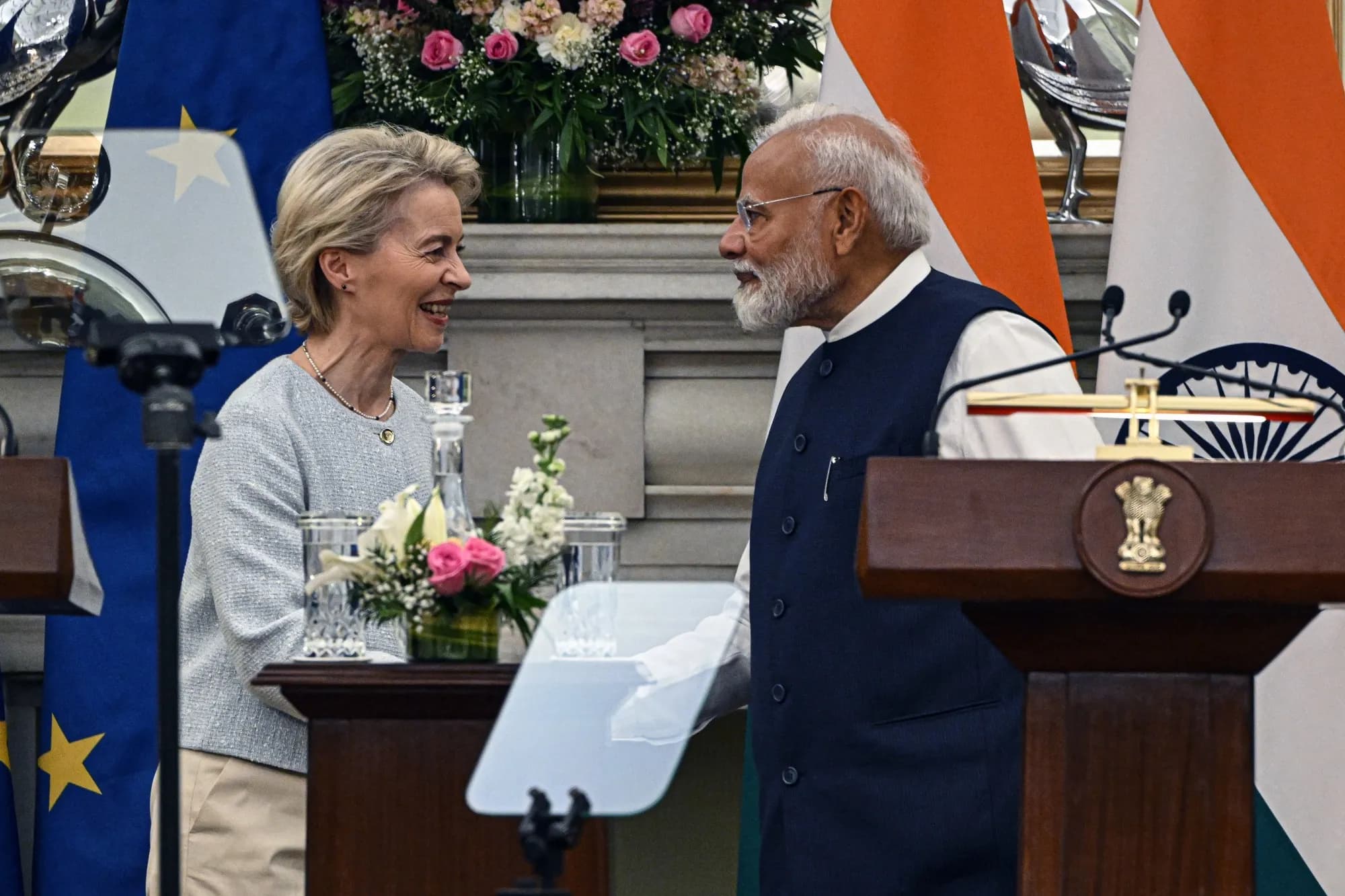
Officials from India and the European Union ended their fourteenth negotiating round in Brussels with unusual confidence. The political mandate, set by Prime Minister Narendra Modi and European Commission President Ursula von der Leyen earlier in the year, is to finish by end 2025, yet both sides now say a 2025 finish could be pulled forward. With goods trade around €120 billion in 2024 and another round due in New Delhi in November, the window for a breakthrough is open, but only if both sides navigate three tough reefs, tariffs, sustainability, and standards.
The Story
Negotiators have been working on a package that balances market access in goods and services with new generation disciplines on sustainability and standards. India’s team for the EU file is led by L. Satya Srinivas. On the EU side, the push is driven by a desire to lock in supply chain resilience with a large, fast growing market. Political attention is high on both sides, with ministers and senior officials cycling through Brussels and New Delhi.
The contours are familiar. The EU seeks lower tariffs on sensitive Indian markets such as automobiles, wines and spirits, and better disciplines on non tariff barriers. India seeks flexible treatment on sustainability clauses, a predictable path around the EU’s Carbon Border Adjustment Mechanism, and improved mobility and services access for Indian professionals. To avoid deadlock, negotiators have reportedly parked the most sensitive lines and focused on deliverable chapters first.
A parallel conversation is unfolding on connectivity. Brussels hosted a steering, Sherpa, meeting for the India Middle East Europe Economic Corridor this week. With a ceasefire window in West Asia and a chance of lower violence, the EU wants to nudge IMEC forward, since an India–EU FTA would sit neatly alongside a physical corridor for goods, energy, and data.
Why It Matters
For India
An ambitious but balanced deal can improve access to a high income market, incentivise upgrades in quality and traceability, and attract investment into green manufacturing. It can also soften the impact of CBAM if sectoral pathways are agreed.
For the EU
India offers scale, diversification from single market dependencies, and a partner in digital, clean tech, and mobility. An FTA would anchor the Global Gateway strategy with a credible Indo Pacific node.
For businesses and workers
Tariff cuts, clear rules, and mutual recognition reduce friction costs. Predictable market access drives firm level investment decisions. Mobility arrangements for services translate into jobs and project pipelines.
Background and Context
A long road to round 14
Talks began in 2007, stalled in 2013, and were relaunched in 2022 alongside investment and geographical indications tracks. Political guidance this year sharpened timelines.
Trade baseline
Goods trade in 2024 stood near €120 billion. The EU is a top partner for India, and India ranks among the EU’s fastest growing partners, but the bilateral is underweight relative to potential, given size and complementarities.
Key friction points
• Tariffs and market access. Autos, dairy, wines and spirits, farm goods, and selected industrial lines are sensitive in India. Certain EU farm products are sensitive in Europe.
• Services. India wants easier business mobility and wider recognition for professional services. The EU seeks regulatory comfort and data safeguards.
• Sustainability and CBAM. The EU wants a robust chapter on trade and sustainable development. India objects to trade linked climate conditionality and to CBAM’s design, which prices embedded carbon at the EU border.
• Quality Control Orders. The EU flags India’s expanding QCO regime as a barrier if conformity assessment is not predictable or accessible for foreign firms.
• Regulatory trust. Digital rules, data flows, and public procurement transparency all sit on the table in some form.
Politics and timing
Both capitals are weighing domestic calendars, industry lobbies, and election cycles in some member states. That pushes negotiators to stage outcomes, quick wins upfront, tougher bargains sequenced with review clauses.
The Sticking Points, Explained
1) Tariffs
Autos and wines are the headline, but the real grind is in dozens of lines where margins are tight and domestic lobbies vocal. A workable path is tariff phase downs with long staging, exclusion lists on both sides, and safeguards if import surges disrupt local markets. India will seek reciprocal wins where it is competitive, textiles, leather, certain engineering goods, and chemicals.
2) Services and mobility
India wants improvements in short term business visas, intra company transfers, recognition of qualifications, and openness in cross border services. The EU will ask for regulatory clarity, data protection alignment, and consumer safeguards. A realistic compromise is a targeted mobility package for defined categories, with monitoring and a mid term review.
3) Sustainability and CBAM
The EU’s trade and sustainable development chapter will remain. The argument is over tone, teeth, and timelines. India’s red line is that climate should not be a stealth tariff. A middle course is a two track compact, India commits to measurable decarbonisation pathways in covered sectors, the EU commits to flexibility mechanisms that reduce immediate CBAM shock, for instance, transitional rebates tied to verifiable emissions data, or cooperation on low carbon process certification. Review and dispute settlement would be calibrated to cooperation first, penalties later.
4) Standards and QCOs
India’s QCOs are designed to lift quality and safety. Exporters, including European ones, want transparent procedures, reasonable transition periods, and testing capacity that does not bottleneck. Mutual recognition of conformity assessment bodies, plus digital documentation, can reduce friction without lowering the bar.
5) Digital and data
Even a light touch chapter needs clarity on cross border data flows, cybersecurity carve outs, and trust frameworks. Pilot projects in trusted research environments can demonstrate value without forcing either side to cross red lines.
The IMEC Connection
A trade deal increases the payoff from a physical corridor. If IMEC proceeds, it will route containers, energy, and data from India to Europe via West Asia. An FTA that clarifies rules of origin, customs cooperation, and standards would reduce delays at each leg. The corridor also creates a rationale to align investment screening and export credit so that European and Indian firms can bid jointly for logistics and energy assets.
Implications
For exporters
Lower tariffs, simplified rules of origin, and mutual recognition of standards cut costs and widen margins. Sectors likely to benefit include machinery, pharmaceuticals, speciality chemicals, textiles, and processed foods that meet sanitary and phytosanitary norms.
For consumers
More choice and competitive pricing in automobiles, premium foods, and appliances, subject to staged tariff cuts. Quality gains from standards alignment tend to spill over into domestic markets.
For climate and compliance teams
CBAM readiness becomes a boardroom issue. Indian steel, cement, aluminium, and chemicals need emissions measurement systems, product level declarations, and decarbonisation roadmaps. A cooperative FTA framework can channel EU technical help into Indian plants that are mid transition.
For small firms
Predictability matters more than headline tariff numbers. Templates for contracts, transparent customs processes, and digital trade documentation help MSMEs enter EU value chains. State and export promotion agencies will need to run playbooks on standards, packaging, and last mile logistics.
For geopolitics
An India–EU deal signals that the two democracies can write rules together, not just talk values. It complements India’s agreements with the UAE and Australia and the EU’s push to diversify its trade profile.
Arguments For and Against
The case for concluding now
• The macro case is strong, both economies want resilient supply chains and diversified markets.
• Staging and review clauses let each side test sensitive openings without irreversible commitments on day one.
• A deal unlocks investment in clean tech, where joint standards and finance matter.
• The IMEC moment increases strategic value, a rules layer alongside a corridor.
The cautionary case
• CBAM could still bite if transitional flexibilities are weak or brief.
• Domestic lobbies on both sides may resist, autos and agriculture in India, farm and labour groups in Europe.
• Regulatory missteps on data, procurement, or QCO enforcement could sour gains.
• If sensitive lines are overly excluded, the pact risks being thin, which underwhelms businesses.
What a Realistic Deal Might Contain
Goods
Tariff phase downs across a wide slate, very long staging for autos and wines, exclusion lists for the most sensitive items, and a bilateral safeguard clause.
Services and mobility
A targeted package on short term business entry, intra company transfers, and recognition pathways for specified professions, subject to domestic law.
Sustainability
A cooperative TSD chapter with binding consultations, technical assistance, and a structured review calendar. Side understandings on CBAM data, verification, and transitional flexibilities.
Standards
Commitments on transparency for QCOs, mutual recognition of conformity assessment bodies where feasible, and digital certification pilots.
Customs and trade facilitation
Advance rulings, trusted trader programs, end to end digitisation of documents, and joint risk management.
Dispute settlement
Consultations first, escalating to panels only after cooperation windows. Special timelines for perishable goods and just in time sectors.
What to Watch Next
• The November round in New Delhi, including language on the sustainability chapter.
• Any signal of a transitional CBAM arrangement that India can live with.
• Mobility specifics for services, even if narrow at first.
• A short list of early harvest items, for example chemicals, machinery, and textiles, with quick tariff cuts.
• IMEC governance steps that align with FTA customs cooperation.
FAQ, Quick Answers
Is CBAM a deal breaker
Not necessarily, if both sides agree on transitional flexibilities, credible measurement systems, and aid for decarbonisation.
Will autos open fully
Unlikely in the near term. Expect long staging, tariff quotas, or narrow windows rather than a big bang cut.
Can MSMEs benefit
Yes, if the agreement includes practical facilitation, templates, and training on EU standards and packaging.
What happens if talks slip
A year end finish is not legally required. The political mandate runs to end 2025. A solid draft this year still counts as momentum.
Conclusion
The India–EU FTA is within reach if negotiators pair ambition with sequencing. The center of gravity is a credible goods package, a narrow but useful mobility window, a cooperative sustainability chapter that de risks CBAM, and pragmatic standards alignment around QCOs. Tie that to IMEC’s physical connectivity and both sides gain a trade backbone that is resilient, green, and investable. The final miles will be hard, but the cost of another missed window would be higher.