

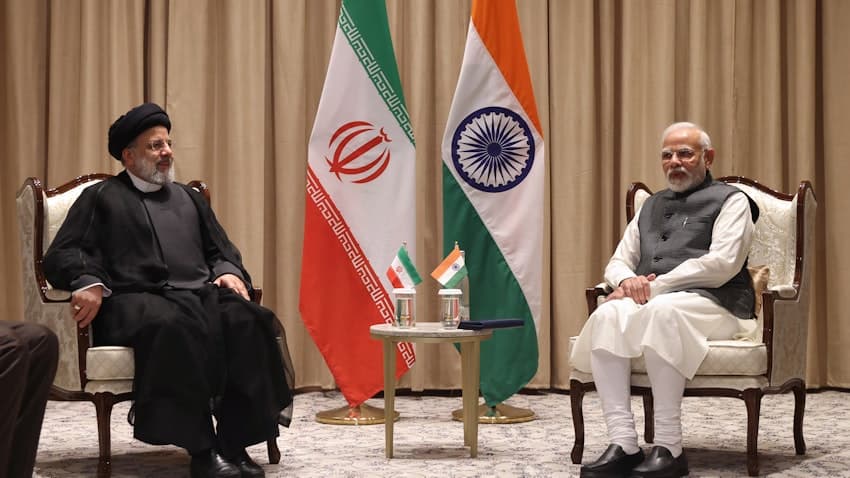
India and Iran often speak in the language of civilisations, and not without reason. Few bilateral relationships carry such a long cultural afterlife in language, literature, and shared intellectual currents. But history is only the opening chapter. The decisive test is whether both countries can convert sentiment into strategy, and strategy into sustained outcomes in a world shaped by sanctions risk, corridor competition, and regional turbulence.
What’s in the news
-
A fresh articulation of India–Iran ties frames the relationship as more than routine diplomacy, emphasising deep historical and cultural continuity.
-
It argues that present-day geopolitics has created renewed space for practical cooperation, especially in energy, transport connectivity through Chabahar and the International North–South Transport Corridor, and discreet security coordination.
-
It also acknowledges the central complication: third-party pressures and financial frictions that repeatedly narrow the bandwidth of bilateral ambition.
Background and context
Civilisational narratives matter in diplomacy because they create political comfort and reduce misunderstanding. The Indo-Persian cultural continuum, the role of Persian as a courtly and intellectual language over centuries, and the shared literary heritage built a reservoir of familiarity that many modern partnerships lack.
Yet the modern India–Iran relationship operates in a far less sentimental arena. Three forces shape it.
-
A contested West Asia where conflicts, polarisation, and shifting alignments can rapidly change economic and security calculations.
-
A sanctions-shaped financial order where the ability to pay, insure, ship, and settle trade can become as important as the trade itself.
-
A global race for corridors and standards where connectivity is not just logistics, but influence.
India’s West Asia policy also requires balance: strong ties with Gulf partners, strategic cooperation with the United States, a significant relationship with Israel, and the imperative to keep access routes to Afghanistan and Central Asia open. Iran sits at the centre of this geometry, as both an opportunity and a constraint.
Key provisions / key details
-
Energy complementarity: India’s demand profile and Iran’s hydrocarbon endowment make energy a natural pillar, but the actual scope is heavily shaped by external constraints and payment channels.
-
Connectivity via Iran: Chabahar and the INSTC idea speak to India’s strategic preference for diversified routes that reduce chokepoint dependence and expand Eurasian trade options.
-
Security convergence: Both countries face the spillover risks of extremism, narcotics networks, and unstable neighbourhoods, creating incentives for selective cooperation.
-
Financial innovation as a necessity: Local currency trade and alternative settlement mechanisms are presented as ways to reduce vulnerability, but they require robust compliance design and sustained political commitment on both sides.
Why it matters
1) Strategic autonomy through route diversity.
Connectivity through Iran is not merely about faster cargo movement. It is about optionality. In a world where chokepoints can be disrupted and geopolitics can weaponise commerce, route diversity becomes a national capability.
2) West Asia stability and India’s economic interests.
India’s exposure to West Asia is multi-layered: energy, remittances, trade, and the safety of the Indian diaspora. A stable, predictable regional order aligns with India’s interests, even when India’s partnerships within the region are not identical.
3) The Eurasia opportunity and the limits of ambition.
Iran’s geography offers a bridge to Central Asia, the Caucasus, and onward markets. But geography is only potential. Turning it into performance requires predictable rules, secure corridors, bankable contracts, and confidence that projects will not be stranded by external shocks.
4) The credibility test for “innovation-driven” cooperation.
Moving beyond oil and ports into technology, health, and knowledge industries is attractive, but it requires institutional trust, IP clarity, and stable financing. Without that, diversification remains a slogan rather than a strategy.
Arguments for and against
Arguments for deepening the partnership
-
Natural complementarity: Energy supply potential, geographic connectivity, and shared concerns over extremism create a pragmatic foundation.
-
Civilisational ballast: Cultural familiarity can reduce friction and keep channels open during geopolitical turbulence.
-
Connectivity leverage: Chabahar and INSTC-type thinking offers India a strategic hedge and a trade facilitation tool.
-
Scope for “middle technology” wins: Health, pharmaceuticals, education, IT services, and applied research partnerships can deliver results without needing frontier breakthroughs at the outset.
Arguments cautioning against overreach
-
Sanctions and compliance risk: Even when political intent exists, banks, insurers, and shippers price risk conservatively. This can throttle trade regardless of diplomatic warmth.
-
Regional alignments are sensitive: Iran’s adversarial relationships in West Asia can complicate India’s balancing act with other key partners.
-
Projects need execution certainty: Connectivity corridors are judged by reliability, time, and cost. If execution is uneven, trade will route elsewhere.
-
Domestic political optics: In both countries, foreign policy narratives can harden positions, narrowing room for flexible bargaining.
Constitutional / legal angle
For India, the operative frame is less constitutional text and more the legal ecosystem that governs cross-border commerce and strategic projects:
-
International sanctions regimes and domestic compliance obligations shape what is financeable and insurable.
-
Contract enforceability, dispute resolution design, and sovereign risk determine whether connectivity projects attract durable private participation.
-
Trade settlement mechanisms must balance strategic intent with transparent governance and regulatory comfort, or they remain episodic.
A partnership of this kind succeeds when legal architecture reduces uncertainty, rather than amplifying it.
Implications
Short-range: Public signalling around civilisational ties can preserve diplomatic space, but hard deliverables will depend on workable settlement channels and corridor security.
Medium-range: If Chabahar-linked and Eurasia-facing connectivity becomes more reliable, India gains leverage through optional routes. If not, the partnership risks becoming rhetorically rich but commercially thin.
Long-range: A stable India–Iran corridor can contribute to a more multipolar regional economic architecture. Conversely, persistent constraints could lock the relationship into limited, tactical engagement rather than strategic depth.
Way ahead
-
Prioritise bankable cooperation over grand communiqués: Focus on fewer, high-certainty projects that prove reliability and build confidence.
-
Design settlement mechanisms that are resilient and compliant: Local-currency or alternative settlement is valuable only if it is predictable, transparent, and insulated from sudden disruption.
-
Build “corridor credibility”: Trade routes succeed when they are boring in the best way: consistent, secure, and administratively smooth.
-
Diversify into practical innovation partnerships: Healthcare collaboration, applied research, skill exchange, and technology services can broaden ties without triggering maximum geopolitical friction.
-
Keep strategic balance steady: India’s strength lies in calibrated multi-alignment. The goal is not choosing camps, but securing interests while reducing vulnerability to external vetoes.
Civilisations can recognise each other across millennia. States, however, must negotiate in the present tense. The India–Iran relationship will endure on history, but it will only rise on execution.
Source credits
The Hindu; Ministry of External Affairs (India); Embassy of the Islamic Republic of Iran in India; academic scholarship on Indo-Persian cultural history; policy commentary on Chabahar and the International North–South Transport Corridor; public domain materials on Myanmar and West Asia regional security dynamics