

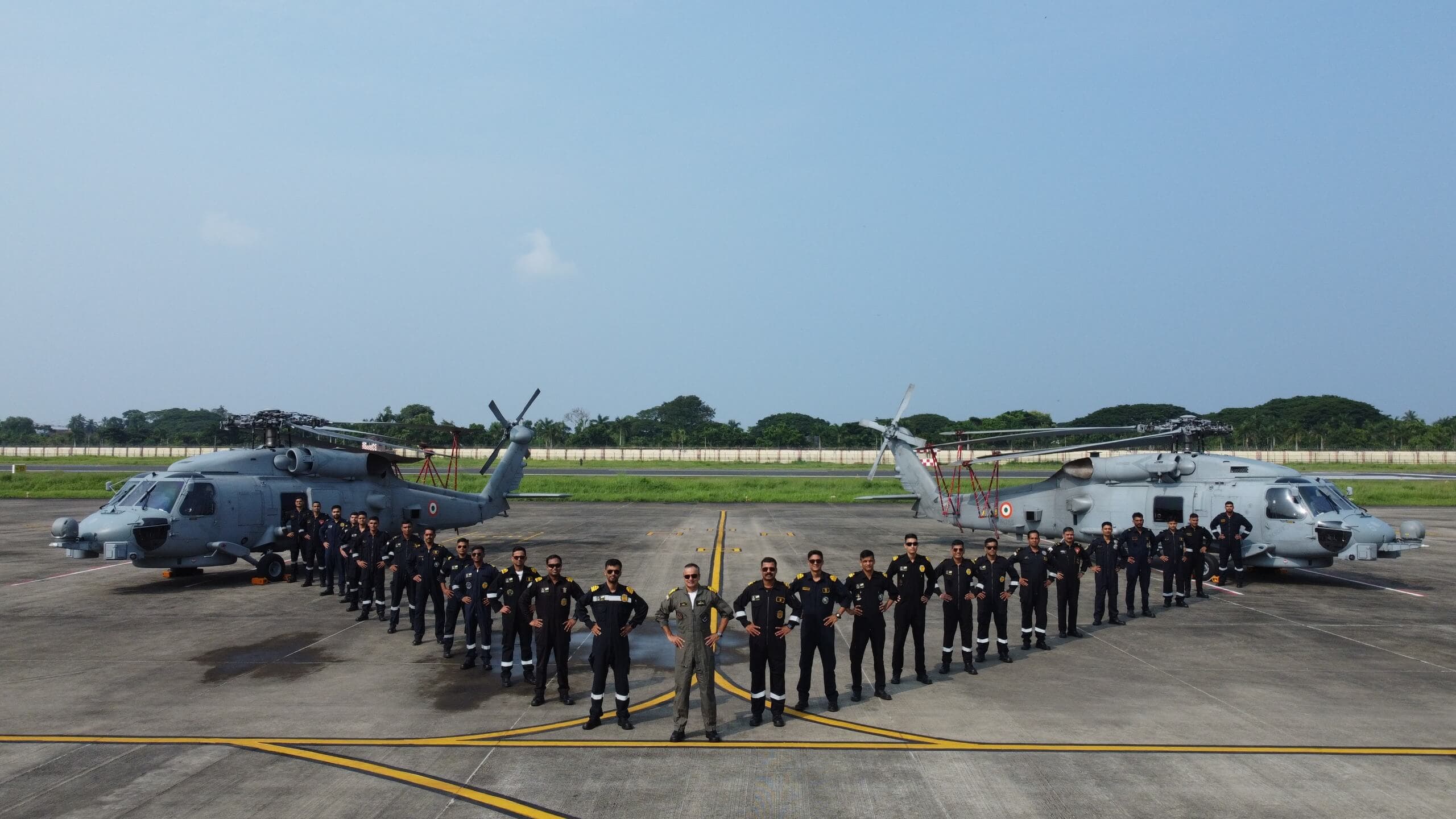
The Indian Navy will commission its second MH-60R helicopter squadron, INAS 335 (Ospreys), on December 17 at INS Hansa in Goa. The Navy has framed the induction as a modernisation milestone, highlighting the helicopter’s multi-role utility, integration with fleet operations, and contribution to higher operational readiness across conventional and asymmetric threat environments.
What’s in the news
Commissioning details
The second MH-60R squadron, INAS 335 (Ospreys), is scheduled to be commissioned at INS Hansa, Goa, with the Chief of the Naval Staff in attendance.
Continuity in induction
The Navy commissioned its first MH-60R squadron at Kochi on March 6 last year, and the new squadron is presented as the next step in expanding operational availability.
Capability emphasis
The Navy underlined the platform’s advanced sensors, weapons, and avionics, and stated that it has already demonstrated operational effectiveness.
Background and context
Why integral aviation matters
Naval helicopters are not an accessory; they are a force-multiplier. They extend the “eyes, ears, and reach” of ships far beyond the horizon, enabling faster detection, classification, tracking and response—especially in dynamic maritime theatres.
Why the Indian Ocean Region is central
The Indian Ocean Region carries dense commercial shipping lanes, strategic chokepoints, and rising grey-zone challenges. A credible maritime presence depends on platforms that can remain persistent, networked, and responsive—particularly in anti-submarine, surface surveillance, and escort missions.
Key operational relevance of MH-60R induction
Multi-role coverage across threat types
A modern multi-role helicopter strengthens the Navy’s ability to respond to both conventional threats and asymmetric challenges such as piracy, hostile surveillance, and irregular maritime tactics.
Fleet integration and readiness
When aviation assets are well-integrated into fleet operations, they improve mission planning and reduce response time. This is often the difference between a “reactive navy” and a “ready navy”.
Sustained operations and blue-water posture
By extending operational reach and enabling sustained missions, such inductions reinforce India’s blue-water capability—meaning credible operations beyond near-coastal waters with endurance and persistence.
Why it matters
Deterrence through capability, not rhetoric
Maritime deterrence is shaped by real-world capacity: surveillance, response time, and the ability to control escalation. A stronger helicopter component improves all three.
Maritime security and sea lane confidence
Even without combat, naval presence signals stability for commercial shipping and friendly partners. It also raises the cost for hostile actors contemplating disruption.
Inter-operability and modernisation momentum
A visible, operationally integrated induction signals a broader shift towards networked warfare—where sensors, platforms, and decision-making are tightly stitched together.
Arguments for and against
Arguments supporting the move
Operational payoff is immediate
Helicopter squadrons translate quickly into deployable capability—especially for surveillance, tracking and escort roles.
Better coverage against undersea and surface challenges
Multi-role aviation improves the Navy’s ability to detect and respond across multiple domains, enhancing overall fleet resilience.
Concerns and cautions
Maintenance and spares discipline
High-end platforms deliver only when sustainment is strong—trained crews, robust maintenance cycles, and assured availability of spares.
Balancing numbers with integration
Capability grows not just with induction, but with doctrine, training, basing, and mission integration. Without these, numbers alone can under-deliver.
Constitutional and governance angle
Defence as a Union responsibility
Defence and the armed forces sit firmly within the Union domain, making such inductions part of national capability-building rather than state-led security policy.
Modernisation and accountability
Major inductions also bring the governance responsibility of lifecycle planning—training pipelines, readiness metrics, safety standards, and transparent sustainment frameworks.
Implications and way forward
Stronger basing and rapid deployment posture
With commissioning at INS Hansa, the Western seaboard and adjoining maritime approaches can see more responsive aviation availability and mission readiness.
Better maritime domain awareness
As more such assets become available, surveillance, tracking, and coordinated responses can become more consistent and persistent across the Indian Ocean Region.
A push towards credible sea-control capabilities
While no single platform is decisive, layered capability—ships, submarines, aviation, and ISR integration—builds a stronger sea-control and sea-denial posture over time.
Source credits
The Hindu (New Delhi Bureau report)