

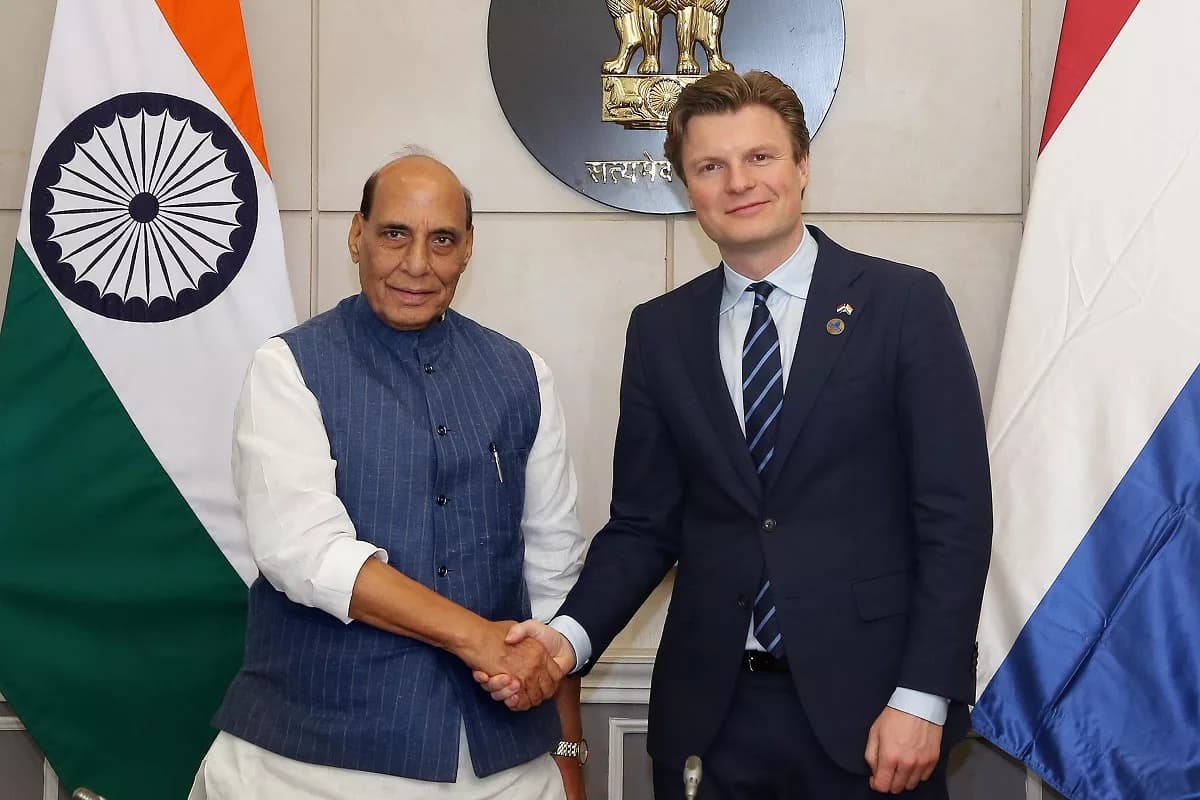
India and the Netherlands have agreed to widen their security and defence partnership, with both sides emphasising co-development and co-production of defence equipment, stronger military-to-military engagement, and closer alignment on a free and rules-based Indo-Pacific. The exchange of a Letter of Intent is a clear signal that the relationship is being nudged from goodwill and dialogue toward an institutional, project-oriented framework.
What’s in the news
Defence Minister Rajnath Singh met Netherlands Foreign Affairs Minister David van Weel in New Delhi. The two leaders discussed bilateral security and defence cooperation, including priority areas for co-development and co-production. A Letter of Intent on Defence Cooperation was exchanged to provide an institutional framework, and both sides agreed to explore a defence industrial road map aimed at technology collaboration and joint development of defence platforms and equipment. They also reaffirmed their shared commitment to a free, open, inclusive, and rules-based Indo-Pacific and highlighted the value of connecting defence industries, particularly in niche and emerging technologies.
Background and context
The India–Netherlands relationship has traditionally rested on trade, innovation, and people-to-people links, with a strong Indian diaspora in the Netherlands acting as a living bridge. The defence dimension has been growing steadily, but it has often remained less visible than economic cooperation.
Two shifts are now pushing defence to the forefront.
First, the Indo-Pacific has become the main theatre where maritime security, supply-chain resilience, cyber threats, and technology competition intersect. Second, India’s defence policy has increasingly prioritised domestic manufacturing capacity, technology absorption, and trusted partnerships that can support co-development rather than only buyer–seller transactions.
For the Netherlands, a technologically advanced European country with a strong orientation toward international rules and maritime stability, expanding defence cooperation with India fits the logic of partnering with capable democracies that have stakes in open sea lanes and resilient high-tech ecosystems.
Key provisions and what they practically mean
1) An institutional anchor through the Letter of Intent
The Letter of Intent provides a structured base for defence collaboration. In practical terms, it usually helps ministries and armed forces move faster from intent to programmes by clarifying cooperation mechanisms, priority themes, and engagement channels.
2) A defence industrial road map
The road map idea is important because it shifts the focus from standalone projects to a pipeline approach: identifying technologies, matching industrial strengths, and creating pathways for joint production and joint development. It also supports predictability for industry, which is essential for investment and R&D planning.
3) Emphasis on niche and emerging technologies
The reference to niche and emerging technologies suggests the partnership will not be limited to conventional hardware. Likely focus areas include advanced sensors, maritime domain awareness, cyber security, AI-enabled decision tools, secure communications, unmanned systems, and specialised components where European firms and Indian manufacturing capacity can complement each other.
4) Stronger military-to-military engagement
Military-to-military engagement is a practical enabler. It improves interoperability, builds confidence, and helps identify capability gaps that industry partnerships can address. It also strengthens real-world coordination on maritime security and crisis response.
5) Indo-Pacific alignment as a strategic layer
The emphasis on a free and rules-based Indo-Pacific frames the cooperation in a wider regional context. This is not only about bilateral ties; it is also about converging approaches to maritime security, norms, and predictability in regional behaviour.
Why it matters
1) From procurement to capability-building
For India, the value of partnerships is increasingly measured by technology transfer, design participation, and the ability to build and sustain systems domestically. A co-development and co-production emphasis supports self-reliance without shutting doors to global innovation. It also helps Indian industry climb the value chain, from assembly to design and IP creation.
2) Europe as a balancing partner in defence technology
India has diversified defence engagements across regions, but European partnerships can offer specialised strengths, high-quality engineering standards, and technology niches that are not always easily available through traditional channels. The Netherlands, in particular, can contribute through specialised industrial know-how and integration capabilities.
3) Maritime security is now an economic issue
Safe sea lanes are not just security concerns; they are trade, energy, and supply-chain concerns. As shipping routes face geopolitical stress, cooperation that improves maritime awareness, surveillance, and crisis coordination can indirectly protect commerce and reduce risk premiums.
4) Defence industry linkage strengthens the broader strategic partnership
When industries connect, strategic relationships become more resilient. Joint projects create long-term interdependence, skilled jobs, and institutional habits of cooperation. That stickiness matters in an era where political cycles and global shocks can otherwise disrupt diplomacy.
5) Signals and deterrence without provocation
A rules-based Indo-Pacific emphasis is a calibrated signal. It underlines commitment to norms and openness, without framing the partnership as a bloc against any single country. Such measured signalling is increasingly valuable for countries that want stability, not escalation.
Arguments for and against deeper defence-industrial cooperation
Arguments in favour
-
Builds domestic capability through co-development and production rather than one-time purchases.
-
Strengthens resilience in high-tech supply chains and specialised components.
-
Encourages standardisation, training exchanges, and interoperability over time.
-
Adds a European technology and standards dimension to India’s diversified defence partnerships.
Concerns and cautions
-
Co-development is slow and governance-heavy; without clear project ownership, road maps can remain paper frameworks.
-
Export control sensitivities and compliance requirements can affect timelines and scope.
-
Divergent industrial expectations can arise: India seeks deeper localisation and affordability; European firms seek IP protection and predictable procurement.
-
Without early “quick wins,” political attention can drift and momentum can fade.
The practical test will be whether the two sides identify a small set of high-impact projects that are technically realistic and commercially viable.
Constitutional and legal angle
Defence cooperation frameworks typically translate into a chain of domestic approvals and contracting structures. On the Indian side, projects must align with procurement rules, security clearances, and industrial policy objectives around domestic manufacturing. On the Dutch side, collaboration may be shaped by national export control frameworks and broader European compliance expectations.
A mature partnership therefore depends on clean legal architecture: well-defined scope of work, IP and licensing terms, quality standards, end-use assurances, and dispute resolution pathways. These “boring” clauses often decide whether cooperation delivers hardware and capability, or only diplomacy.
Implications
1) More joint work in high-tech niches
Expect the strongest traction in areas where the Netherlands’ specialised capabilities can pair with India’s manufacturing scale and engineering talent, creating mutual benefit without excessive political risk.
2) A template for EU-facing defence industrial engagement
If executed well, this cooperation can become a practical model for India’s defence industrial engagement with other European partners: focused, technology-led, and anchored in co-development rather than headline-heavy procurement.
3) Greater focus on interoperability and maritime awareness
Military-to-military engagement can translate into improved coordination in maritime surveillance, information sharing, and best practices in coastal and offshore security.
4) Higher expectations from industry on policy clarity
Once a road map is announced, industry expects clarity on procurement pathways, trials, certification, and timelines. Administrative delays can become the biggest enemy of collaboration.
5) A stronger strategic narrative in the Indo-Pacific
Even without operational alliances, consistent cooperation among capable partners can shape the strategic environment by reinforcing norms, transparency, and readiness.
Way ahead
To convert intent into outcomes, the partnership will need disciplined choices and institutional stamina.
-
Pick 3–5 flagship projects in emerging technologies that have clear operational relevance and feasible delivery pathways.
-
Create a joint industry–government working structure that meets regularly and is empowered to resolve bottlenecks on standards, certification, and contracting.
-
Design co-development with a clear IP and localisation formula so both sides know what is shared, what is protected, and what is produced where.
-
Link military engagement to industrial outcomes by aligning exercises, training, and capability needs with the technologies being pursued.
-
Build trust through early deliverables such as joint research modules, component-level co-production, or upgrades and sustainment partnerships that can move faster than full platform development.
Conclusion
The India–Netherlands defence conversation is entering a more consequential phase: institutional anchoring through a Letter of Intent, and a planned road map that prioritises emerging technologies and industrial linkage. If both sides can translate this into a few credible joint projects, the partnership can become a quiet but sturdy pillar of India’s wider strategic and technology ecosystem.
Source credits : Ministry of Defence statement; MEA updates; The Hindu report; press photographs and official briefing notes as reported.