

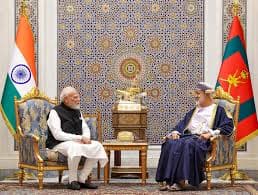
India and Oman have signed a Comprehensive Economic Partnership Agreement (CEPA) that gives Indian exporters sweeping duty-free access to the Omani market and creates an expanded mobility channel for Indian professionals. While the headline numbers look like classic tariff liberalisation, the agreement is also a strategic instrument: it tightens India’s economic footprint in a Gulf corridor that matters for energy, shipping, investment flows, and regional supply chains.
What’s in the news
India and Oman signed a CEPA in Muscat in the presence of Prime Minister Narendra Modi and Sultan Haitham bin Tarik. Oman will grant zero-duty access to 98.08% of its tariff lines, covering 99.38% of India’s exports by value. India will liberalise tariffs on 77.79% of its tariff lines, covering 94.81% of India’s imports from Oman by value, while keeping a list of sensitive products excluded. The agreement also includes enhanced services access and a structured mobility framework, including expanded quotas and longer stays for certain categories of Indian workers.
Background and context
India’s recent trade diplomacy has increasingly used “comprehensive” agreements that combine goods, services, investment facilitation, and mobility, instead of narrowly reducing customs duties. Oman is a smaller market than the UAE or Saudi Arabia, but it has outsized relevance for India’s West Asia strategy due to geography and connectivity, and because it is often treated by businesses as a stable gateway into wider Gulf commercial networks.
Two broader context points matter.
First, the Gulf region is central to India’s energy security and remittance economy, with dense people-to-people ties and deep corporate linkages.
Second, India’s CEPA approach is now shaped by a dual objective: protect sensitive domestic sectors while securing high-impact access for labour-intensive exports and globally competitive services.
Key provisions
1) Tariff elimination for Indian exports to Oman
Oman has offered zero-duty access on 98.08% of its tariff lines, covering 99.38% of India’s exports by value. A large share is scheduled for immediate elimination, signalling quick on-ground benefits for exporters once implementation procedures kick in.
2) India’s tariff liberalisation offer to Oman
India will liberalise tariffs on 77.79% of its tariff lines, covering 94.81% of imports from Oman by value. Where products are sensitive for India, the agreement leans toward calibrated instruments such as tariff-rate quota style liberalisation rather than blanket duty removal.
3) Priority sectors likely to gain in India
The agreement targets labour-intensive and employment-rich sectors. Goods cited as beneficiaries include gems and jewellery, textiles, leather, footwear, sports goods, plastics, furniture, agricultural products, engineering goods, pharmaceuticals, medical devices, and automobiles. The intent is straightforward: price competitiveness through duty removal, plus predictability for long-term buyer contracts.
4) Exclusions and red lines
India has kept sensitive products out of concessions, notably several agricultural items and certain bullion and jewellery categories, as well as selected labour-intensive segments and metal scrap categories. This is the defensive spine of the deal, designed to contain domestic disruption.
5) Services expansion and market-entry commitments
A major design feature is services. Oman has opened commitments across a wide set of sub-sectors, signalling a willingness to deepen service-sector integration beyond merchandise trade. This matters for India because services is where India’s competitiveness often scales faster than goods, particularly in professional services, IT-enabled services, and education and health-linked offerings.
6) Enhanced mobility under Mode 4
The headline mobility shift is the expansion in Intra-Corporate Transferee quota from 20% to 50%, and the extension of permitted stay for Contractual Service Suppliers from 90 days to two years, with the possibility of a further two-year extension. The agreement also signals more liberal entry and stay for skilled professionals in areas such as accountancy, taxation, architecture, and medical and allied services.
7) Investment facilitation signals
The agreement includes commitments that support commercial presence for Indian companies in Oman, including indications around higher openness for Indian investment in major services sectors. This is critical because many services exports are delivered most efficiently through a local presence rather than cross-border delivery.
8) Social security coordination pathway
A future-oriented clause provides for discussions on social security coverage coordination once Oman’s contributory social security system is implemented. If operationalised well, this could become a quiet but meaningful worker-protection pillar for Indian professionals and contracted staff.
Why it matters
1) It turns “market access” into measurable export headroom
Duty-free access on almost all export value is not symbolic. In price-sensitive categories like textiles, leather, and engineering goods, even single-digit tariff relief can decide whether a supplier wins repeat orders. For Indian exporters, the CEPA reduces the friction cost of entering and scaling in the Omani market.
2) It upgrades the services narrative from talk to structured entry
India’s export strength is increasingly services-led. When a CEPA translates into defined sector openings and clearer professional entry conditions, it reduces uncertainty for firms planning multi-year contracts. The mobility upgrades are particularly relevant for project-based services and maintenance contracts, where “time in country” is often the difference between viable delivery and a non-starter.
3) It strengthens India’s Gulf strategy without overexposing sensitive sectors
The exclusion list is not an afterthought. It reflects a political economy lesson India has learned: trade agreements survive when they create visible winners without generating a concentrated set of domestic losers. By shielding sensitive farm items and other categories, India is trying to keep the agreement economically credible and politically durable.
4) It deepens a corridor that matters for energy, logistics, and supply chains
Oman’s location and its role in regional maritime and logistics networks give the agreement a strategic layer. Even if the Omani consumer market is modest in size, Oman can function as a commercial node for warehousing, re-exports, and service delivery into a wider region. That “gateway value” is often larger than bilateral trade figures suggest.
5) People-to-people ties convert into economic throughput
India has a large Indian community presence in Oman and a sizeable base of Indian establishments operating there. Mobility provisions that regularise professional movement can raise remittances, improve worker stability, and reduce the informal frictions that often plague overseas contracting.
Arguments for and against
The case for the CEPA
-
Export competitiveness: Duty elimination improves price advantage and can unlock new buyer contracts, especially in labour-intensive sectors.
-
Services scaling: Clearer entry categories and longer stays support higher-value services exports and project execution.
-
Investment and confidence effects: Rules-based frameworks can crowd in investment and joint ventures as businesses gain predictability.
-
Strategic diversification: Expanding Gulf trade links helps diversify markets and reduces overdependence on a narrow set of destinations.
The case for caution
-
Import concentration risks: If tariff liberalisation coincides with commodity cycles, imports could surge, widening trade deficits in select periods.
-
Rules of origin and rerouting: Preferential agreements can be misused through trans-shipment unless origin rules and enforcement are tight.
-
Domestic sector anxiety: Even with exclusions, some sub-sectors may feel competitive pressure if concessions are broader than expected in practice.
-
Mobility politics: Labour market sensitivities in host countries can shift over time; the real test is implementation consistency at the ground level.
Constitutional and legal angle
Trade agreements sit at the intersection of international commitments and domestic legal implementation. In India, benefits typically flow only after enabling steps such as customs notifications, tariff schedule adjustments, and operational guidelines for services and mobility categories. The agreement’s mobility architecture also interacts with immigration and labour frameworks on both sides, meaning the legal promise must translate into clear, enforceable administrative pathways.
For businesses, the practical legal heart of such agreements is often three things: rules of origin, dispute avoidance mechanisms, and transparent procedures for certification and compliance. If these are cumbersome, headline tariff cuts deliver less than expected. If they are clean and predictable, even a smaller market can become a reliable base for expansion.
Implications
1) Near-term: a competitiveness bump for targeted sectors
Sectors that rely on tight margins and rapid order cycles are likely to test the new advantage quickly. Early movers could lock in distribution relationships before competitors adjust.
2) Medium-term: services firms may treat Oman as a platform market
Mobility clarity and services openings can encourage Indian firms to establish a deeper on-ground presence for contracts that require longer duration and local client servicing. This can raise both export earnings and investment linkages.
3) Trade deficit optics will be watched
India imports significant value from Oman. If imports rise faster than exports in the early implementation phase, the agreement may face political scrutiny, even if the longer-term balance improves. Communication and transparent reporting will matter.
4) Compliance capacity becomes a competitiveness factor
Exporters that can handle documentation, certification, and origin compliance smoothly will capture more of the gains. MSMEs may need institutional support to avoid being priced out by compliance complexity.
5) Labour mobility could mature into a worker-protection framework
If social security coordination discussions progress and mobility rules are applied predictably, it can reduce the insecurity that often defines overseas contractual work. That can also improve productivity and reduce disputes.
Way ahead
The CEPA’s success will be judged less by the signing ceremony and more by execution quality. A few practical pivots can determine whether this becomes a headline pact or a high-performing one.
-
Make compliance MSME-friendly: Simplify origin certification processes and ensure clear, quick guidance so smaller exporters can participate.
-
Build sector-specific export playbooks: Identify 8–10 sectors with immediate tariff elimination and align export promotion, standards support, and buyer discovery around them.
-
Treat services as the real multiplier: Map the opened sub-sectors to India’s strengths, especially IT-enabled services, professional services, education-linked services, and health-related offerings, and operationalise mobility channels for project delivery.
-
Strengthen enforcement against misuse: Ensure robust origin verification and customs cooperation so preferential access is not diluted by rerouting or misdeclaration.
-
Institutionalise worker mobility safeguards: Create predictable pathways for professional entry and dispute handling; align future social security coordination with worker welfare and portability goals.
-
Use the agreement as a GCC template: Oman can act as a testing ground for what works, especially around Mode 4 and services. Lessons from implementation can strengthen India’s negotiating posture with other Gulf partners.
Conclusion
The India–Oman CEPA is best read as a three-layer agreement: tariffs that sharpen export competitiveness, services and mobility provisions that expand India’s higher-value footprint, and a strategic corridor play that deepens India’s Gulf integration. The promise is large, but delivery will depend on how cleanly rules are implemented, how quickly businesses adapt, and how responsibly mobility commitments are operationalised.
Source credits (no links): Press Information Bureau; Reuters; The Hindu; major Indian business dailies.