

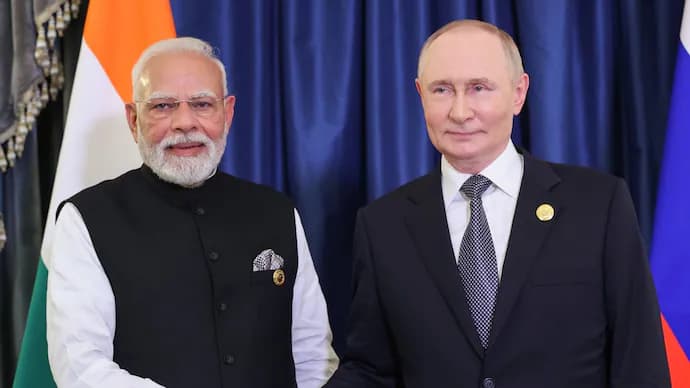
When Russian President Vladimir Putin arrives in New Delhi on December 5 for the 23rd India–Russia annual summit, it will be more than a diplomatic ritual. It will signal an effort by both nations to reaffirm a relationship that has survived the Cold War, the collapse of the Soviet Union, and the geopolitical turbulence of the Ukraine war. But the meeting also comes at a time when India’s balancing act — between its historical ally Russia and its growing partnerships with the West — is being tested as never before.
The Story
Putin’s visit will be his first since December 2021, when India hosted him for a brief but symbolic in-person meeting months before Russia’s invasion of Ukraine. Since then, the war, Western sanctions, and shifting energy dynamics have reshaped global diplomacy.
India’s energy calculus is under scrutiny. Data shows that Indian oil imports from Russia dipped by 16% in September 2025 compared with last year, suggesting that New Delhi may be diversifying supply after facing 25% U.S. penalty tariffs on Russian oil. While Russia remains India’s top oil supplier, the government insists its choices will be guided by “energy security and national interest.”
Ahead of the summit, Russian Deputy Prime Minister Dmitry Patrushev and Foreign Minister Sergey Lavrov have both engaged Indian counterparts to discuss trade balances, defence cooperation, and a proposed India–Eurasian Free Trade Agreement. Both countries seek to stabilise their economic relationship amid financial restrictions, logistics constraints, and dollar-denominated payment hurdles.
Historical Roots: From Soviet Solidarity to Strategic Partnership
The India–USSR relationship dates back to the early years of the Cold War. While India formally pursued non-alignment under Nehru, its ideological and practical affinities often leaned toward Moscow.
1950s–1970s: Political Trust and Strategic Support
-
The USSR backed India’s industrialisation drive through major projects like Bhilai and Bokaro Steel Plants, BHEL, and the Heavy Engineering Corporation.
-
It consistently supported India in the UN Security Council, notably during the Kashmir question and the 1971 Bangladesh Liberation War. The Indo-Soviet Treaty of Peace, Friendship and Cooperation (1971) sealed a quasi-alliance that gave India diplomatic cover against U.S. and Chinese pressure.
-
Defence cooperation flourished: the MiG aircraft, T-72 and T-90 tanks, and later the Sukhoi Su-30 fighters became symbols of strategic interdependence.
1980s–1990s: Transition and Realignment
The Soviet collapse in 1991 caused a temporary dislocation. Russia’s domestic turmoil and India’s liberalisation forced both nations to redefine priorities. Yet, ties revived with the 1993 Treaty of Friendship and Cooperation and the 1996 strategic partnership framework.
2000s Onwards: Strategic Partnership in a Multipolar World
In 2000, the Declaration on the India–Russia Strategic Partnership was signed during President Putin’s first visit, institutionalising annual summits. Cooperation expanded into nuclear energy (Kudankulam), hydrocarbons (Sakhalin-1), and space (GLONASS navigation).
Over time, this evolved into a “Special and Privileged Strategic Partnership”, reflecting mutual trust and alignment on global issues — from BRICS to the Shanghai Cooperation Organisation (SCO).
Strengths of the Partnership
1. Defence Cooperation
-
Russia remains India’s largest defence supplier, accounting for around 45% of India’s military imports.
-
Flagship projects include the S-400 Triumf air defence system, INS Vikramaditya, and the BrahMos missile joint venture.
-
Joint production and technology transfer distinguish Russia from most other defence partners.
2. Energy and Nuclear Collaboration
-
Russia is key to India’s civil nuclear programme (Kudankulam reactors).
-
Oil imports from Russia now constitute roughly one-third of India’s crude basket after Western sanctions created discounts.
-
Cooperation is expanding into Arctic exploration and offshore LNG projects.
3. Space and Science
-
Longstanding cooperation continues through ISRO–Roscosmos collaboration, including astronaut training for the Gaganyaan mission.
4. Multilateral Coordination
-
Both nations share platforms like BRICS, SCO, and G20, advocating multipolarity, reform of global institutions, and resistance to Western unilateralism.
Challenges and Contradictions
1. Ukraine War and Global Sanctions
The ongoing war has complicated India’s balancing act. New Delhi abstains from UN votes condemning Russia but reiterates calls for dialogue and respect for sovereignty. Western partners, especially the U.S. and EU, have grown uneasy with India’s continued Russian energy and defence engagement.
2. China Factor
Russia’s increasing dependence on China, both economically and diplomatically, troubles New Delhi. India views Moscow’s proximity to Beijing — including their joint military exercises — with unease, given India’s border tensions with China.
3. Trade Imbalance and Payment Systems
India’s exports to Russia lag far behind its imports, creating a large rupee–ruble settlement problem. Sanctions have restricted dollar payments and shipping insurance, affecting logistics.
4. Technological Divergence
Russia’s tech sector has been hit by sanctions, limiting its ability to supply advanced components. India, meanwhile, is sourcing high-end defence and tech equipment from France, Israel, and the U.S.
5. Public Diplomacy and Perception
Russia’s global isolation has pushed it toward authoritarian alignments, which contrasts with India’s democratic brand. While people-to-people ties remain warm, India’s younger generation increasingly associates modernisation with the West.
World Diplomacy: India’s Balancing Act
1. Between Washington and Moscow
India’s policy is guided by strategic autonomy — maintaining ties with both the U.S. and Russia without being subsumed by either. The U.S. remains India’s top trading and technology partner, but Russia is its principal defence and energy ally.
This balancing reflects the principle of multi-alignment, where India engages multiple power centres — Washington for technology, Moscow for military assets, Paris for defence diversification, and Tokyo for infrastructure.
2. Oil, Sanctions, and Energy Security
The current dilemma on Russian oil typifies India’s realist approach. New Delhi insists that affordable energy is a domestic priority. Yet, if U.S. penalties increase, India may diversify supplies from the Middle East, Africa, and U.S. producers, as it did when cutting Iranian oil in 2018.
3. Emerging Multilateralism
India’s role in BRICS expansion, the Global South narrative, and its G20 presidency demonstrate that it seeks to act as a bridge — engaging Western economies while retaining solidarity with developing and post-Soviet states.
Looking Ahead: A Relationship Under Adaptation
Putin’s visit will test whether India and Russia can sustain a partnership built in the 20th century within a 21st-century world order. The strategic partnership’s durability will depend on several factors:
-
Whether Russia can remain a reliable defence partner despite sanctions;
-
Whether payment and logistics mechanisms can overcome Western restrictions;
-
Whether India’s outreach to the U.S., Europe, and Japan can coexist with its Eurasian partnerships.
For Moscow, India remains a key Asian partner that provides diplomatic legitimacy and market access. For New Delhi, Russia remains indispensable in defence and energy but must adapt to a global environment increasingly defined by U.S.–China rivalry and Western sanctions.
Conclusion
The India–Russia relationship has moved from the sentimentalism of Indo-Soviet friendship to the pragmatism of strategic necessity. As Putin visits Delhi, the challenge for both sides will be to preserve the trust of history while navigating the turbulence of today’s geopolitics. For India, the real test is whether it can continue to balance its old friend and new partners — maintaining autonomy without isolation, and cooperation without compromise.