

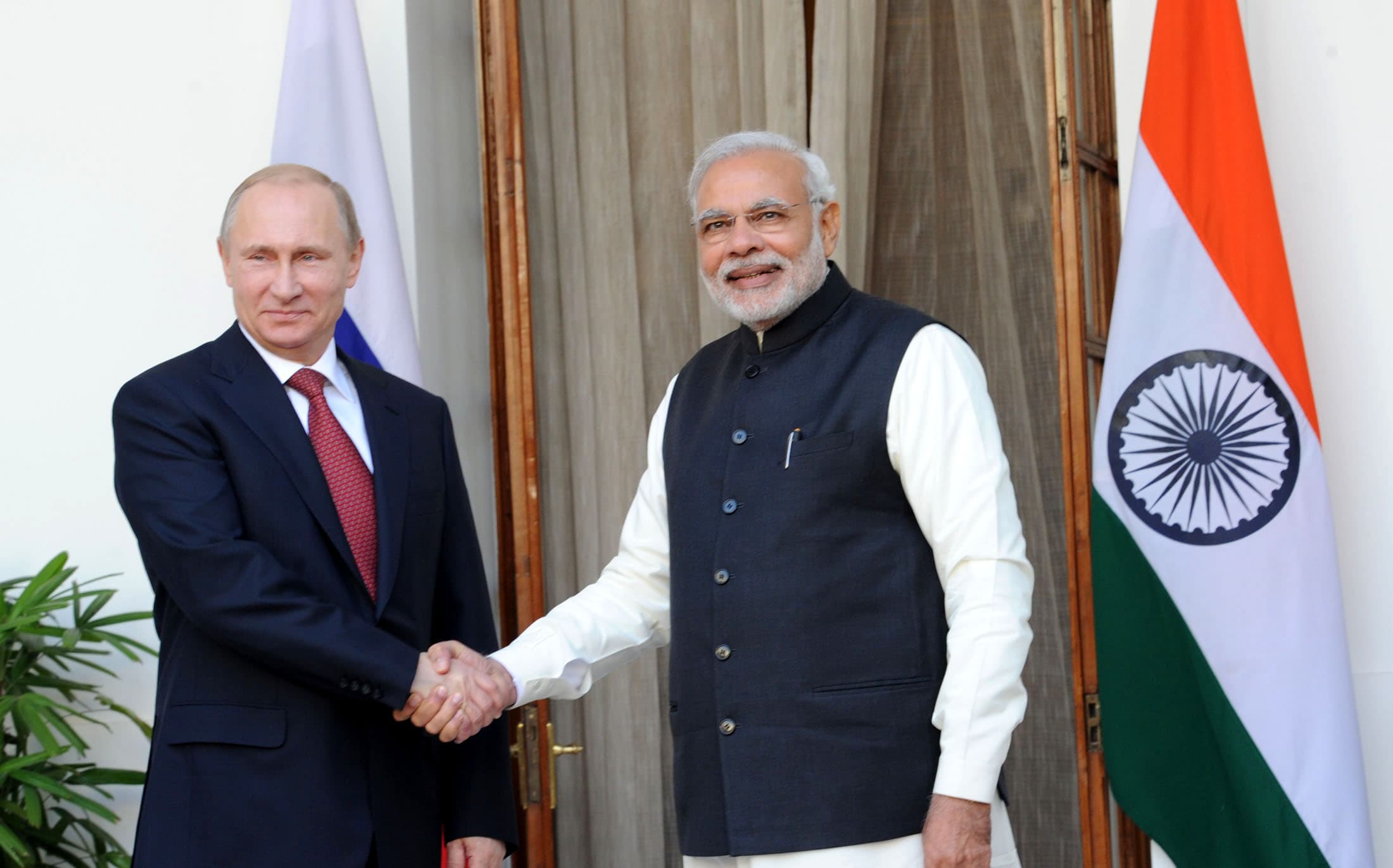
The 23rd India–Russia Summit in New Delhi did more than revive a traditional partnership; it exposed the treacherous geopolitical landscape that India must now navigate. With the Ukraine war pitting India’s most important partners — the United States, Europe and Russia — against each other, New Delhi’s diplomacy is less about choosing sides and more about shaping outcomes. The summit’s message was clear: India will deepen strategic ties with Moscow, support a negotiated peace in Ukraine, and still seek to preserve its gains with the West.
The Story
Optics, timing and Ukraine peace
Russian President Vladimir Putin’s first visit to India since the Ukraine war began was rich in symbolism.
-
Red carpet treatment in Delhi signalled India’s intent to remove any ambiguity about the relationship with Russia.
-
A large, high-powered delegation accompanied him, including Kirill Dmitriev, a key figure in ongoing peace efforts on Ukraine alongside U.S. interlocutors such as Steve Witkoff and Jared Kushner.
In diplomacy, optics and timing matter. The summit took place at a moment when:
-
Russia’s position on the battlefield is described as strong,
-
Ukraine is facing the prospect of military defeat,
-
The U.S. has, for all practical purposes, stepped back from deep involvement.
In this context, the only active peace initiative “in town” is associated with former U.S. President Donald Trump. Mr. Modi’s clear support for peace efforts on Ukraine, the editorial argues, should be read as a full endorsement of this Trump-linked process — and in that sense, India and the U.S. are on the same page on the need for a negotiated end to the war. The real outlier, at this point, is Europe, and India’s challenge will be to preserve its major gains with European partners while staying close to Moscow.
Economic Pillar: Programme 2030 and Trade in National Currencies
On the bilateral side, the summit adopted a Programme for the Development of Strategic Areas of India–Russia Economic Cooperation till 2030 (“Programme 2030”). Key economic elements include:
-
Strengthening arrangements for settlements and trade in national currencies, reducing dependence on the U.S. dollar system.
-
Removal of non-tariff barriers affecting bilateral trade.
-
Diversification of the trade basket, moving beyond a narrow energy focus.
-
Investment in non-energy sectors such as:
-
fertilisers,
-
railways,
-
pharmaceuticals,
-
mineral resources and critical raw materials.
-
Together, these steps are meant to make the $100 billion trade target by 2030 realistically achievable. For India, Russia’s under-utilised potential in raw materials, fertilisers and critical inputs is “an invaluable fit” for long-term growth needs.
Energy as a Foundational Pillar
India is the second-largest importer of fossil fuels in the world. As the editorial notes, assured and affordable energy is a national security imperative.
-
Russia’s energy resources dwarf much of the rest of the world.
-
China recognised this early and has worked relentlessly to secure a large share of Russian energy assets and supplies.
-
U.S. companies are also “waiting in the wings” to lock in access, including for critical minerals.
If India does not play its cards right, it could be pushed out of what is naturally its preserve, at great risk to its economic and energy security.
Hence, energy cooperation is expected to be a foundational pillar going forward, covering:
-
long-term oil and gas supplies,
-
joint projects in upstream exploration,
-
collaboration in critical minerals essential for energy transition.
New Frontiers: Connectivity, Arctic, Skilled Workers
Three new areas are highlighted as maturing well:
-
Maritime Connectivity and Shipbuilding
-
The Chennai–Vladivostok Maritime Corridor,
-
The Northern Sea Route, which offers shorter sea links between Asia and Europe through Arctic waters,
-
Enhanced cooperation in the shipbuilding sector.
-
-
Arctic Cooperation and Seafarer Training
-
Russian offers to train Indian seafarers,
-
India’s entry into Arctic operations and logistics, where Russia is the principal coastal power.
-
-
Export of Indian Skilled Workers to Russia
-
A major agreement, finalised after years of negotiation, to send Indian skilled workers to Russia.
-
This is driven by Russia’s structural demographic crisis, aggravated by:
-
war casualties,
-
reduced labour flows from Central Asia,
-
unease about growing Chinese presence in Russia’s Far East.
-
-
An agreement to ease tourist visas is flagged as another quick-yielding, overdue initiative, likely to support people-to-people ties and tourism flows.
Strategic Technology: Defence, Space, Nuclear, S&T
Science and technology cooperation — particularly in space, nuclear energy and defence — remains a legacy strength of the India–Russia relationship.
-
Russia has historically been described as a generous partner, often attaching fewer conditions than Western suppliers.
-
The Indo-Russian BrahMos missile has become a mainstay of India’s missile forces.
-
The S-400 air defence system proved its value during Operation Sindoor (May 2025), underlining the operational importance of Russian platforms.
Thanks to persistent Indian efforts:
-
Localisation,
-
Technology transfer, and
-
Joint production have all increased in recent years.
India still needs Russian support to maintain and upgrade its large legacy inventory of Russian origin equipment, even as it pushes for indigenisation under “Aatmanirbhar Bharat”.
Future defence collaboration is likely to focus on niche technologies and high-end systems, rather than simply buying off-the-shelf platforms.
Why It Matters
From an international relations and UPSC perspective, this summit matters on multiple levels:
-
It showcases strategic autonomy: India engaging deeply with Russia while maintaining strong ties with the U.S. and Europe.
-
It links energy security, technology access, and labour mobility to long-term national power.
-
It reflects how India reads the U.S.–China–Russia triangle: as great-power competition intensifies, India and Russia may find more reasons to close ranks in select sectors.
-
It highlights India’s belief that peace in Europe must ultimately come from Europe–Russia dialogue, not from prescriptions written in New Delhi — but that India can be a valuable partner and honest friend to all sides.
In Perspective
The editorial argues that the “real story” of the 23rd India–Russia Summit lies in:
-
the re-engineering of the relationship under new global conditions,
-
the resolve to move ahead despite sanctions, war and Western pressure,
-
and the strategic awareness of shifting equations between the U.S. and China that, paradoxically, draw India and Russia closer.
For Europe, the message is subtle but clear:
-
The road to peace does not run through New Delhi; it runs through serious engagement between Europe and Russia.
-
India’s role is not to mediate from the centre, but to remain a trusted partner to all, drawing on historical examples — both successes and mistakes — in great-power diplomacy.
Conclusion
The 23rd India–Russia Summit underscores India’s attempt to shape, not merely survive, a fractured world order. As the Ukraine war strains ties between its key partners, New Delhi is betting that deep energy and technology ties with Moscow, alignment with a negotiated peace, and careful management of relations with the West can coexist.
For India, the stakes are long-term: energy security, economic resilience, access to critical technologies and a stable Eurasian balance. The summit signals that India is willing to take calculated risks, confident that its strategic autonomy and diplomatic capital can keep doors open in Washington, Moscow and Brussels at the same time.