

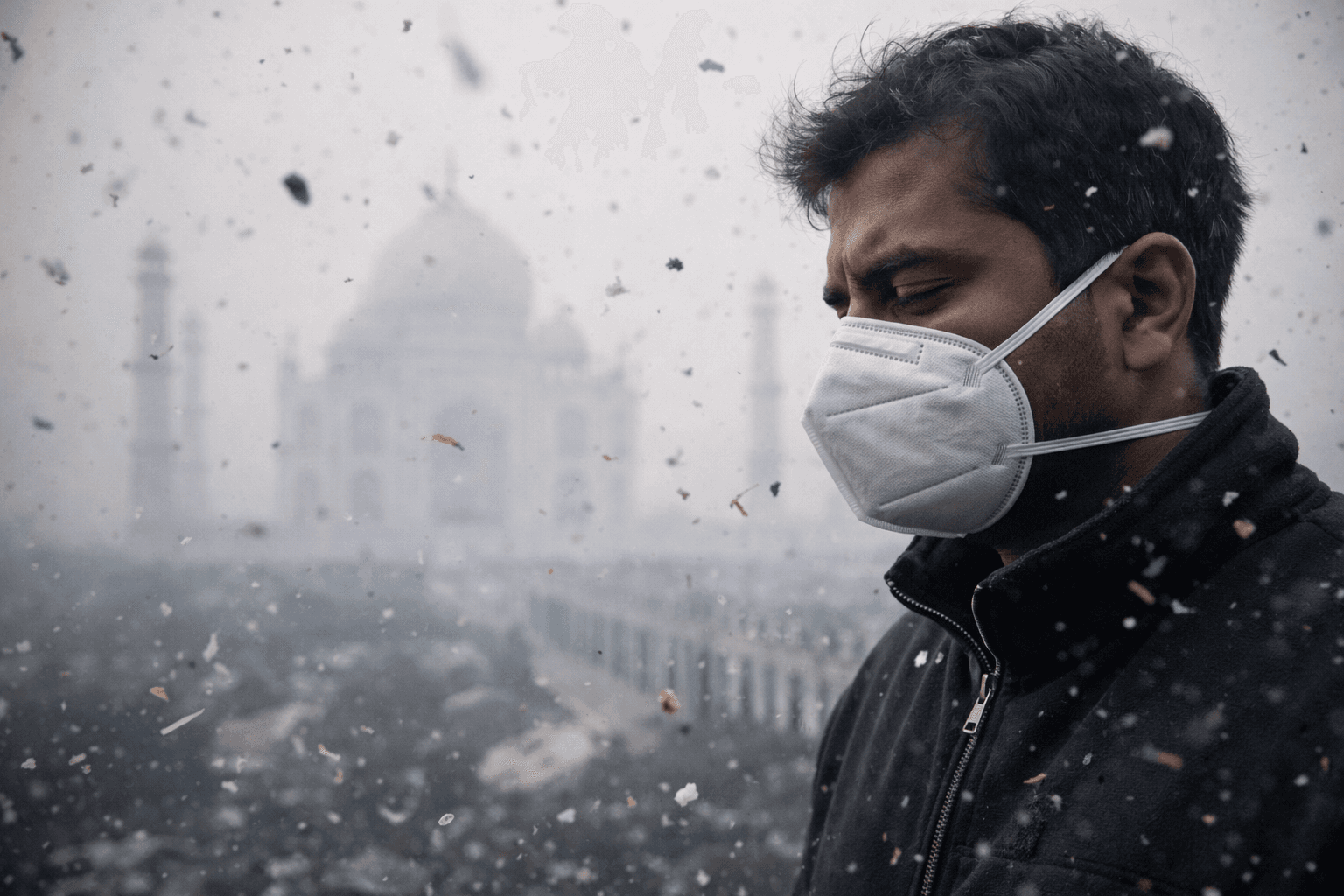
India’s winter air is already a toxic blend of particulate matter, traffic emissions, dust and smoke from waste burning. Now, an emerging contaminant is adding a new layer of risk: inhalable microplastics, tiny plastic particles that can enter the respiratory system and potentially transport other harmful substances deeper into the body. The concern is no longer only what the air contains, but also what these particles can carry.
What’s in the news
A peer-reviewed study published in Environment International (November 2025) reported measurable levels of inhalable microplastics (generally described as particles smaller than 10 micrometres) in high-footfall locations across major Indian cities, sampled at human breathing height. The study also flagged that these particles can act as carriers for co-pollutants such as heavy metals and chemical additives, and may even harbour microbes.
Background and context
Microplastics are usually discussed in water bodies, oceans, packaged food, and even table salt. Airborne exposure has received less public attention, partly because India’s air-quality discourse is dominated by PM2.5 and PM10. But microplastics overlap with this story: they can be a component within the particulate “soup”, generated by everyday urban activity and made worse by winter meteorology that traps pollutants close to the ground.
Why “inhalable” is the key word
Not all microplastics behave the same. Size decides where a particle ends up inside the body. Coarser particles may irritate the upper airway, but smaller particles are more likely to bypass natural defences and deposit deeper in the lungs. That is why inhalable microplastics shift the problem from being merely environmental to being directly physiological.
Key findings that sharpen the risk picture
The study’s value is not just detection, but the framing of a new exposure pathway.
Concentrations vary sharply by city and season
The reported exposure is not uniform. Higher concentrations were observed in non-coastal, high-density settings like Delhi and Kolkata, while coastal cities like Mumbai and Chennai showed lower levels, consistent with meteorology playing a strong role in dispersal. Winter conditions, especially stagnant air and inversions, appear to raise concentrations further, compounding an already severe smog season.
Microplastics as “Trojan horses”
The most policy-relevant insight is that inhalable microplastics may function like vehicles for other hazards:
-
Heavy metals such as lead and cadmium can attach to or travel with these particles.
-
Chemical additives (including plasticisers like certain phthalates) raise concerns around endocrine disruption.
-
Microbial hitchhiking has been flagged as a possibility, including organisms linked to respiratory disease and the broader threat of antibiotic resistance.
This matters because it reframes microplastics from being a standalone irritant to a multiplier of toxic exposure.
Likely sources are mundane and everywhere
The study’s discussion points to sources that are easy to underestimate: synthetic textiles and fibres, packaging fragments, tyre and brake wear, construction activity, household dust, small workshops, and mismanaged waste. In other words, this is not only a “plastic ban” issue. It is also a mobility, materials, and municipal governance issue.
Why it matters for health systems and city life
Air pollution already burdens India with chronic respiratory disease, cardiovascular risks, and reduced productivity. Inhalable microplastics create three additional complications:
-
A deeper-lung exposure route that standard public messaging does not yet address.
-
A combined-toxicity problem, where plastics plus heavy metals plus chemical additives become harder to regulate through single-pollutant thinking.
-
Occupational vulnerability, especially for people who spend long hours outdoors in traffic corridors and dense commercial zones: traffic police, street vendors, sanitation workers, delivery workers, and construction labour.
The policy gap hiding in plain sight
India’s AQI framework and city action plans focus on criteria pollutants and particulate mass thresholds. Microplastics do not yet sit comfortably inside this structure because:
-
routine monitoring networks are not designed to identify polymer type, particle morphology, or attached contaminants;
-
regulations are still evolving globally on how to define, measure, and attribute health impacts;
-
local interventions often target visible culprits (dust, smoke, stubble) but miss persistent urban generators like tyre wear, synthetic fibre shedding, and informal waste burning.
What strengthening the response can look like
This does not require inventing a brand-new environmental bureaucracy. It requires upgrading the current one.
Better measurement and disclosure
-
Add pilot monitoring for airborne microplastics in selected urban hotspots (markets, traffic corridors, industrial edges).
-
Build a standard protocol for sampling at breathing height and reporting results in a comparable way across cities.
Stronger municipal waste discipline
-
Reduce open burning through enforceable segregation, decentralised processing, and predictable collection.
-
Treat landfill fires and chronic burning points as continuous air-pollution sources, not seasonal inconveniences.
Cleaner mobility and materials
-
Target non-exhaust emissions (tyre and brake wear) through road-dust management, smoother traffic flow, and better street cleaning.
-
Encourage material standards that reduce micro-fibre shedding in high-volume applications, without pushing the burden onto consumers alone.
Protecting high-exposure workers
-
Issue occupational advisories during severe pollution spells.
-
Provide protective gear and rotate duties for high-exposure roles, similar to heat-action plans but tailored for air-risk days.
Source credits
Environment International (November 2025 study on inhalable microplastics in Indian cities); IISER Kolkata research team and collaborating institutions; public air-quality frameworks and winter pollution response measures used by Indian urban regulators.