

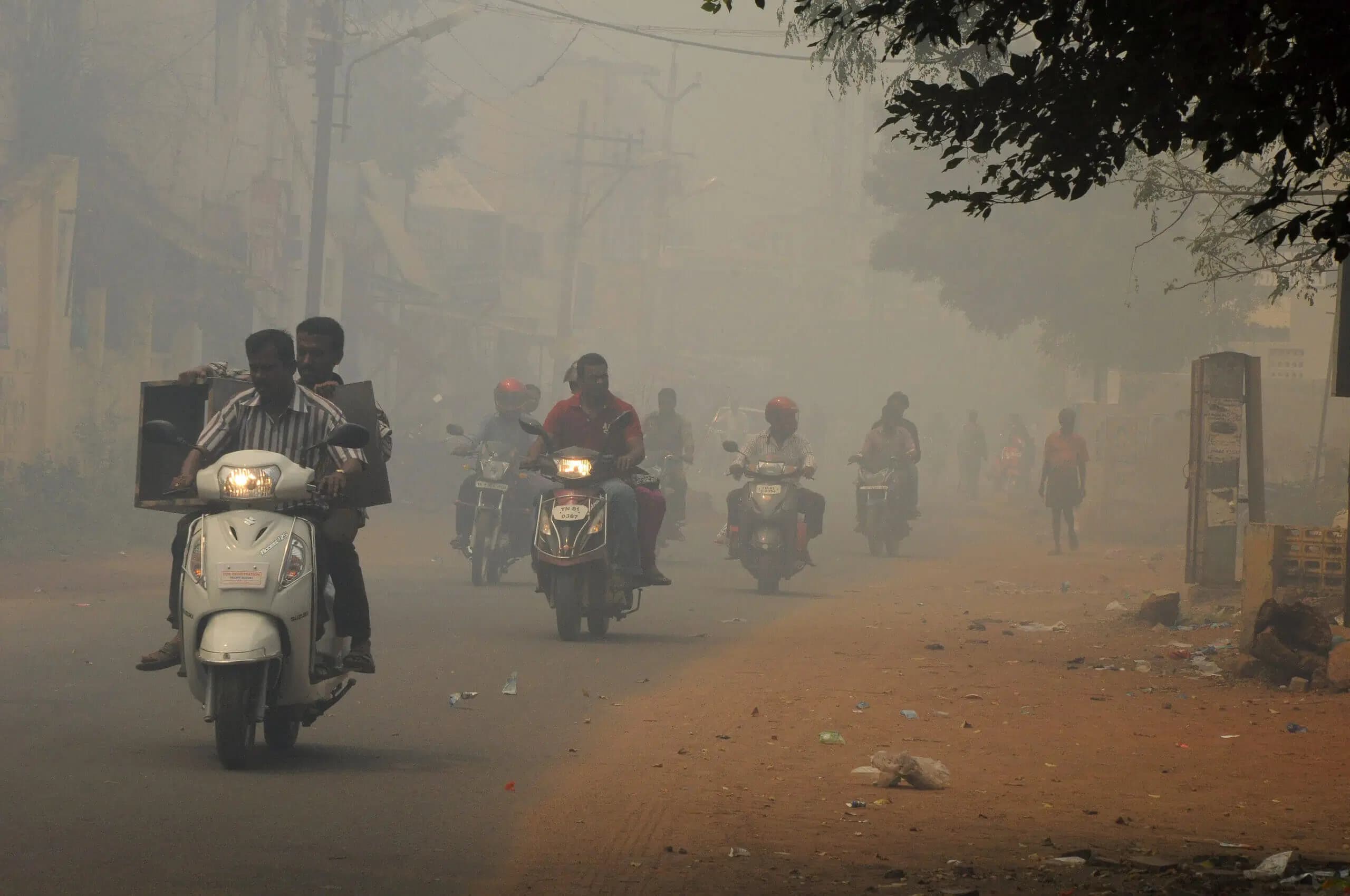
India’s air pollution crisis has moved beyond winter headlines. It is now a persistent public-health risk that compounds non-communicable diseases, deepens inequality, and dilutes the gains of economic growth. The real challenge is not awareness, but governance that treats clean air as a core development asset.
The Story
Evidence now shows a wide spread of cities exceeding national PM2.5 standards, while medical and epidemiological assessments increasingly attribute a large mortality and morbidity burden to long-term exposure. The policy response exists, but remains constrained by measurement gaps, uneven enforcement, and a tendency to treat the problem as episodic rather than structural.
Why It Matters
1) Air pollution is not a “lungs-only” problem, it is a whole-of-body risk amplifier
PM2.5 does not merely irritate airways. It behaves like a systemic stressor, accelerating cardiovascular disease, worsening diabetes outcomes, and increasingly being linked to cognitive decline. In governance terms, that changes the lens from “environment” to national health security, similar to how unsafe water is treated as a development emergency.
2) The biggest policy error is treating a chronic exposure like a short-term shock
Smog episodes make headlines, but the deeper harm is the baseline exposure across months and years. When a risk is chronic, the state’s response must be chronic too: stable monitoring, routine health integration, and predictable enforcement. Otherwise, we keep fighting symptoms while the disease progresses quietly.
3) Inequality is built into the air people breathe
Air pollution acts like a regressive tax. Low-income households are more likely to live closer to highways, landfill fires, brick kilns, and construction dust. They also have less access to indoor filtration, safer fuels, and timely healthcare. This converts air quality into an equity and social justice issue, not only a climate or urban issue.
4) The credibility crisis is also a measurement crisis
When the index caps “extreme” values into a single bucket, risk communication becomes blunt. Public messaging then struggles to differentiate between “bad” and “catastrophic,” weakening behavioural guidance, school health advisories, and emergency protocols. A modern state needs granular public-risk communication, not a one-word label.
5) Clean air is now tied to constitutional expectations, not only policy preference
Courts have repeatedly read the right to a pollution-free environment, including clean air, into Article 21. That means clean air is increasingly treated as a rights obligation, not a discretionary welfare scheme. In practice, this shifts debate from “should we act” to “how fast, how fairly, and with what accountability.”
Background and Context
1) Standards, guidelines, and the compliance gap
India’s NAAQS for PM2.5 remain significantly looser than WHO’s updated guidelines. This gap matters because it influences what is counted as “acceptable,” how city plans are evaluated, and what gets normalised as routine exposure.
2) Policy architecture already exists, but needs sharper teeth
-
NCAP has a revised target framework linked to PM10 reduction and meeting national standards by 2025–26.
-
The CAQM framework in NCR and adjoining areas reflects an attempt to solve the hardest governance problem: multi-State coordination for one airshed.
3) Monitoring is expanding, but reliability and completeness remain weak links
A larger network is useful only if data quality is dependable and comparable, and if it feeds enforcement rather than dashboards alone. Monitoring should be treated like “public health surveillance,” not a decorative statistic.
Implications
1) From “pollution control” to “health-first governance”
If air pollution is a leading risk factor, then public health systems must integrate it like they integrate malnutrition or TB: advisories, screening, prevention, and risk stratification. This is not a new programme demand. It is a re-framing of existing state capacity.
2) Economic growth without clean air becomes self-defeating
Polluted air silently reduces labour productivity, increases healthcare spending, and diminishes learning outcomes. That undermines the very growth dividends India seeks. Clean air, therefore, is not anti-growth; it is pro-growth insurance.
3) The next frontier is airshed governance and accountability
City-by-city plans help, but pollution behaves like a regional phenomenon. The policy frontier is coordinated action across transport corridors, industrial clusters, agricultural zones, and waste ecosystems, with clear responsibility lines and measurable compliance.
Conclusion
India does not lack evidence or institutions. What it needs is a national pivot that treats clean air as a non-negotiable public good, backed by credible measurement, enforceable standards, and health-centred governance. The dividend is not only longer life, but fairer growth and stronger human capital.