

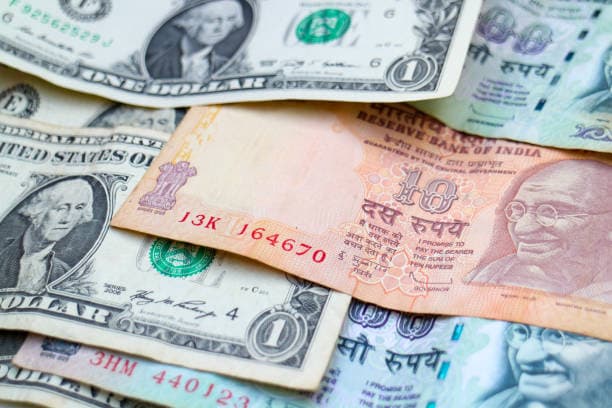
A currency crossing a round number is always a flashpoint, because it feels like a verdict on the economy. The rupee’s slide below ₹90 to a dollar has invited exactly that reaction. But exchange rates do not move on emotion alone. They respond to the balance of dollar demand and supply, global interest-rate expectations, trade flows, and the risk appetite of foreign investors. The practical question is not whether the rupee “should” be at a particular level. The question is whether the move is orderly and financeable—or whether it is becoming self-reinforcing and disruptive for households, firms and the government.
What’s in the news
The rupee has weakened sharply in recent sessions, staying below ₹90/$ amid discussion on trade uncertainty, portfolio flows, the trade deficit and the degree of market intervention by the Reserve Bank of India. Economists have also pointed to a distinction between the “real economy” (growth, domestic demand) and “external price pressure” (dollar scarcity, risk-off flows).
Background and context
Exchange rate moves are often about the world, not just India
In the short run, currencies can overshoot because global capital moves faster than goods trade. When the dollar strengthens globally or investors seek safety, emerging market currencies tend to come under pressure—even if domestic growth is robust.
A “weak rupee” is not automatically a “weak economy”
Currency movement is one indicator among many. Strong domestic growth, stable inflation and comfortable reserves can coexist with a weaker currency if global conditions and capital flows turn adverse. The more useful signal is not the level alone, but whether the movement is volatile, panicky, and reserve-draining.
Why the rupee is weakening
Portfolio outflows and risk appetite
Foreign portfolio investors can move money quickly across markets. When global returns look more attractive elsewhere, or when valuations feel stretched, capital flows can turn negative. That increases dollar demand and adds pressure on the rupee, independent of domestic growth.
Trade imbalance and the current account
When imports grow faster than exports, the economy demands more dollars than it earns through trade. Even if services exports perform well, a widening goods deficit can still tilt the demand–supply balance against the currency.
Sentiment around trade policy and tariffs
Where trade negotiations and tariff expectations are in flux, uncertainty becomes a price in itself. Markets begin to price the risk of lower export growth, margin pressure, or delays in investment decisions.
RBI’s role: smoothing, not fixing
The central bank typically aims to curb excessive volatility rather than defend a particular number. Limited intervention can signal confidence that the move is within tolerable bounds. Heavy, visible intervention can calm markets, but it also invites speculation about how much the RBI is willing to spend from reserves.
Is the rupee falling worse than other currencies?
The right comparison is the “real effective exchange rate” and peer baskets
A bilateral rate against the dollar can exaggerate fear because the dollar itself may be strengthening. A better assessment looks at:
-
how the rupee performs against a basket of trading partners,
-
whether the rupee is losing competitiveness unusually fast,
-
and whether the move is faster than peers facing similar global conditions.
Short bursts can look extreme in “three-month” charts and appear milder on a “two-year” view. Both matter: the former for volatility and business planning, the latter for structural stability.
Who gains and who loses from a weaker rupee
Exporters and services firms gain in rupee terms
A weaker rupee improves rupee realisations for exporters, especially in IT and services where revenue is dollar-linked while many costs are rupee-linked. That can support earnings, investment and—sometimes—wage and bonus cycles.
Importers pay more, with unequal pain
Import-dependent sectors face immediate stress: fuel-linked industries, electronics, machinery, chemicals, and firms importing intermediate inputs. The impact depends on hedging. Firms with strong hedges feel less pain; firms without hedges face sudden margin compression.
Inflation: usually a nudge, not a wildfire—unless fuel shocks join in
Imported inflation in India tends to be most visible through energy channels and some tradable commodities. A gradual depreciation typically pushes prices up at the margin, not explosively, especially if domestic demand is not overheated. The danger rises when depreciation coincides with a jump in global crude or commodity prices.
Fiscal implications show up quietly
A weaker rupee can raise the rupee cost of subsidised imports and certain procurement bills, and it can increase the effective cost of programmes linked to imported inputs. The impact is rarely immediate enough to panic budgets, but it can tighten fiscal room at the margin.
What would genuinely be alarming
Disorderly volatility and a self-fulfilling spiral
A slow slide is manageable. A sharp, gapping move is disruptive because it breaks the ability of businesses to price contracts and hedge risks. When markets sense no anchor, speculation can feed further depreciation.
A persistent deterioration in the external balance
If the current account deficit widens materially and stays wide—without offsetting stable capital inflows—pressure becomes structural rather than temporary.
Rapid reserve drawdown or visible liquidity stress
Reserves exist to provide confidence and stability. Alarm begins if reserves fall quickly in a short span, or if domestic liquidity conditions become strained due to heavy intervention.
A policy credibility shock
Markets also watch for consistency: inflation management, fiscal discipline, and regulatory stability. If any of these are seen to weaken, currency pressure can intensify regardless of growth.
What policy can realistically do
Keep the move orderly, not “strong”
The most practical goal is to avoid disorderly swings. This can be achieved through calibrated intervention, clearer communication, and ensuring liquidity conditions remain stable.
Reduce vulnerability through structural buffers
Over time, the currency becomes less fragile when:
-
exports broaden beyond a few sectors,
-
domestic manufacturing reduces import intensity,
-
energy dependence is lowered,
-
nd long-term capital inflows deepen.
Bottom line
A rupee below ₹90/$ is not, by itself, a national emergency. It is a warning signal to watch volatility, external financing conditions, and inflation transmission—while avoiding the temptation to treat a currency level as a scoreboard. If depreciation remains orderly and fundamentals stay intact, the economy can absorb it. The real risk begins when the move becomes disorderly, reserve-draining, and confidence-eroding.
Source credits
Edited conversation excerpts featuring Madan Sabnavis and Ranen Banerjee, moderated by TCA Sharad Raghavan (as shared by the user); RBI policy and communication context (general background); standard macroeconomic transmission concepts used by central banks and international financial institutions.