

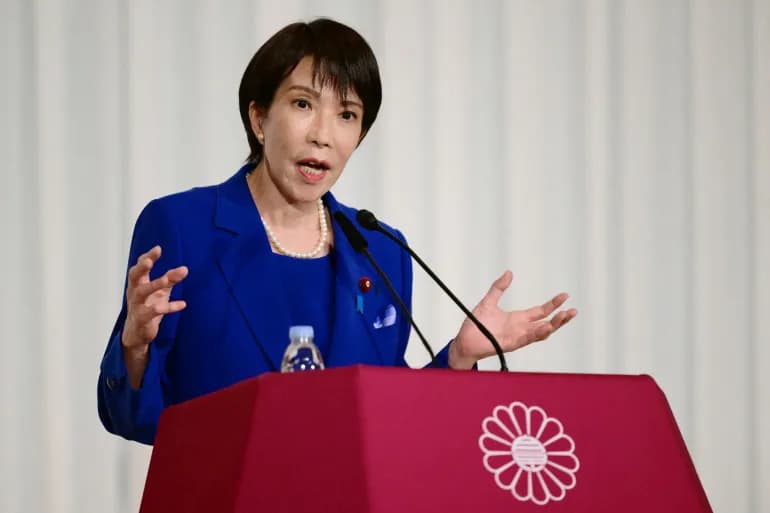
Within days of taking office, Prime Minister Sanae Takaichi has pledged to lift defence expenditure to 2% of GDP by March 2026 (two years ahead of the earlier glide path), reaffirmed support for security partnerships including the Quad, and signalled that India sits at the heart of Japan’s Free and Open Indo-Pacific (FOIP) strategy. The agenda is ambitious. Here’s the strategic, fiscal, and diplomatic reality check.
1) The 2% defence target — what it really buys
-
From “shield” to “active shield”: Japan’s modernisation drive spans integrated air & missile defence, counter-strike capabilities (stand-off missiles), ISR (satellites, P-1/P-3, UAVs), cyber & space, and maritime power (Aegis destroyers, submarines).
-
Budget physics: Hitting 2% of GDP by FY2025–26 compresses procurement schedules, O&M, and munitions stockpiles into fewer budget cycles. The binding constraint may be industrial capacity (shipyards, missile lines, electronics) and workforce more than money alone.
-
Article 9 guardrails remain: Tokyo’s doctrine stays defensive, with “counter-strike” framed as deterrence—not power projection. Expect careful legal justifications and rules of engagement that keep public opinion on board.
Watchlist: munitions surge plans, shipyard throughput, joint production timelines, and whether sustained O&M (spares, training hours, fuel) keeps pace with shiny new platforms.
2) India in Japan’s FOIP: from slogans to supply chains
-
Why India is pivotal: Geography (sea lanes via Malacca–Lombok), market scale, defence interoperabilitypotential, and converging concerns about coercion in the Indo-Pacific.
-
What can move fast:
-
Maritime domain awareness (MDA): more info-sharing, white-shipping agreements, and HADRplaybooks for the Bay of Bengal/IO.
-
Critical tech and logistics: semiconductor and EV supply-chain hedges, rare-earth processing, and defence components where export rules allow.
-
Connectivity: coordinated financing between Japan’s JICA/JBIC and India’s agencies for ports, rail, industrial corridors, and resilient digital infra.
-
-
Where realism is needed: India’s Make in India localisation, Japanese export controls and compliance culture, and differing comfort levels on military basing keep ambitions grounded.
Quick wins: tri-service tabletop exercises, joint unmanned systems trials at sea, and time-bound pilots in battery materials and chip packaging.
3) The Quad signal — substance over summitry
-
Operational centre of gravity: The Quad works best on practical public goods—MDA, undersea cable security, satellite data for climate and fisheries, supply-chain risk mapping, standards for trusted tech/AI, and HADR.
-
India–U.S. friction ≠ Quad freeze: Even if bilateral trade spats slow optics, the Quad’s working groups can keep delivering. Expect Tokyo to shepherd continuity while aligning with Canberra and Washington on timelines.
Measure, don’t proclaim: publish deliverables (cable repair SLAs, maritime alerts lead-times, shared satellite products) rather than communiqués alone.
4) Domestic headwinds in Tokyo
-
Inflation & fiscal stress: A tighter household squeeze complicates sustained defence outlays; any tax tweak or bond financing will test political capital.
-
Demographics & labour: The PM flagged population decline and stricter immigration controls; that narrows the very talent pool needed for defence tech and care-economy reforms.
-
Consensus politics: Durable security shifts in Japan require elite and public consensus; transparent messaging on threat assessments (China, North Korea, Russia) will be key.
5) ASEAN outreach and U.S. alignment
-
ASEAN first stop: Signalling that FOIP isn’t anti-ASEAN but with ASEAN—expect maritime capacity building, green finance, and digital standards.
-
U.S. ties “to greater heights”: Expect emphasis on interoperability, missile defence, and co-development—with careful choreography around regional sensitivities.
6) What this means for India (actionable)
-
Maritime: Scale P-8I/JMSDF data-sharing drills; prototype a Quad HADR playbook pre-monsoon; expand Andaman–Nicobar–Japan coast guard coordination.
-
Industry: Pick 3–4 winnable JV lanes (naval electronics, UAV subsystems, battery materials, specialty machine tools). Lock time-boxed milestones and procurement pipelines.
-
Tech & standards: Align on 5G/ORAN security, semicon packaging, AI audit frameworks, and critical mineral traceability—areas where Quad/Japan standards can globalise.
-
Finance: Use Japan’s patient capital to de-risk long-gestation manufacturing in India; blend with production-linked incentives and single-window clearances.
Risks & mitigations
-
Budget slippage: Hedge with multi-year framework contracts and modular capability blocks.
-
Supply-chain choke points: Dual-source components; build strategic spares; negotiate emergency carve-outsin export rules.
-
Regional escalation: Keep crisis hotlines, Rules of Behaviour at sea, and confidence-building with ASEAN to avoid miscalculation narratives.
-
Quad optics vs outcomes: Ring-fence working-level cooperation from summit schedules; track outputs quarterly.
Quick notes (recall)
-
FOIP: Open sea lanes, rules-based order, connectivity, resilient supply chains.
-
Japan’s defence shift: Toward 2% of GDP, emphasis on missile defence/counter-strike, cyber/space, naval strength.
-
India–Japan synergy: Maritime security, supply chains, infrastructure finance, critical tech.
-
Quad’s comparative advantage: Practical public goods (MDA, HADR, tech standards), not alliance-style guarantees.
Credits: The UPSC Times diplomacy desk analysis based on official speeches, parliamentary statements, and standard defence-economics frameworks.