

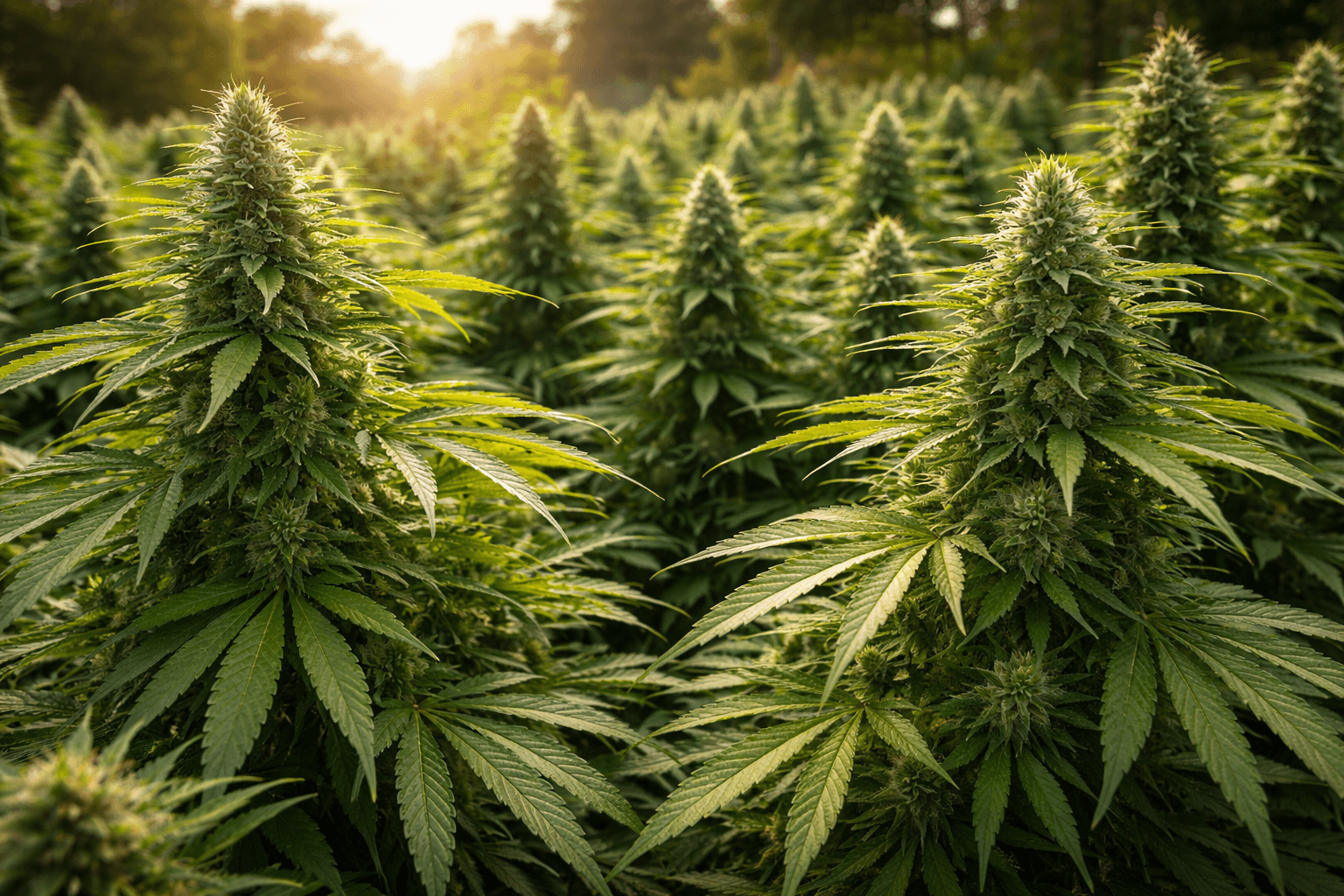
A short drive from Kandhamal’s district headquarters and a modest trek into the hills can open into a valley that looks untouched—until the sound of mowers and boots breaks the illusion. What appears as green abundance is often an illegal crop with a long shadow. In Kandhamal, illicit cannabis cultivation has become both a policing problem and a livelihood distortion: a high-return plant rooted in difficult terrain, weak land legibility, and a supply chain that rewards those who fund and move it far more than those who grow it.
What’s happening on the ground
A campaign built on destruction and interception
Local enforcement has moved beyond sporadic raids into a sustained seasonal campaign—flattening standing crops before flowering, seizing consignments early, and trying to ensure that produce does not exit the district. The scale is striking: thousands of acres cleared, large quantities seized, and hundreds of arrests in a single year, as per district-level figures quoted by officials in field reporting.
A parallel challenge: fatigue and cost
Uprooting cannabis in Kandhamal is not a “paper exercise.” It is manpower-heavy, physically exhausting, and expensive. Many plantations sit far from motorable roads, requiring hours of trekking with tools and rations. This creates a structural imbalance: cultivation can be decentralised cheaply; destruction is centralised and costly.
Why Kandhamal became fertile for an illicit crop
Terrain that hides, climate that helps
Remote forested slopes and broken hillsides make surveillance difficult and access harder. The same landscape that sustains biodiversity also offers concealment—natural cover, dispersed plots, and multiple exit routes for transporters.
A crop that outbids legality
Cannabis brings faster and higher cash returns than many legal crops available to small farmers in fragile hill ecologies. When household budgets are shaped by uncertain rains, limited market access, and debt cycles, the attraction of assured cash becomes overwhelming—especially when the risk is spread across an entire village network.
A value chain that rewards the invisible player
The most important actor is often not the grower but the financier—someone who pays for seeds, coordinates procurement, arranges transport, and insulates identity through layers of intermediaries. The grower becomes replaceable; the financier remains hidden.
The “cat-and-mouse” technology war
Drones and detection, camouflage and fragmentation
Authorities are using drones and tech-based monitoring to spot plantations. Growers have responded with a simple strategy: shrink the patch, break it into multiple micro-plots, and hide plants under tree cover. Smaller plantations reduce detection probability and complicate the economics of large-scale destruction.
The limits of surveillance
Even advanced detection cannot solve the “proof problem” on forestland—establishing who controlled the plot, who financed it, and who benefits from the final sale. In court, that chain matters.
The money trail: where the battle is shifting
From crops to cash flows
There is a visible shift toward targeting those who bankroll cultivation—running crop raids alongside criminal investigations, and following suspicious transactions that do not align with known income sources.
Why this is difficult
Financial investigation requires skills, time, and inter-agency cooperation. Informal cash movement, proxy accounts, and layered transfers are designed to blur responsibility. Without consistent financial intelligence and prosecution capacity, the system defaults to catching foot soldiers while kingpins remain insulated.
Security and governance complications
Organised crime thrives in institutional gaps
Kandhamal’s cannabis economy exploits overlapping jurisdictions—forest department land, police enforcement, revenue records, and local governance. When land ownership is unclear and enforcement is episodic, illicit cultivation becomes a “low-visibility enterprise.”
The insurgency angle
Officials and police sources have linked illicit cultivation networks with extremist patronage in parts of the region. Even the perception of such backing is enough to create fear, silence informants, and harden local compliance with network operators.
What this does to society and the local economy
A fast-cash crop can hollow out lawful farming
When cannabis becomes the highest-paying option, it crowds out legitimate crops and discourages long-horizon investments—soil improvement, orchard development, irrigation, and market linkages. Over time, this can trap communities in an illegal monoculture that is profitable in good years and devastating in crackdown years.
Women, youth and the hidden costs
Illicit economies often reshape household roles—who moves money, who absorbs risk, who faces arrest. The social cost is rarely visible in seizure data: school dropouts, normalisation of illegal income, and rising local conflict over shares and suspicion.
A public health pipeline to distant cities
The cultivation site is rural, but consumption and harm travel outward. Large consignments that leave the hills feed urban demand, driving a supply loop where rural risk underwrites metropolitan consumption.
What could change the trajectory
Alternative livelihoods must be credible, not symbolic
Replacing cannabis requires legal options that compete on three fronts:
-
income certainty (predictable cashflow),
-
market access (procurement, aggregation, transport),
-
risk cover (support during crop failure or price crashes).
Spices, fruits, high-value vegetables, beekeeping, and agroforestry can work in hill districts—but only when backed by assured buyers, extension support, and local processing.
Use public works as a bridge, not a substitute
Rural employment support can help families during sowing and lean months, reducing the pressure to take illicit advances from financiers. But public works alone cannot replace an organised market. The bridge must lead somewhere: stable value chains, cooperative marketing, and local enterprise.
Strengthen prosecution capacity, not only raids
The deterrent effect rises sharply when financiers and transport coordinators face consistent prosecution outcomes. That requires:
-
tighter evidence collection,
-
better financial investigation,
-
stronger inter-district coordination,
-
and witness protection and community trust measures.
Conclusion
Kandhamal’s cannabis problem is not simply a law-and-order story. It is a story of geography, incentives, hidden capital, and governance gaps—where the plant survives because the economics make it rational for the vulnerable and profitable for the powerful. Crop destruction can disrupt supply, but durable success will come only when lawful livelihoods become easier to choose than illegal ones—and when the system can reliably reach the financiers who currently treat the hills as a low-risk production zone.
Source credits: Field report from Kandhamal (Phulbani, Odisha) carried by national media; background reportage on Odisha’s anti-cannabis drives and livelihood alternatives; official statements quoted from district police leadership in the same reporting.