

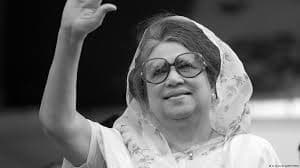
Bangladesh is entering election season with a sudden historical full stop. Khaleda Zia’s death does not merely mark the passing of a former Prime Minister. It ends the living presence of a political figure who, alongside Sheikh Hasina, defined the country’s democratic churn, street politics, and governing culture for over three decades. The question now is not only who inherits her party’s leadership, but whether the transition to an elected government in 2026 can be made believable to an exhausted polity.
What’s in the news
Khaleda Zia, chairperson of the Bangladesh Nationalist Party (BNP) and the country’s first woman Prime Minister, died in Dhaka on December 30, 2025, aged 80. Bangladesh announced three days of state mourning; funeral prayers were scheduled on December 31 in front of the national Parliament complex area, with burial beside former President Ziaur Rahman with state honours.
Her death comes weeks after Bangladesh’s Election Commission announced February 12, 2026 as the date for parliamentary polls, the first national election since the 2024 upheaval that led to an interim government under Muhammad Yunus.
Background and context
Khaleda Zia’s political identity fused three strands: legacy, party organisation, and anti-incumbency mobilisation. Widowed after President Ziaur Rahman’s assassination, she rose to lead the BNP and served as Prime Minister in 1991–96 and 2001–06, becoming one of the world’s earliest women leaders in a Muslim-majority country.
Her rivalry with Sheikh Hasina became Bangladesh’s signature political structure: alternating mandates, deep polarisation, periodic boycotts, and institutions caught in the crossfire. Over time, politics hardened into a winner-takes-all contest where legitimacy was frequently litigated on the streets as much as in Parliament.
In recent years, her legal troubles and illness reduced her direct operational role, but she remained a unifying emblem for the BNP’s base. The Supreme Court’s acquittal in her last pending corruption case earlier in 2025 was politically consequential because it revived the idea of her moral “vindication” in BNP narratives, even as practical leadership moved to her son and party acting chair, Tarique Rahman.
Key details
1) Timing: election season and succession clarity
Khaleda Zia’s death arrives when the BNP is already pivoting toward Tarique Rahman as the face of the 2026 contest. His return from long exile in late December 2025 was treated by the party as a mobilisation moment; her passing now converts mobilisation into memorial politics, a powerful emotional register in South Asian electoral behaviour.
2) Funeral as political choreography
Large state funerals in polarised societies are not only rituals; they are signals of who holds institutional goodwill, who commands the streets, and how the state treats Opposition legitimacy. The management of crowds, security posture, and official messaging will be read as a preview of election conduct.
3) The old binary ends, but polarisation does not
The Hasina–Zia era as a two-person rivalry ends, yet the deeper cleavage remains: the BNP’s claim of victimhood and restoration versus the counter-claim that the Opposition’s past governance enabled illiberal drift. The electoral contest is likely to be less about policy platforms and more about institutional trust.
Why it matters
For Bangladesh:
This is a transition moment where grief intersects with governance. If handled well, it can calm politics through dignified consensus. If mishandled, it can widen mistrust and street tension at exactly the wrong time. The interim government’s central challenge is not just conducting an election, but conducting one that looks procedurally clean in every district, every booth, and every dispute.
For India and the region:
Bangladesh’s stability matters for border management, migration pressures, trade corridors, coastal security, and the broader Bay of Bengal balance. Leadership change in Dhaka can influence the tone of bilateral engagement, especially on security cooperation and economic connectivity, even when core national interests remain steady.
For democratic credibility:
The region is watching whether Bangladesh can move from upheaval to a credible mandate without sliding into either crackdown politics or perpetual street vetoes.
Arguments for and against
Argument that this could stabilise the transition
A unifying national mourning period can lower the temperature temporarily. It can also reduce the temptation for immediate escalatory rhetoric, creating space for the interim administration and political parties to publicly recommit to non-violence, due process, and campaign norms.
Argument that this could intensify electoral tension
Martyr-memory politics can harden positions. The BNP may gain emotional momentum, while rivals and state institutions may fear mass mobilisation. In a climate of weak trust, even routine administrative actions can be interpreted as partisan signalling, leading to faster escalation over small triggers.
A realistic middle view
The stabilising effect, if any, will be short-lived unless backed by visible institutional fairness: neutral policing, predictable permissions for rallies, transparent dispute resolution, and credible election management.
Constitutional / legal angle
Bangladesh’s immediate constitutional stress-point is institutional neutrality during an election under an interim arrangement. Even if election schedules and formal frameworks are in place, credibility depends on how laws are applied: policing of rallies, enforcement of campaign rules, and adjudication of complaints.
Khaleda Zia’s own legal trajectory also remains politically salient: it is cited by supporters as evidence of political targeting, and by critics as proof of accountability. In such a contested environment, the handling of high-profile cases and rights of political participation must appear consistent, not selective.
Implications
Domestic politics: The BNP’s campaign will likely consolidate faster around Tarique Rahman, with the party projecting continuity of legacy plus a promise of “restoration.” The risk is over-personalisation: when politics becomes biography, policy debate thins out.
Election management: Crowd mobilisation around memorial events increases the premium on disciplined policing. Any perception of coercion, selective permissions, or uneven enforcement can become a flashpoint.
Regional diplomacy: India, China, and other partners will watch the stability of Dhaka and the direction of policy signals. Uncertainty during transitions can slow investment decisions and complicate security coordination.
Way ahead
Bangladesh’s best path here is sober, procedural confidence. That means keeping politics competitive but the state visibly restrained.
-
Make election administration boring again: publish clear operating procedures for complaints, timelines for disposal, and transparency on enforcement actions, so outcomes look rule-driven, not discretionary.
-
De-escalate the street: encourage parties to use public commitments on non-violence, restraint in rhetoric, and cooperation with lawful permissions and routes.
-
Protect civic space without romanticising chaos: free campaigning needs safety, and safety needs predictable enforcement. The balance will define legitimacy.
-
Keep foreign policy steady: reassure partners that core commitments on trade, border coordination, and maritime security remain continuous regardless of the electoral contest.
Source credits
Reuters; Associated Press; The Hindu; The Daily Star; Bangladesh Sangbad Sangstha (BSS); Al Jazeera; The Washington Post; The Times of India; Hindustan Times; The Indian Express.