

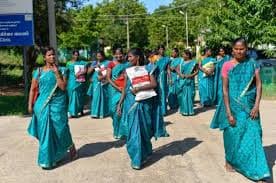
From Maharashtra’s Anshakalin Stri Parichars to ASHAs and anganwadi workers nationwide, India’s rural care economy runs on women’s labour that is essential yet undervalued. As protests recur, the policy question is no longer whether these workers matter—it is how quickly India can ensure fair pay, social security, and safe work while sustaining last-mile services.
Who are ASHA workers?
Accredited Social Health Activists (ASHAs) are community health volunteers under the National Health Mission, launched in 2005. They mobilise households for maternal–child health, immunisation, sanitation, disease surveillance and primary care linkages. Selection norms require a woman resident of the village, preferably aged 25–45 years, literate, with preference given to those educated up to class 10.
Who can be an ASHA (eligibility/qualifications)?
Eligibility emphasises that the woman must be a permanent resident of the village, aged 25–45, minimally literate (class 8 or above), with preference for class 10 pass, and trusted by the community.
How many ASHAs does India have?
India has more than 10 lakh ASHAs deployed across states. For example, Bihar has over 90,000, Maharashtra about 70,000, and Madhya Pradesh nearly 69,000. This vast network underscores the programme’s scale and importance.
How are ASHAs paid—what changed recently?
ASHAs receive a mix of fixed incentives from the Centre and performance-linked payments, with states allowed to top up. The fixed incentive has been revised upward in recent years, but earnings remain modest and often below minimum wages. Some states, such as Kerala, have moved closer to recognising ASHAs as health workers and pay higher honoraria, but variation across states persists. Delays in payments remain a chronic problem.
Who are anganwadi workers?
Anganwadi workers and helpers are frontline staff of the Integrated Child Development Services (ICDS), now operating under Saksham Anganwadi and Poshan 2.0. They provide supplementary nutrition, growth monitoring, early childhood care and education, and maternal-child counselling through anganwadi centres.
ASHA vs Anganwadi—what’s the difference?
-
Mandate: ASHAs focus on health mobilisation and linkages; anganwadi workers focus on nutrition and early childhood services.
-
Programme: ASHAs are under the Ministry of Health and Family Welfare (National Health Mission); anganwadi workers are under the Ministry of Women and Child Development (ICDS/Saksham Anganwadi).
-
Pay: ASHAs are mostly incentive-based; anganwadi workers receive honoraria with periodic revisions.
Recent data & studies on ASHAs and women in care work
Research shows ASHAs have expanded access to maternal–child services and strengthened community care, but the incentive-based payment design undermines stability and morale. Studies highlight ASHAs’ threefold role as facilitators, service providers, and health activists. Across states, low or delayed payments, gaps in training and supervision, and lack of supplies remain challenges.
Why It Matters
India’s public health and nutrition systems rely on these women for immunisation, maternal and child care, TB and malaria surveillance, and referrals. Yet legally many are still “volunteers” or “honorarium-based” workers. The paradox is stark: the most visible providers are the least protected. Ensuring fair wages, travel allowance, protective equipment, and social security is fundamental for sustaining last-mile health services.
Background / Context
Legal and policy framework
-
ASHA Programme (2005): community-selected female residents attached to primary care, incentivised for tasks such as immunisation and antenatal check-ups.
-
ICDS → Saksham Anganwadi & Poshan 2.0: umbrella programme for nutrition and early childhood education, supported by digital tools like the Poshan Tracker.
-
Compensation: Central incentives and honoraria exist, but wide inter-state variations and irregular payments remain.
What evidence shows
Global and Indian evaluations show community health worker programmes succeed when workers are adequately paid, supervised, and equipped. Underpayment, delayed wages, and lack of recognition erode trust and performance.
Implications
-
Pay reform: Move from fragmented incentives to predictable base pay plus performance-linked bonuses, aligned with minimum wages.
-
Status and social security: Recognise them as workers entitled to pensions, maternity cover, and occupational safety insurance.
-
Tools and technology: Provide reliable devices and connectivity for mandated apps to avoid cost-shifting onto workers.
-
Training and supervision: Regular refresher courses, supportive oversight, and reliable supply kits to prevent burnout.
-
Transparency: Publish dashboards on take-home pay, arrears, travel reimbursements, and safety incidents.
Case Studies: Lessons from Abroad
-
Brazil: Community health agents are salaried, formally integrated into Family Health Teams, which improved immunisation and chronic disease outcomes.
-
Rwanda: Community health workers are organised into cooperatives with performance-based financing, ensuring both accountability and income stability.
-
Ethiopia: Health Extension Workers are salaried, state-employed women delivering defined packages of care at village health posts, with strong evidence of cost-effectiveness.
These models show that when community health workers are recognised as employees with stable pay and benefits, outcomes improve and attrition drops.
Conclusion
India’s rural health and nutrition depend on ASHAs, anganwadi workers, and similar cadres of women. Yet they remain underpaid, insecure, and undervalued. The way forward is clear: predictable wages, social security, safe conditions, and the tools to do their jobs. Anything less risks sabotaging the very system they hold together.