

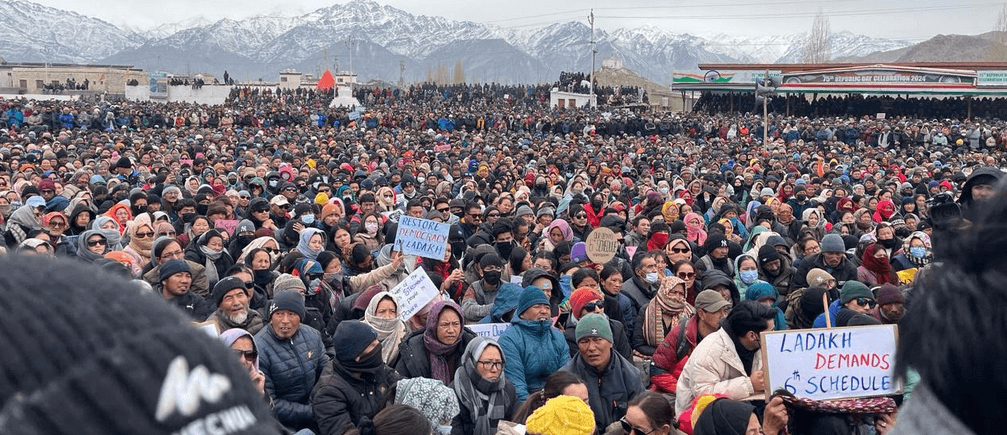
In Ladakh, public confidence in the administration’s probe into the September 24 violence appears to have eroded. The Leh Apex Body (LAB) and the Kargil Democratic Alliance (KDA) have refused to cooperate with the magisterial inquiry ordered by the Union Territory administration, calling it inadequate. They have instead sought a judicial inquiry—one conducted under court supervision—arguing that only an independent process can ensure accountability in a case that involves deaths, detentions, and allegations of excessive force.
The September 24 protests in Leh turned violent, leading to four deaths—including that of a Kargil War veteran—and over a hundred injuries. Following the unrest, the administration ordered a magisterial inquiry led by the Sub-Divisional Magistrate of Nubra, asking the public to submit evidence by mid-October.
However, local bodies have dismissed the probe as an “eyewash”, citing lack of independence since it is led by an executive officer of the same administration. They have demanded a judicial inquiry, ideally monitored by a High Court or Supreme Court judge, and the release of detained youth and activist Sonam Wangchuk, who is in custody under the National Security Act (NSA).
What Is a Magisterial Inquiry?
A magisterial inquiry is an investigation conducted by an executive magistrate—such as a District Magistrate, Sub-Divisional Magistrate, or Additional District Magistrate—under provisions of the Code of Criminal Procedure (CrPC), especially Sections 176(1) and 190.
Key Features:
-
Conducted by: Executive or Judicial Magistrate (usually from the district administration).
-
Purpose: To determine causes and circumstances of incidents such as deaths in custody, police firing, riots, or major accidents.
-
Powers: Can summon witnesses, examine records, and submit a report to the government or higher authority.
-
Nature: Administrative and fact-finding; not judicially binding.
-
Outcome: Helps government decide on further action or whether to initiate criminal proceedings.
Example: Magisterial inquiries are commonly ordered after custodial deaths, police firing, or major industrial accidents to establish a preliminary factual record.
What Is a Judicial Inquiry?
A judicial inquiry (or judicial commission) is a deeper probe headed by a sitting or retired High Court or Supreme Court judge under the Commissions of Inquiry Act, 1952, or directed by courts under their constitutional powers.
Key Features:
-
Conducted by: A judge or judicial officer, independent of the executive.
-
Authority: Can compel attendance, summon witnesses, take evidence under oath, and order production of documents.
-
Nature: Quasi-judicial; findings carry significant legal and moral weight.
-
Outcome: The report can influence court cases, legislative action, or government accountability.
Example: The Liberhan Commission (Babri Masjid, 1992), the Justice Srikrishna Commission (Mumbai riots, 1992–93), and the Justice Nanavati Commission (Gujarat riots, 2002) were all judicial inquiries.
Difference Between Magisterial and Judicial Inquiries
| Basis | Magisterial Inquiry | Judicial Inquiry |
|---|---|---|
| Conducted by | Executive or Judicial Magistrate | Judge (High Court or Supreme Court) |
| Legal basis | CrPC (Sections 176–190) | Commissions of Inquiry Act, 1952 / Constitutional mandate |
| Independence | Within administrative framework | Independent, overseen by judiciary |
| Nature | Administrative, fact-finding | Quasi-judicial, evidence-based |
| Outcome | Advisory; not binding | Persuasive; can influence trials or policy |
| Public perception | Limited transparency | Greater credibility and autonomy |
In sensitive cases—especially those involving deaths in police action—public bodies often demand a judicial inquiry to ensure impartiality and transparency.
From Inquiry to Custody: Understanding the Legal Continuum
1. Police Custody
When a person is arrested, the police can seek police custody for interrogation, allowed under Section 167(2) CrPC, for a maximum of 15 days. During this time, the accused remains under police control. Any extension beyond this period requires judicial remand.
2. Judicial Custody
After police custody ends—or if deemed necessary—the accused is sent to judicial custody, where they are lodged in jail under the supervision of the court. The police cannot interrogate them without court permission. Judicial custody can extend until the investigation and trial are complete, subject to bail orders.
Key Difference:
-
Police custody: Investigative; controlled by police.
-
Judicial custody: Detentive; controlled by courts.
Parole and Furlough: Temporary Release Mechanisms
Parole
-
Purpose: Temporary release of a convicted prisoner for humanitarian grounds—family illness, death, or marriage.
-
Authority: Granted by state government or prison department, not by courts directly (though courts can direct reconsideration).
-
Duration: Usually up to one month, extendable under rules.
-
Nature: Conditional; the convict remains under supervision and must return after the period.
Furlough
-
Purpose: A periodic break from prison life to maintain family and social ties and aid reformation.
-
Eligibility: Usually after a certain portion of sentence served (e.g., three years).
-
Duration: Shorter (two weeks to a month) but can be availed more frequently than parole.
-
Nature: Right-based if conditions are met; not solely discretionary.
Key Difference: Parole is need-based and humanitarian, while furlough is routine and reformative.
Why These Distinctions Matter
In the Ladakh case, the dispute over inquiry type reflects larger concerns about accountability and independence. When deaths occur in police action, executive inquiries can appear conflicted because the administration probes itself. A judicial inquiry ensures an arm’s-length process, while provisions like judicial custody and parole/furlough underline the balance between individual rights and state authority.
Understanding these distinctions is crucial for governance: they mark the difference between law enforcement and rule of law.
Conclusion
The call for a judicial investigation in Ladakh highlights the enduring tension between administrative control and judicial oversight. While magisterial inquiries offer speed, they rarely inspire public confidence in politically charged cases. Judicial inquiries, in contrast, carry the moral weight of independence. Beyond Ladakh, India’s justice system must continue to refine its mechanisms—from custody to parole—to ensure that accountability is both procedural and perceptible. True justice demands not just action, but trust.