

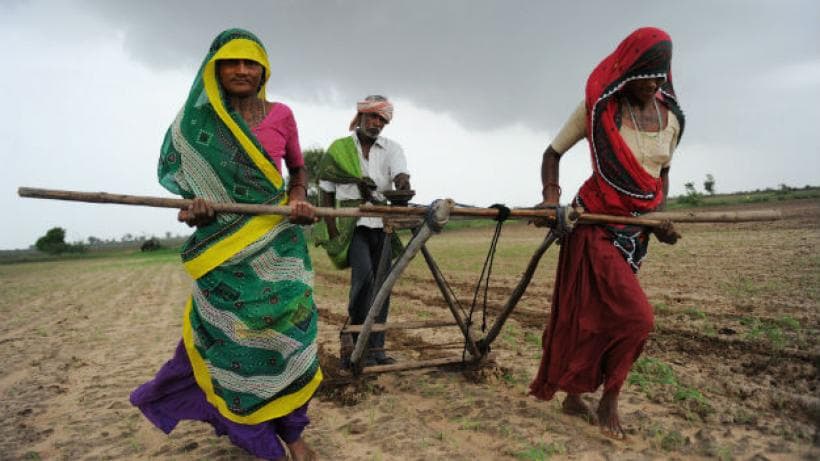
More Indian women are working on farms, but many remain unpaid family workers. With smart design of trade policy, digital public goods, and secure land rights, India can shift women from invisible labour to income-generating roles across agri value chains.
The Story
-
Rising participation, agri-heavy: Female LFPR rose from 21.1% (2017-18) to ~35–36% (2023-24), driven mainly by rural India where agriculture is women’s primary employer.
-
Unpaid work remains high: A large share of women are still helpers in household enterprises (unpaid family workers); the proportion has eased only slightly year-on-year, leaving one of the biggest pockets of “invisible” labour.
-
Land & recognition gaps: Women hold only ~13–14% of operational landholdings; recognition as “farmer” lags, depressing access to KCC, crop insurance, formal credit, and scheme benefits.
-
Value is post-harvest: Agriculture’s share in GVA is ~18%; sustained income gains require shifting women into processing, packaging, branding, certification, and exports rather than more low-value field tasks.
-
Collectives are a ready channel: Under the 10,000 FPOs initiative, about 3 million farmers are linked to FPOs and ~40% are women—an on-ramp for skills, finance, compliance, and market access.
Why It Matters
Women are doing more farm work without proportional wages, assets, or voice. Moving them into higher-value nodes raises household incomes, improves export readiness, and strengthens rural resilience without forcing an exit from agriculture.
Background / Context
-
Female labour force participation is up; the increase is concentrated in rural, agriculture-linked work.
-
Asset asymmetry persists: low female land titles constrain finance and insurance.
-
With agri-GVA broadly stable, productivity and value addition—not longer hours—drive income growth.
Implications (Policy & Practice)
Trade → Income
-
Prioritise women-dense chains (tea, spices, millets, organic produce, seafood processing, RTE foods).
-
Fund HACCP/ISO/BRC certification, packaging/label upgrades, and buyer audits through APEDA/commodity boards/SFAC with a women-FPO fast lane.
-
Provide concessional working capital against confirmed orders; offer first-export risk cover.
Tech → Access
-
Scale voice-first, multilingual advisories (DPI stacks) for prices, advisories, scheme navigation, logistics booking and e-payments.
-
Digitise collection centres; enable warehouse receipts and invoice discounting so women-led FPOs can finance inventory, not just inputs.
Tenure → Agency
-
Fast-track joint/individual land titles in women-majority FPO catchments; auto-link land records to KCC, PMFBY, e-KYC.
-
Recognise women as “farmers” across all scheme documentation, procurement, and grievance systems.
Institutional Pathways
-
Create a Women-FPO corridor with higher capex ceilings, reserved training modules (quality, export compliance, digital bookkeeping), and buyer-anchored procurement MOUs.
Guardrails
-
Credit guarantees for first lots; pooled logistics and lab-testing vouchers; simple dispute redress for MSME-style protections in buyer contracts.
What to Scale (Proven Models)
-
Rice fortification and nutrition chains: Women-centred roles in blending, QA, and last-mile delivery; replicate across districts with public lab support.
-
Women-majority FPOs: Use them to launch GI/branding + traceability pilots for spices and millets; bundle with packaging grants and export readiness camps.
-
Climate-smart packages: Drying, grading and solar cold-room micro-hubs run by women groups; pay-for-quality contracts with local processors.
Numbers to Use (for graphics/notes)
-
Female LFPR: ~21% → 35–36% (2017-18 to 2023-24), rural-led.
-
Unpaid work: Helpers in household enterprises remain a large share of women’s rural employment, easing only marginally year-on-year.
-
Women’s landholdings: ~13–14% of operational holdings.
-
Agri-GVA: ~18% of total GVA (recent years).
-
FPO pipeline: ~3 million farmers linked; ~40% women membership.
Conclusion
The bottlenecks are known—unpaid labour, weak titles, thin margins—and the pipes now exist—FPOs, voice-first govtech, quality infrastructure. Put women-led FPOs at the centre of certified, branded, export-facing value chains, back them with concessional finance and DPI, and fix titles. That is how rising participation becomes real, durable incomes.
Sources (no links):
Periodic Labour Force Survey (MoSPI, various rounds); Agriculture Census (DAC&FW); National Accounts—GVA by economic activity (MoSPI); APEDA/SFAC/FPO programme documents; WFP India and allied UN country programme notes.